Troisi Jacopo, Venutolo Giorgia, Pujolassos Tanyà Meritxell, Delli Carri Matteo, Landolfi Annamaria, Fasano Alessio
Metabolomics Section, Theoreo srl - Spin-off Company of the University of Salerno, Montecorvino Pugliano 84090, SA, Italy.
European Biomedical Research Institute of Salerno, Salerno 84125, SA, Italy.
World J Gastroenterol. 2021 Apr 14;27(14):1406-1418. doi: 10.3748/wjg.v27.i14.1406.
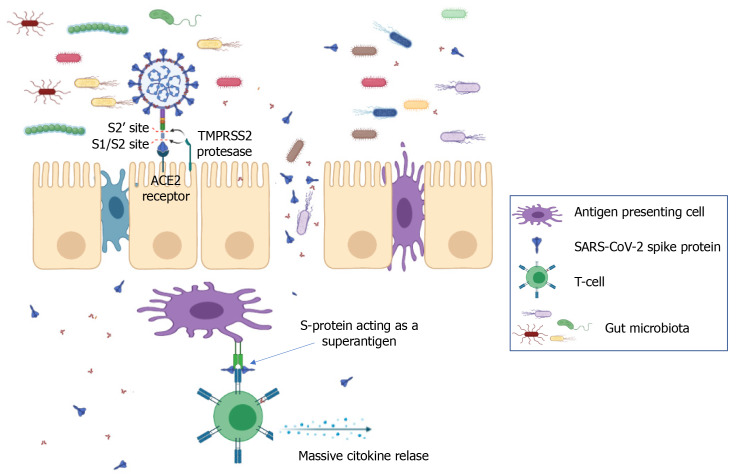
Gastrointestinal (GI) symptoms have been described in a conspicuous percentage of coronavirus disease 2019 (COVID-19) patients. This clinical evidence is supported by the detection of viral RNA in stool, which also supports the hypothesis of a possible fecal-oral transmission route. The involvement of GI tract in severe acute respiratory syndrome coronavirus 2 (SARS-CoV-2) infection is corroborated by the theoretical assumption that angiotensin converting enzyme 2, which is a SARS-CoV-2 target receptor, is present along the GI tract. Studies have pointed out that gut dysbiosis may occur in COVID-19 patients, with a possible correlation with disease severity and with complications such as multisystem inflammatory syndrome in children. However, the question to be addressed is whether dysbiosis is a consequence or a contributing cause of SARS-CoV-2 infection. In such a scenario, pharmacological therapies aimed at decreasing GI permeability may be beneficial for COVID-19 patients. Considering the possibility of a fecal-oral transmission route, water and environmental sanitation play a crucial role for COVID-19 containment, especially in developing countries.
胃肠道(GI)症状在相当比例的2019冠状病毒病(COVID-19)患者中都有描述。粪便中检测到病毒RNA支持了这一临床证据,这也支持了可能存在粪口传播途径的假说。严重急性呼吸综合征冠状病毒2(SARS-CoV-2)感染累及胃肠道这一观点得到了理论假设的支持,即作为SARS-CoV-2靶受体的血管紧张素转换酶2存在于胃肠道各处。研究指出,COVID-19患者可能会出现肠道菌群失调,这可能与疾病严重程度以及儿童多系统炎症综合征等并发症有关。然而,需要解决的问题是菌群失调是SARS-CoV-2感染的结果还是促成因素。在这种情况下,旨在降低胃肠道通透性的药物治疗可能对COVID-19患者有益。考虑到粪口传播途径的可能性,水和环境卫生对于控制COVID-19至关重要,尤其是在发展中国家。