Fellows Martha, Paye Valéria, Alencar Ane, Nicácio Mário, Castro Isabel, Coelho Maria Emília, Silva Camila V J, Bandeira Matheus, Lourival Reinaldo, Basta Paulo Cesar
Amazon Environmental Research Institute, Brasilia, Brazil.
Coordination of the Indigenous Organizations of the Brazilian Amazon, Manaus, Brazil.
Front Psychiatry. 2021 Apr 12;12:638359. doi: 10.3389/fpsyt.2021.638359. eCollection 2021.
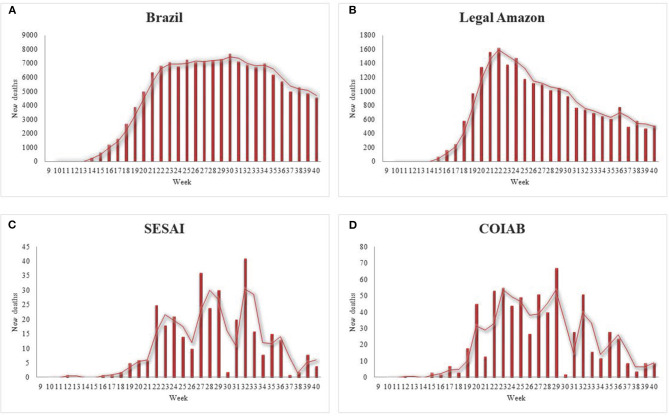
To estimate the incidence, mortality and lethality rates of COVID-19 among Indigenous Peoples in the Brazilian Amazon. Additionally, to analyze how external threats can contribute to spread the disease in Indigenous Lands (IL). The Brazilian Amazon is home to nearly half a million Indigenous persons, representing more than 170 ethnic groups. As a pioneer in heading Indigenous community-based surveillance (I-CBS) in Brazil, the Coordination of the Indigenous Organizations of the Brazilian Amazon (COIAB) started to monitor Indigenous COVID-19 cases in March of 2020. Brazil's Ministry of Health (MOH) was the main source of data regarding non-Indigenous cases and deaths; to contrast the government's tally, we used the information collected by I-CBS covering 25 Special Indigenous Sanitary Districts (DSEI) in the Brazilian Amazon. The incidence and mortality rates of COVID-19 were calculated using the total number of new cases and deaths accumulated between the 9th and 40th epidemiological weeks. We studied (a) the availability of health care facilities to attend to Indigenous Peoples; (b) illegal mines, land grabbing, and deforestation to perform a geospatial analysis to assess how external threats affect Indigenous incidence and mortality rates. We used the Generalized Linear Model (GLM) with Poisson regression to show the results. MOH registered 22,127 cases and 330 deaths, while COIAB's survey recorded 25,356 confirmed cases and 670 deaths, indicating an under-reporting of 14 and 103%, respectively. Likewise, the incidence and mortality rates were 136 and 110% higher among Indigenous when compared with the national average. In terms of mortality, the most critical DSEIs were and . The GLM model reveals a direct correlation between deforestation, land grabbing and mining, and the incidence of cases among the Indigenous. Through this investigation it was possible to verify that not only the incidence and mortality rates due to COVID-19 among Indigenous Peoples are higher than those observed in the general population, but also that the data presented by the federal government are underreported. Additionally, it was evident that the presence of illegal economic activities increased the risk of spreading COVID-19 in ILs.
评估巴西亚马逊地区原住民中新冠病毒病的发病率、死亡率和致死率。此外,分析外部威胁如何促使疾病在原住民土地(IL)上传播。巴西亚马逊地区居住着近50万原住民,分属170多个民族。作为巴西开展基于社区的原住民监测(I-CBS)的先驱,巴西亚马逊地区原住民组织协调会(COIAB)于2020年3月开始监测原住民新冠病毒病病例。巴西卫生部(MOH)是关于非原住民病例和死亡数据的主要来源;为了与政府的统计数据形成对比,我们使用了I-CBS收集的信息,这些信息涵盖了巴西亚马逊地区的25个特殊原住民卫生区(DSEI)。新冠病毒病的发病率和死亡率是根据第9至40个流行病学周累计的新增病例和死亡总数计算得出的。我们研究了:(a)为原住民提供医疗服务的卫生保健设施的可及性;(b)非法采矿、土地侵占和森林砍伐情况,以进行地理空间分析,评估外部威胁如何影响原住民的发病率和死亡率。我们使用带有泊松回归的广义线性模型(GLM)来展示结果。卫生部记录了22127例病例和330例死亡,而COIAB的调查记录了25356例确诊病例和670例死亡,分别表明漏报率为14%和103%。同样,与全国平均水平相比,原住民中的发病率和死亡率分别高出136%和110%。在死亡率方面,最严重的DSEI是[具体名称1]和[具体名称2]。GLM模型揭示了森林砍伐、土地侵占和采矿与原住民病例发生率之间存在直接关联。通过这项调查可以证实,不仅原住民中新冠病毒病的发病率和死亡率高于普通人群,而且联邦政府提供的数据存在漏报情况。此外,很明显非法经济活动的存在增加了新冠病毒病在原住民土地上传播的风险。