Department for Psychotherapy and Biopsychosocial Health, Danube University Krems, 3500 Krems, Austria.
Department of Work, Organization and Society, Ghent University, Sint-Pietersnieuwstraat, 9000 Ghent, Belgium.
Int J Environ Res Public Health. 2021 Apr 1;18(7):3679. doi: 10.3390/ijerph18073679.
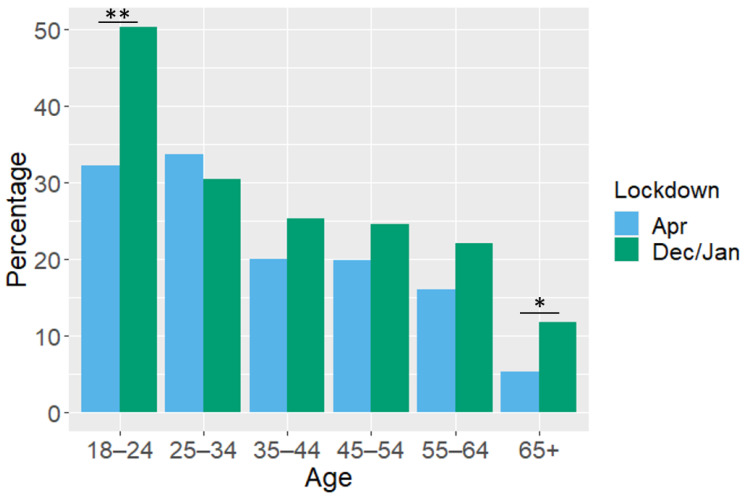
Since the beginning of the COVID-19 pandemic a decline in mental health has been reported. This online study investigated mental health and well-being in Austria during a strict lockdown. In total, = 1505 participants were recruited between 23 December 2020 and 4 January 2021 and levels of depression (PHQ-9), anxiety (GAD-7), sleep quality (ISI), well-being (WHO-5), quality of life (WHO-QOL) and stress (PSS-10) were measured. 26% scored above the cut-off for moderate depressive symptoms (PHQ-9 ≥ 10; ♀ = 32%; ♂ = 21%), 23% above the cut-off for moderate anxiety (GAF-7 ≥ 10; ♀ = 29%; ♂ = 17%) and 18% above the cut-off for moderate insomnia (ISI ≥ 15; ♀ = 21%; ♂ = 16%). Mean-scores for quality of life (psychological WHO-QOL) were 68.89, for well-being (WHO-5) 14.34, and for stress (PSS-10) 16.42. The youngest age group (18-24) was most burdened and showed significantly more mental health symptoms compared with the oldest age group (65+) in depressive symptoms (50% vs. 12%), anxiety symptoms (35% vs. 10%), and insomnia (25% vs. 11%, all -values < 0.05). Mental health decreased compared to both the first lockdown earlier in 2020 and pre-pandemic data. Further analyses indicate these findings were especially apparent for the under 24-year-olds, women, single/separated people, low incomes and those who do not partake in any physical activity (all -values < 0.05). We highlight the need for ongoing mental health support, particularly to the most burdened groups.
自 COVID-19 大流行开始以来,人们报告称心理健康状况有所下降。这项在线研究调查了奥地利在严格封锁期间的心理健康和幸福感。共有 1505 名参与者于 2020 年 12 月 23 日至 2021 年 1 月 4 日之间被招募,并测量了抑郁水平(PHQ-9)、焦虑水平(GAD-7)、睡眠质量(ISI)、幸福感(WHO-5)、生活质量(WHO-QOL)和压力(PSS-10)。26%的人得分高于中度抑郁症状的临界值(PHQ-9≥10;♀=32%;♂=21%),23%的人得分高于中度焦虑的临界值(GAD-7≥10;♀=29%;♂=17%),18%的人得分高于中度失眠的临界值(ISI≥15;♀=21%;♂=16%)。生活质量(心理 WHO-QOL)的平均得分是 68.89,幸福感(WHO-5)的平均得分是 14.34,压力(PSS-10)的平均得分是 16.42。年龄最小的组(18-24 岁)负担最重,与年龄最大的组(65+岁)相比,抑郁症状(50%比 12%)、焦虑症状(35%比 10%)和失眠(25%比 11%)更为明显(所有 -值<0.05)。与 2020 年早些时候的第一次封锁和大流行前的数据相比,心理健康状况有所下降。进一步的分析表明,这些发现对于 24 岁以下的人、女性、单身/分居的人、低收入者和不参加任何体育活动的人来说尤其明显(所有 -值<0.05)。我们强调需要持续提供心理健康支持,特别是对负担最重的群体。