Warwickshire Institute for the Study of Diabetes, Endocrinology and Metabolism, University Hospitals Coventry and Warwickshire, Clifford Bridge Road, Coventry CV2 2DX, UK.
Division of Biomedical Sciences, Warwick Medical School, University of Warwick, Coventry CV2 2DX, UK.
Nutrients. 2021 Apr 3;13(4):1187. doi: 10.3390/nu13041187.
Diets have been a central component of lifestyle modification for decades. The Low-Carbohydrate Diet (LCD), originally conceived as a treatment strategy for intractable epilepsy (due to its association with ketogenesis), became popular in the 1970s and since then has risen to prominence as a weight loss strategy.
To explore the efficacy, limitations and potential safety concerns of the LCD.
We performed a narrative review, based on relevant articles written in English from a Pubmed search, using the terms 'low carbohydrate diet and metabolic health'.
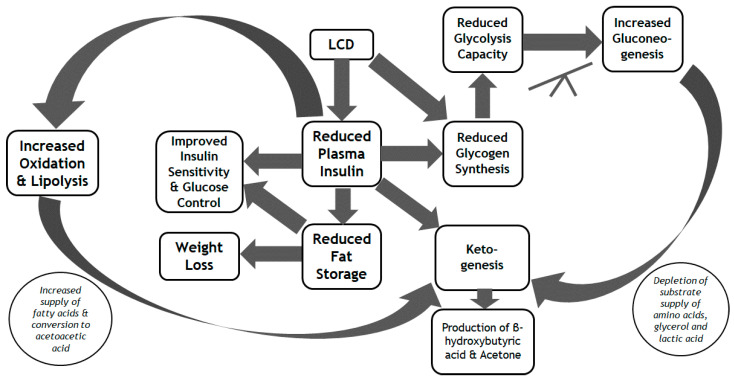
Evidence supports the efficacy of the LCD in the short-term (up to 6-months) for reduction in fat mass and remission of Type 2 Diabetes Mellitus (T2D). However, the longer-term efficacy of the LCD is disappointing, with diminishment of weight loss potential and metabolic benefits of the LCD beyond 6-months of its adoption. Furthermore, practical limitations of the LCD include the associated restriction of food choices that restrict the acceptability of the LCD for the individual, particularly over the longer term. There are also safety concerns of the LCD that stem from nutritional imbalances (with a relative excess of dietary fat and protein intake with associated dyslipidaemia and increased risk of insulin resistance and T2D development) and ketotic effects. Finally, the LCD often results in a reduction in dietary fibre intake, with potentially serious adverse consequences for overall health and the gut microbiota.
Although widely adopted, the LCD usually has short-lived metabolic benefits, with limited efficacy and practicality over the longer term. Dietary modification needs tailoring to the individual, with careful a priori assessments of food preferences to ensure acceptability and adherence over the longer term, with avoidance of dietary imbalances and optimization of dietary fibre intake (primarily from plant-based fruit and vegetables), and with a posteriori assessments of the highly individual responses to the LCD. Finally, we need to change our view of diets from simply an excipient for weight loss to an essential component of a healthy lifestyle.
几十年来,饮食一直是生活方式改变的核心组成部分。低碳水化合物饮食(LCD)最初是作为治疗难治性癫痫的一种策略(由于其与酮生成有关)而提出的,它在 20 世纪 70 年代流行起来,此后作为一种减肥策略而备受关注。
探讨 LCD 的疗效、局限性和潜在的安全性问题。
我们根据 Pubmed 上用英语撰写的相关文章进行了叙述性综述,使用的术语是“低碳水化合物饮食和代谢健康”。
证据支持 LCD 在短期内(长达 6 个月)减少脂肪量和缓解 2 型糖尿病(T2D)的疗效。然而,LCD 的长期疗效令人失望,采用 6 个月后,其减肥潜力和代谢益处逐渐减弱。此外,LCD 的实际限制包括与食物选择相关的限制,这限制了个人对 LCD 的接受程度,尤其是在长期内。LCD 还存在一些安全性问题,这些问题源于营养失衡(饮食中脂肪和蛋白质摄入相对过多,导致血脂异常,胰岛素抵抗和 T2D 发生风险增加)和酮症效应。最后,LCD 通常会导致膳食纤维摄入量减少,对整体健康和肠道微生物群产生潜在严重的不良后果。
尽管广泛采用,但 LCD 通常具有短暂的代谢益处,长期来看疗效和实用性有限。饮食调整需要因人而异,在长期内需要仔细评估食物偏好,以确保接受度和依从性,避免饮食失衡和优化膳食纤维摄入量(主要来自植物性水果和蔬菜),并在后评估对 LCD 的高度个体反应。最后,我们需要改变我们对饮食的看法,从简单地将其作为减肥的赋形剂转变为健康生活方式的重要组成部分。