Department of Biomedical and Neuromotor Science, University of Bologna, 40126 Bologna, Italy.
ARDEC Academy, 47923 Rimini, Italy.
Int J Environ Res Public Health. 2021 Apr 6;18(7):3846. doi: 10.3390/ijerph18073846.
In edentulous patients, bone resorption cannot allow the installation of standard implants and it is demanded to use short implants in the residual alveolar bone or longer implants in grafted bone.
To compare the survival and bone level changes of standard plus short 4-mm implants used as distal support of a maxillary full-arch fixed dental prostheses (FDPs) with standard (10-mm) implants placed in association with a bilateral sinus floor augmentation procedure.
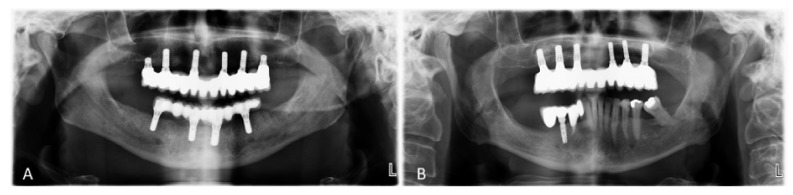
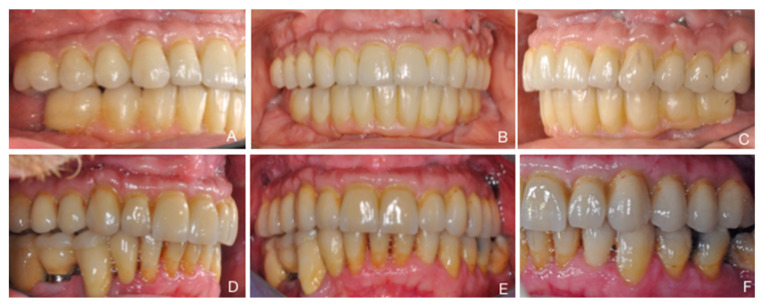
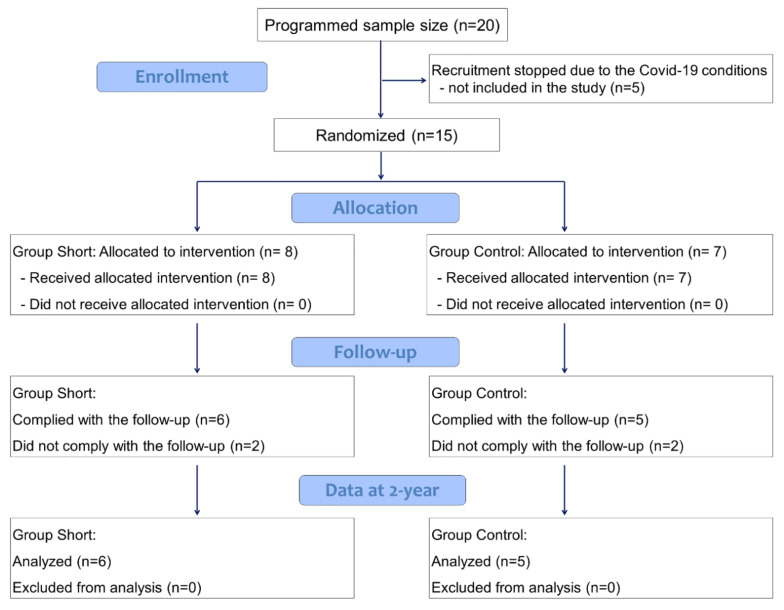
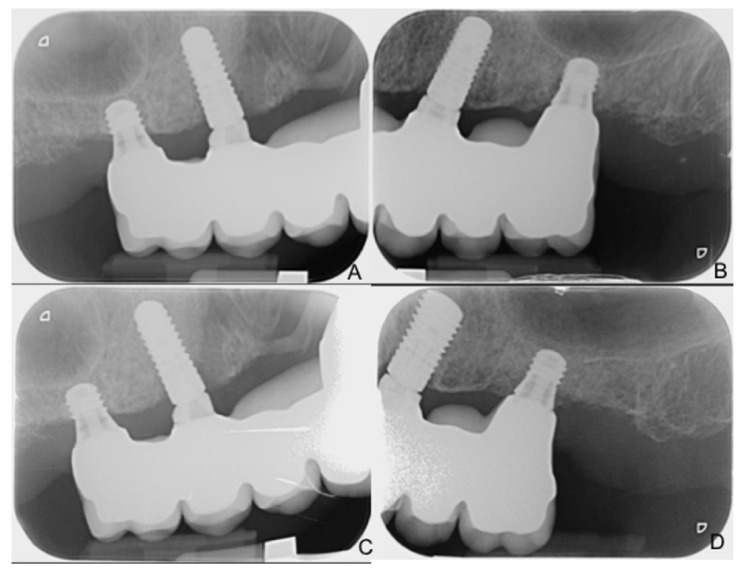
Full-arch FDPs supported by six implants were randomly placed in both groups. In the control group, all implants were 10 mm long and 4.1 mm in diameter. The distal implant in both sides of the maxilla was installed after 4 months from bilaterally sinus floor elevation. In the test group (short group), the distal implant in both sides of the maxilla was 4 mm long and 4.1 mm in diameter. No sinus floor elevations were performed in the test group. Clinical assessments and X-rays were taken at prosthesis delivering and after 6, 12, 18, and 24 months. Patient-reported outcome measures (PROMs) were also evaluated before surgery and after 6, 12, and 24 months.
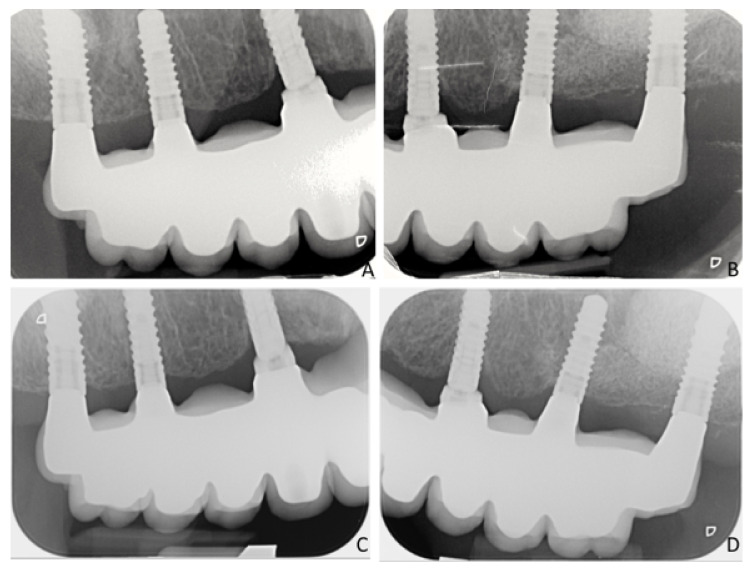
The changes over time of the bone level for the short implants were -0.01 ± 0.11 mm, -0.04 ± 0.13 mm, -0.17 ± 0.29 mm, and -0.28 ± 0.37 mm after 6, 12, 18, and 24 months from prosthesis delivering, respectively. For the standard implants, bone changes were -0.21 ± 0.33 mm ( = 0.103), -0.30 ± 0.32 mm ( = 0.023), -0.40 ± 0.37 mm ( = 0.144), and -0.54 ± 0.49 mm ( = 0.128), respectively. A statistically relevant difference was found only at 12 months after loading between the two groups.
Similar results on implant survival rate and marginal bone loss were observed for the short and standard implants, placed in association with a bilateral sinus floor augmentation procedure, used as distal support of a maxillary full-arch FDP. A statistically relevant difference was found only at 12 months after loading between the two groups ( = 0.023).
在无牙颌患者中,骨吸收不允许安装标准种植体,因此需要在剩余牙槽骨中使用短种植体,或在植骨中使用更长的种植体。
比较标准加短 4mm 种植体作为上颌全口固定义齿(FDP)远端支撑物与标准(10mm)种植体联合双侧窦底提升术的种植体存活率和骨水平变化。
两组均随机放置六枚种植体支持的全口 FDP。对照组所有种植体长 10mm,直径 4.1mm。上颌双侧窦底提升术后 4 个月植入双侧远侧种植体。实验组(短植体组)上颌双侧远侧种植体长 4mm,直径 4.1mm。实验组未行窦底提升术。在修复体交付时以及 6、12、18 和 24 个月时进行临床评估和 X 线检查。还在术前以及 6、12 和 24 个月后评估患者报告的结果测量(PROMs)。
短种植体的骨水平随时间的变化分别为修复体交付后 6、12、18 和 24 个月时为-0.01±0.11mm、-0.04±0.13mm、-0.17±0.29mm 和-0.28±0.37mm。标准种植体的骨变化分别为-0.21±0.33mm( = 0.103)、-0.30±0.32mm( = 0.023)、-0.40±0.37mm( = 0.144)和-0.54±0.49mm( = 0.128)。仅在负荷后 12 个月时,两组间有统计学差异。
在与双侧窦底提升术联合使用、作为上颌全口 FDP 远端支撑物的短种植体和标准种植体,其种植体存活率和边缘骨丢失的结果相似。仅在负荷后 12 个月时,两组间有统计学差异( = 0.023)。