Department of Pharmacy, University of Pisa, Via Bonanno 6, 56126 Pisa, Italy.
School of Pharmacy, University of Camerino, via Gentile III da Varano, 62032 Camerino, Italy.
Int J Mol Sci. 2021 Apr 21;22(9):4295. doi: 10.3390/ijms22094295.
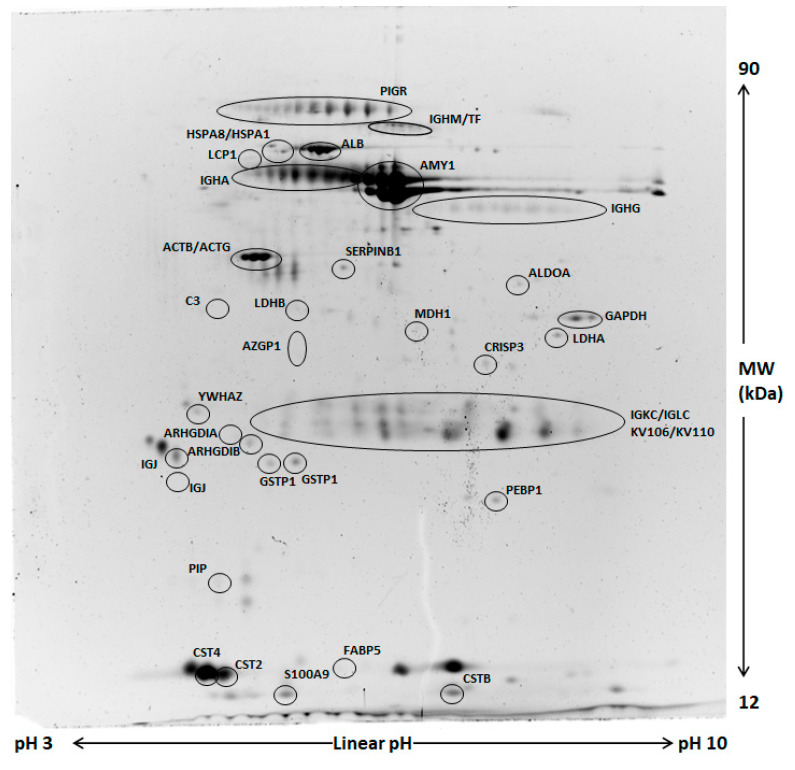
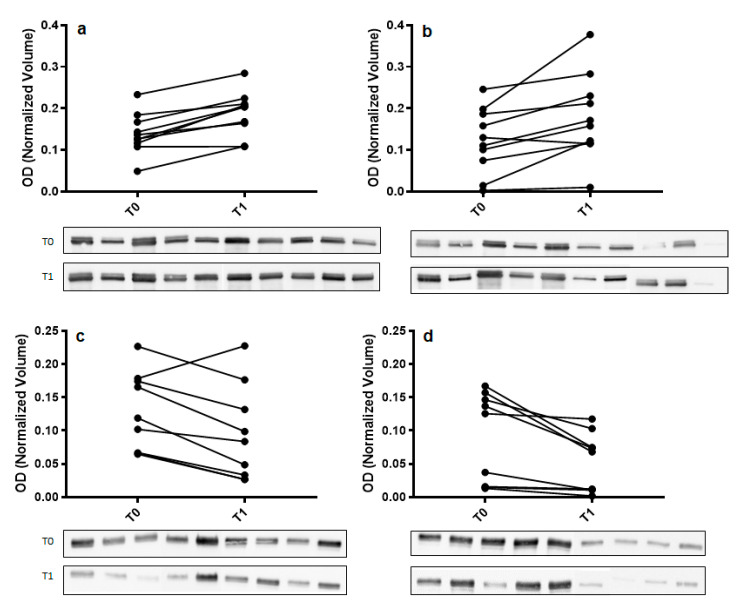
The autonomic nervous system (ANS) plays a crucial role both in acute and chronic psychological stress eliciting changes in many local and systemic physiological and biochemical processes. Salivary secretion is also regulated by ANS. In this study, we explored salivary proteome changes produced in thirty-eight University students by a test stress, which simulated an oral exam. Students underwent a relaxation phase followed by the stress test during which an electrocardiogram was recorded. To evaluate the effect of an olfactory stimulus, half of the students were exposed to a pleasant odor diffused in the room throughout the whole session. Saliva samples were collected after the relaxation phase (T0) and the stress test (T1). State anxiety was also evaluated at T0 and T1. Salivary proteins were separated by two-dimensional electrophoresis, and patterns at different times were compared. Spots differentially expressed were trypsin digested and identified by mass spectrometry. Western blot analysis was used to validate proteomic results. Anxiety scores and heart rate changes indicated that the fake exam induced anxiety. Significant changes of α-amylase, polymeric immunoglobulin receptor (PIGR), and immunoglobulin α chain (IGHA) secretion were observed after the stress test was performed in the two conditions. Moreover, the presence of pleasant odor reduced the acute social stress affecting salivary proteome changes. Therefore, saliva proteomic analysis was a useful approach to evaluate the rapid responses associated to an acute stress test also highlighting known biomarkers.
自主神经系统(ANS)在急性和慢性心理应激中起着至关重要的作用,它会引起许多局部和全身生理和生化过程的变化。唾液分泌也受 ANS 调节。在这项研究中,我们通过模拟口腔考试的测试应激,探究了 38 名大学生唾液蛋白质组的变化。学生先经历放松阶段,然后进行应激测试,在此期间记录心电图。为了评估嗅觉刺激的效果,一半的学生在整个测试过程中暴露于房间内散发的宜人气味中。在放松阶段(T0)和应激测试(T1)后采集唾液样本。在 T0 和 T1 还评估了状态焦虑。通过二维电泳分离唾液蛋白,并比较不同时间的图谱。差异表达的斑点经胰蛋白酶消化后,通过质谱进行鉴定。使用 Western blot 分析验证蛋白质组学结果。焦虑评分和心率变化表明,假考试会引起焦虑。在两种情况下进行应激测试后,α-淀粉酶、多聚免疫球蛋白受体(PIGR)和免疫球蛋白α链(IGHA)的分泌均发生明显变化。此外,宜人气味的存在减轻了急性社交应激对唾液蛋白质组变化的影响。因此,唾液蛋白质组分析是评估急性应激测试相关快速反应的有效方法,同时突出了已知的生物标志物。