Neurology Unit, S. Andrea Hospital, Department of Translational Medicine, University of Piemonte Orientale, Corso Abbiate 21, 13100 Vercelli, Italy.
School of Psychology, Vita-Salute San Raffaele University, 20132 Milan, Italy.
Int J Environ Res Public Health. 2021 Apr 18;18(8):4285. doi: 10.3390/ijerph18084285.
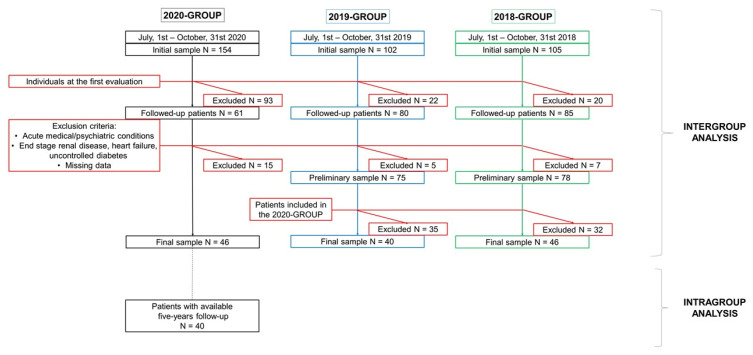
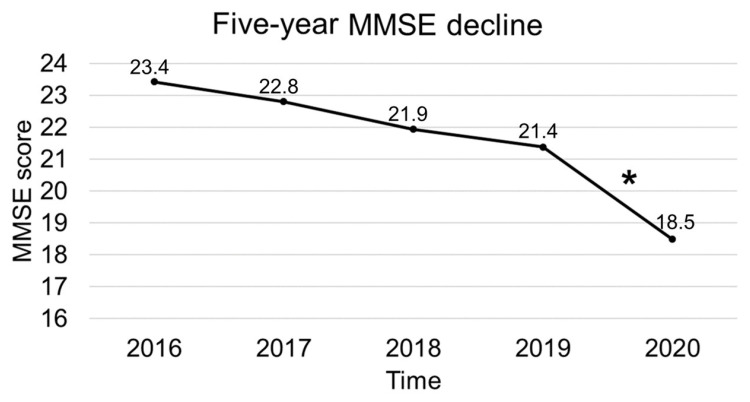
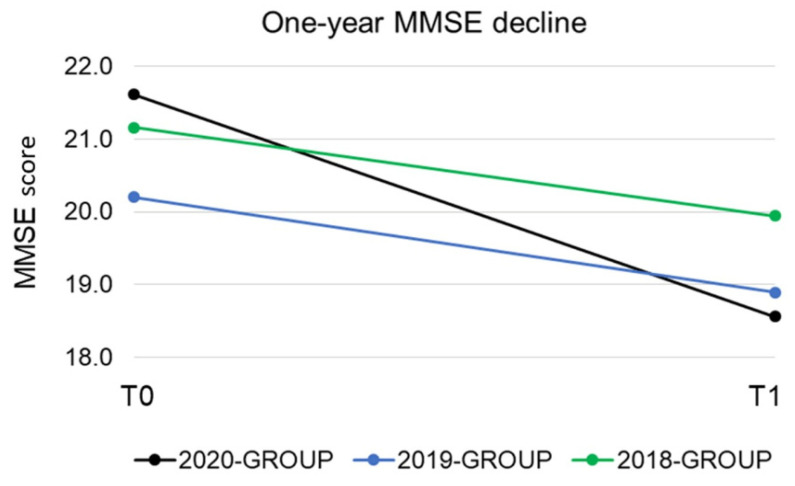
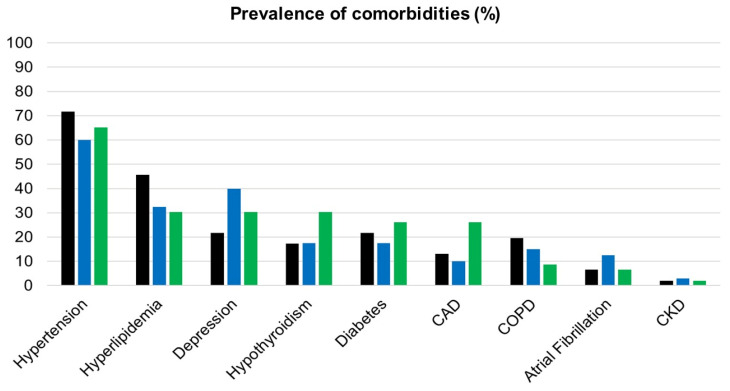
(1) Background: To limit the COVID-19 outbreak, the Italian government implemented social restrictions that may have had psychological and cognitive repercussions on people with dementia. We aimed to analyze cognitive decline during the pandemic year in people evaluated in a memory clinic in northern Italy, the epicenter of COVID-19 spread. (2) Methods: A single-center retrospective study was carried out, including individuals with annual follow-up evaluated in three different years (2020-GROUP, 2019-GROUP, 2018-GROUP). We performed an intergroup comparison of cognitive decline over a one-year follow-up, and an intragroup comparison in the 2020-GROUP to analyze the five-year cognitive decline trajectory, as measured by the MMSE. (3) Results: The 2020-GROUP showed a significant loss of MMSE points per year in the considered follow-up period compared with the 2019-GROUP and 2018-GROUP ( = 0.021). Demographics, clinical features, and the other analyzed variables, including rate of diagnosis, therapy, and comorbidities, did not significantly differ between groups. The five-year cognitive decline trajectory confirmed a significant worsening of cognitive decline between 2019 and 2020 ( < 0.001), while the decrease in MMSE scores was not statistically significant between previous time points. (4) Conclusions: COVID-19 pandemic measures have induced a significant worsening of cognitive decline in people with dementia, needing more careful assistance to minimize the adverse effects of social isolation in case of future lockdowns.
(1) 背景:为了限制 COVID-19 的爆发,意大利政府实施了社会限制措施,这可能对痴呆症患者的心理和认知产生影响。我们旨在分析意大利北部 COVID-19 传播中心的记忆诊所评估的患者在大流行期间的认知下降情况。(2) 方法:进行了一项单中心回顾性研究,包括在三年(2020 年组、2019 年组、2018 年组)进行年度随访的个体。我们对一年随访期间的认知下降进行了组间比较,并在 2020 年组中进行了组内比较,以分析 MMSE 测量的五年认知下降轨迹。(3) 结果:与 2019 年组和 2018 年组相比,2020 年组在考虑的随访期内每年的 MMSE 分数明显下降(= 0.021)。组间的人口统计学、临床特征和其他分析变量,包括诊断率、治疗和合并症,没有显著差异。五年认知下降轨迹证实,2019 年至 2020 年间认知下降明显恶化(< 0.001),而之前的时间点 MMSE 评分下降无统计学意义。(4) 结论:COVID-19 大流行措施导致痴呆症患者的认知恶化显著加剧,需要更加小心地提供帮助,以最大程度地减少未来封锁时社会隔离的不利影响。