Schulich School of Medicine & Dentistry, The University of Western Ontario, London, ON N6A3K7, Canada.
Department of Ophthalmology, Li Ka Shing Faculty of Medicine, The University of Hong Kong, Hong Kong, China.
Biomolecules. 2021 Apr 15;11(4):581. doi: 10.3390/biom11040581.
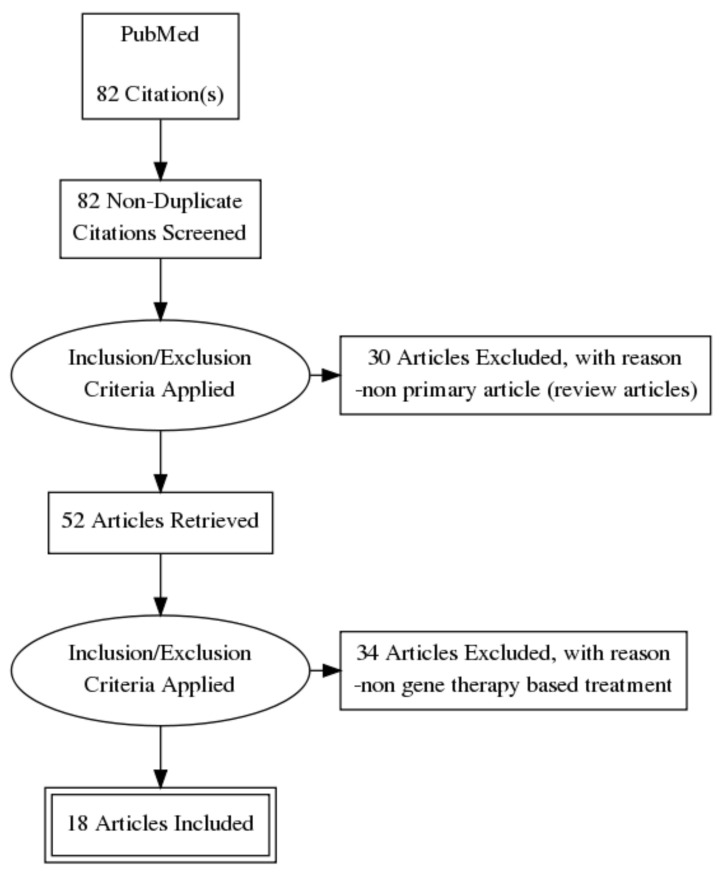
We systematically reviewed published translational research on gene-based therapy for retinal ganglion cell (RGC) neuroprotection. A search was conducted on Entrez PubMed on 23 December 2020 using the keywords "gene therapy", "retinal ganglion cell" and "neuroprotection". The initial search yielded 82 relevant articles. After restricting publications to those with full text available and in the English language, and then curating for only original articles on gene-based therapy, the final yield was 18 relevant articles. From the 18 papers, 17 of the papers utilized an adeno-associated viral (AAV) vector for gene therapy encoding specific genes of interest. Specifically, six of the studies utilized an AAV vector encoding brain-derived neurotrophic factor (BDNF), two of the studies utilized an AAV vector encoding erythropoietin (EPO), the remaining 10 papers utilized AAV vectors encoding different genes and one microRNA study. Although the literature shows promising results in both in vivo and in vitro models, there is still a significant way to go before gene-based therapy for RGC neuroprotection can proceed to clinical trials. Namely, the models of injury in many of the studies were more acute in nature, unlike the more progressive and neurodegenerative pathophysiology of diseases, such as glaucoma. The regulation of gene expression is also highly unexplored despite the use of AAV vectors in the majority of the studies reviewed. It is also expected that with the successful launch of messenger ribonucleic acid (mRNA)-based vaccinations in 2020, we will see a shift towards this technology for gene-based therapy in glaucoma neuroprotection.
我们系统地回顾了已发表的关于视网膜神经节细胞(RGC)神经保护的基因治疗转化研究。于 2020 年 12 月 23 日在 Entrez PubMed 上使用“基因治疗”、“视网膜神经节细胞”和“神经保护”等关键词进行了搜索。最初的搜索产生了 82 篇相关文章。在将出版物限制为提供全文且为英文的出版物,并对仅基于基因的治疗的原创文章进行策展之后,最终的结果是 18 篇相关文章。在这 18 篇论文中,有 17 篇论文使用腺相关病毒(AAV)载体进行基因治疗,编码特定的感兴趣基因。具体来说,有 6 项研究使用 AAV 载体编码脑源性神经营养因子(BDNF),2 项研究使用 AAV 载体编码促红细胞生成素(EPO),其余 10 篇论文使用 AAV 载体编码不同的基因和一项 microRNA 研究。尽管文献在体内和体外模型中都显示出有前景的结果,但在将 RGC 神经保护的基因治疗推进到临床试验之前,还有很长的路要走。即,许多研究中的损伤模型本质上更为急性,与青光眼等疾病更为渐进和神经退行性的病理生理学不同。尽管在综述的大多数研究中都使用了 AAV 载体,但基因表达的调控也尚未得到充分探索。预计随着信使核糖核酸(mRNA)疫苗在 2020 年的成功推出,我们将看到针对青光眼神经保护的基因治疗向这项技术的转变。