Chen Yi-Wei, Lee Yi-Yen, Lin Chun-Fu, Pan Po-Shen, Chen Jen-Kun, Wang Chun-Wei, Hsu Shih-Ming, Kuo Yu-Cheng, Lan Tien-Li, Hsu Sanford P C, Liang Muh-Lii, Chen Robert Hsin-Hung, Chang Feng-Chi, Wu Chih-Chun, Lin Shih-Chieh, Liang Hsiang-Kuang, Lee Jia-Cheng, Chen Shih-Kuan, Liu Hong-Ming, Peir Jinn-Jer, Lin Ko-Han, Huang Wen-Sheng, Chen Kuan-Hsuan, Kang Yu-Mei, Liou Shueh-Chun, Wang Chun-Chieh, Pai Ping-Ching, Li Chih-Wei, Chiek Daniel Quah Song, Wong Tai-Tong, Chiou Shih-Hwa, Chao Yee, Tanaka Hiroki, Chou Fong-In, Ono Koji
Faculty of Medicine, National Yang Ming Chiao Tung University, Taipei City 112304, Taiwan.
Department of Oncology, Taipei Veterans General Hospital, Taipei City 11217, Taiwan.
Biology (Basel). 2021 Apr 15;10(4):334. doi: 10.3390/biology10040334.
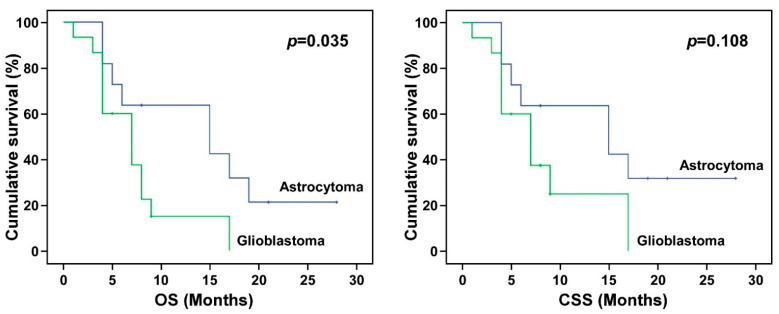
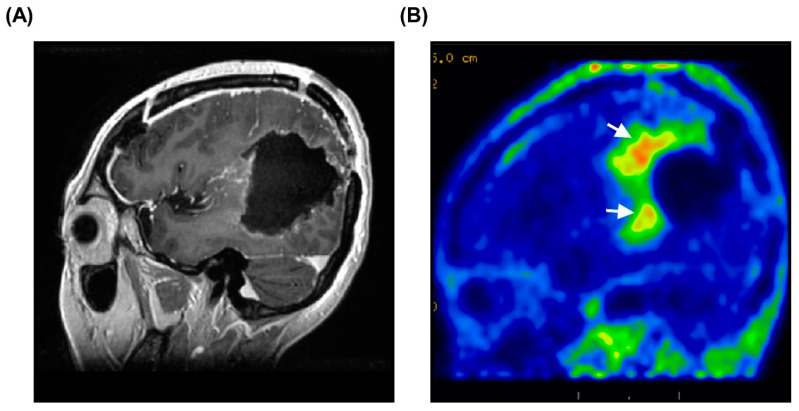
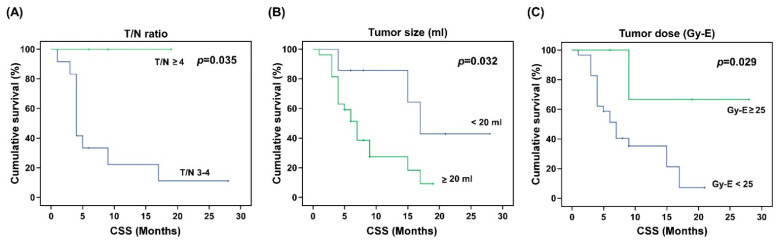
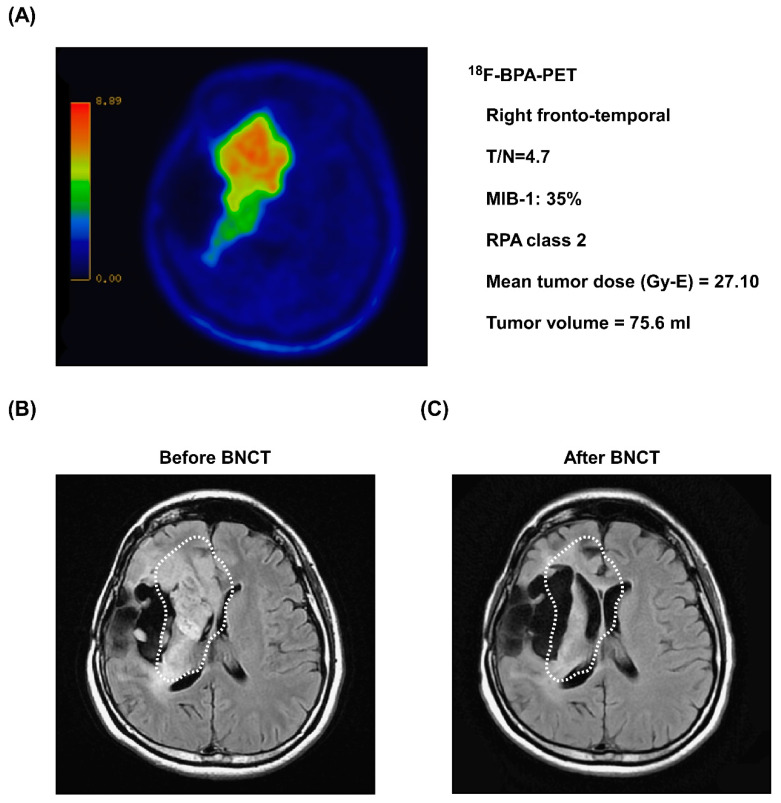
Although boron neutron capture therapy (BNCT) is a promising treatment option for malignant brain tumors, the optimal BNCT parameters for patients with immediately life-threatening, end-stage brain tumors remain unclear. We performed BNCT on 34 patients with life-threatening, end-stage brain tumors and analyzed the relationship between survival outcomes and BNCT parameters. Before BNCT, MRI and F-BPA-PET analyses were conducted to identify the tumor location/distribution and the tumor-to-normal tissue uptake ratio (T/N ratio) of F-BPA. No severe adverse events were observed (grade ≥ 3). The objective response rate and disease control rate were 50.0% and 85.3%, respectively. The mean overall survival (OS), cancer-specific survival (CSS), and relapse-free survival (RFS) times were 7.25, 7.80, and 4.18 months, respectively. Remarkably, the mean OS, CSS, and RFS of patients who achieved a complete response were 17.66, 22.5, and 7.50 months, respectively. Kaplan-Meier analysis identified the optimal BNCT parameters and tumor characteristics of these patients, including a T/N ratio ≥ 4, tumor volume < 20 mL, mean tumor dose ≥ 25 Gy-E, MIB-1 ≤ 40, and a lower recursive partitioning analysis (RPA) class. In conclusion, for malignant brain tumor patients who have exhausted all available treatment options and who are in an immediately life-threatening condition, BNCT may be considered as a therapeutic approach to prolong survival.
尽管硼中子俘获疗法(BNCT)是治疗恶性脑肿瘤的一种有前景的选择,但对于处于生命垂危终末期脑肿瘤患者的最佳BNCT参数仍不清楚。我们对34例生命垂危的终末期脑肿瘤患者进行了BNCT,并分析了生存结果与BNCT参数之间的关系。在进行BNCT之前,进行了MRI和F-BPA-PET分析,以确定肿瘤的位置/分布以及F-BPA的肿瘤与正常组织摄取率(T/N比)。未观察到严重不良事件(≥3级)。客观缓解率和疾病控制率分别为50.0%和85.3%。平均总生存期(OS)、癌症特异性生存期(CSS)和无复发生存期(RFS)分别为7.25、7.80和4.18个月。值得注意的是,达到完全缓解的患者的平均OS、CSS和RFS分别为17.66、22.5和7.50个月。Kaplan-Meier分析确定了这些患者的最佳BNCT参数和肿瘤特征,包括T/N比≥4、肿瘤体积<20 mL、平均肿瘤剂量≥25 Gy-E、MIB-1≤40以及较低的递归分区分析(RPA)分级。总之,对于用尽所有可用治疗方案且处于生命垂危状态的恶性脑肿瘤患者,可考虑将BNCT作为延长生存期的一种治疗方法。