• 文献检索
  • 文档翻译
  • 深度研究
  • 学术资讯
  • Suppr Zotero 插件Zotero 插件
  • 邀请有礼
  • 套餐&价格
  • 历史记录
应用&插件
Suppr Zotero 插件Zotero 插件浏览器插件Mac 客户端Windows 客户端微信小程序
定价
高级版会员购买积分包购买API积分包
服务
文献检索文档翻译深度研究API 文档MCP 服务
关于我们
关于 Suppr公司介绍联系我们用户协议隐私条款
关注我们

Suppr 超能文献

核心技术专利:CN118964589B侵权必究
粤ICP备2023148730 号-1Suppr @ 2026

文献检索

告别复杂PubMed语法,用中文像聊天一样搜索,搜遍4000万医学文献。AI智能推荐,让科研检索更轻松。

立即免费搜索

文件翻译

保留排版,准确专业,支持PDF/Word/PPT等文件格式,支持 12+语言互译。

免费翻译文档

深度研究

AI帮你快速写综述,25分钟生成高质量综述,智能提取关键信息,辅助科研写作。

立即免费体验

基于外泌体的荧光金纳米簇的合成及其在细胞成像中的应用。

Synthesis of Exosome-Based Fluorescent Gold Nanoclusters for Cellular Imaging Applications.

机构信息

Department of Biological Engineering, College of Engineering, Konkuk University, 120 Neungdong-ro, Gwangjin-gu, Seoul 05029, Korea.

出版信息

Int J Mol Sci. 2021 Apr 23;22(9):4433. doi: 10.3390/ijms22094433.

DOI:10.3390/ijms22094433
PMID:33922681
原文链接:https://pmc.ncbi.nlm.nih.gov/articles/PMC8122875/
Abstract

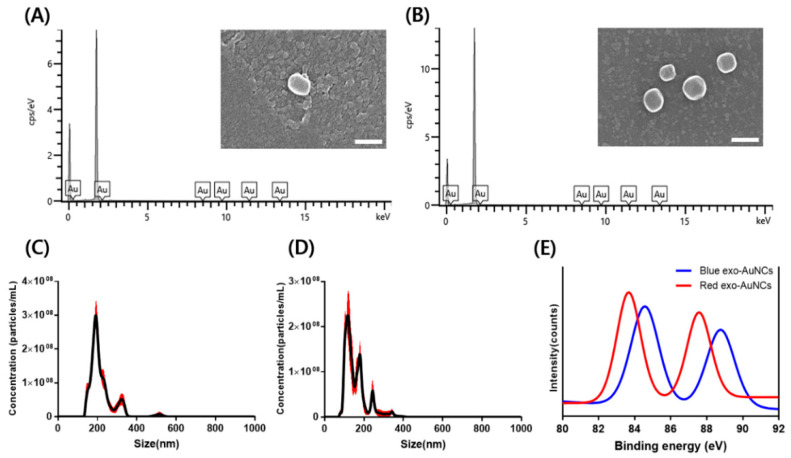
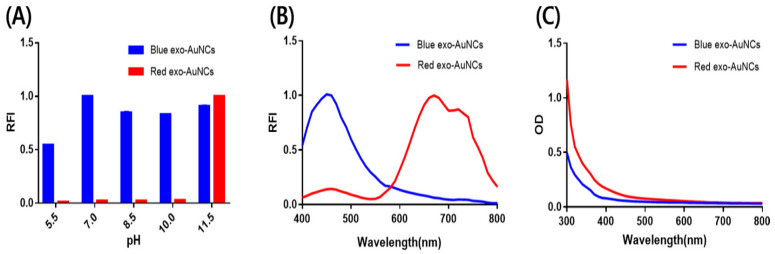
In recent years, fluorescent metal nanoclusters have been used to develop bioimaging and sensing technology. Notably, protein-templated fluorescent gold nanoclusters (AuNCs) are attracting interest due to their excellent fluorescence properties and biocompatibility. Herein, we used an exosome template to synthesize AuNCs in an eco-friendly manner that required neither harsh conditions nor toxic chemicals. Specifically, we used a neutral (pH 7) and alkaline (pH 11.5) pH to synthesize two different exosome-based AuNCs (exo-AuNCs) with independent blue and red emission. Using field-emission scanning electron microscopy, energy dispersive X-ray microanalysis, nanoparticle tracking analysis, and X-ray photoelectron spectroscopy, we demonstrated that AuNCs were successfully formed in the exosomes. Red-emitting exo-AuNCs were found to have a larger Stokes shift and a stronger fluorescence intensity than the blue-emitting exo-AuNCs. Both exo-AuNCs were compatible with MCF-7 (human breast cancer), HeLa (human cervical cancer), and HT29 (human colon cancer) cells, although blue-emitting exo-AuNCs were cytotoxic at high concentrations (≥5 mg/mL). Red-emitting exo-AuNCs successfully stained the nucleus and were compatible with membrane-staining dyes. This is the first study to use exosomes to synthesize fluorescent nanomaterials for cellular imaging applications. As exosomes are naturally produced via secretion from almost all types of cell, the proposed method could serve as a strategy for low-cost production of versatile nanomaterials.

摘要

近年来,荧光金属纳米团簇已被用于开发生物成像和传感技术。值得注意的是,由于其出色的荧光特性和生物相容性,基于蛋白质模板的荧光金纳米团簇(AuNCs)引起了人们的兴趣。在此,我们使用外泌体模板以一种既不需要苛刻条件也不需要有毒化学物质的环保方式合成 AuNCs。具体来说,我们使用中性(pH7)和碱性(pH11.5)pH 值来合成两种具有独立蓝色和红色发射的基于外泌体的不同 AuNCs(exo-AuNCs)。通过场发射扫描电子显微镜、能量色散 X 射线微分析、纳米颗粒跟踪分析和 X 射线光电子能谱,我们证明了 AuNCs 在外泌体中成功形成。与蓝色发射的 exo-AuNCs 相比,红色发射的 exo-AuNCs 具有更大的斯托克斯位移和更强的荧光强度。两种 exo-AuNCs 均与 MCF-7(人乳腺癌)、HeLa(人宫颈癌)和 HT29(人结肠癌细胞)兼容,尽管高浓度(≥5mg/mL)的蓝色发射 exo-AuNCs 具有细胞毒性。红色发射的 exo-AuNCs 成功地对细胞核进行了染色,并且与膜染色染料兼容。这是首次使用外泌体合成用于细胞成像应用的荧光纳米材料的研究。由于外泌体是通过几乎所有类型的细胞分泌产生的,因此所提出的方法可以作为低成本生产多功能纳米材料的策略。
https://cdn.ncbi.nlm.nih.gov/pmc/blobs/b048/8122875/b4b186fb091a/ijms-22-04433-g005.jpg
https://cdn.ncbi.nlm.nih.gov/pmc/blobs/b048/8122875/5bd31d3882c9/ijms-22-04433-g001.jpg
https://cdn.ncbi.nlm.nih.gov/pmc/blobs/b048/8122875/edeb957ecdc9/ijms-22-04433-g002.jpg
https://cdn.ncbi.nlm.nih.gov/pmc/blobs/b048/8122875/9cddba591dab/ijms-22-04433-g003.jpg
https://cdn.ncbi.nlm.nih.gov/pmc/blobs/b048/8122875/352811c4ee4f/ijms-22-04433-g004.jpg
https://cdn.ncbi.nlm.nih.gov/pmc/blobs/b048/8122875/b4b186fb091a/ijms-22-04433-g005.jpg
https://cdn.ncbi.nlm.nih.gov/pmc/blobs/b048/8122875/5bd31d3882c9/ijms-22-04433-g001.jpg
https://cdn.ncbi.nlm.nih.gov/pmc/blobs/b048/8122875/edeb957ecdc9/ijms-22-04433-g002.jpg
https://cdn.ncbi.nlm.nih.gov/pmc/blobs/b048/8122875/9cddba591dab/ijms-22-04433-g003.jpg
https://cdn.ncbi.nlm.nih.gov/pmc/blobs/b048/8122875/352811c4ee4f/ijms-22-04433-g004.jpg
https://cdn.ncbi.nlm.nih.gov/pmc/blobs/b048/8122875/b4b186fb091a/ijms-22-04433-g005.jpg

相似文献

1
Synthesis of Exosome-Based Fluorescent Gold Nanoclusters for Cellular Imaging Applications.基于外泌体的荧光金纳米簇的合成及其在细胞成像中的应用。
Int J Mol Sci. 2021 Apr 23;22(9):4433. doi: 10.3390/ijms22094433.
2
Polysaccharide enabled biogenic fabrication of pH sensing fluorescent gold nanoclusters as a biocompatible tumor imaging probe.多糖促进的生物合成制备 pH 响应型荧光金纳米簇作为一种生物相容性的肿瘤成像探针。
Mikrochim Acta. 2020 Mar 25;187(4):246. doi: 10.1007/s00604-020-4189-8.
3
The assembly of protein-templated gold nanoclusters for enhanced fluorescence emission and multifunctional applications.基于蛋白质模板的金纳米簇的组装用于增强荧光发射和多功能应用。
Acta Biomater. 2020 Jan 1;101:436-443. doi: 10.1016/j.actbio.2019.10.035. Epub 2019 Oct 28.
4
Synthesis of fluorescent AuNCs with RNA as template.以 RNA 为模板合成荧光金纳米簇。
Colloids Surf B Biointerfaces. 2024 Sep;241:114056. doi: 10.1016/j.colsurfb.2024.114056. Epub 2024 Jun 24.
5
Recent advances in biomedical applications of fluorescent gold nanoclusters.荧光金纳米簇在生物医学应用中的最新进展。
Adv Colloid Interface Sci. 2017 Apr;242:1-16. doi: 10.1016/j.cis.2017.02.005. Epub 2017 Feb 16.
6
A biomimetic approach to conjugate vitamin B cofactor with the lysozyme cocooned fluorescent AuNCs and its application in turn-on sensing of zinc(II) in environmental and biological samples.一种将维生素B辅因子与包裹溶菌酶的荧光金纳米团簇共轭的仿生方法及其在环境和生物样品中锌(II)的开启式传感中的应用。
Anal Bioanal Chem. 2018 Jan;410(1):201-210. doi: 10.1007/s00216-017-0710-2. Epub 2017 Nov 2.
7
Biosurfactant templated quantum sized fluorescent gold nanoclusters for in vivo bioimaging in zebrafish embryos.生物表面活性剂模板量子尺寸荧光金纳米簇用于斑马鱼胚胎体内生物成像。
Colloids Surf B Biointerfaces. 2016 Jul 1;143:472-480. doi: 10.1016/j.colsurfb.2016.03.067. Epub 2016 Mar 24.
8
Gold nanocluster-based fluorescent sensors for and ratiometric imaging of biomolecules.基于金纳米簇的荧光传感器用于生物分子的和比率成像。
Phys Chem Chem Phys. 2023 Aug 23;25(33):21787-21801. doi: 10.1039/d3cp02714g.
9
Intracellular thermometry by using fluorescent gold nanoclusters.利用荧光金纳米簇进行细胞内测温。
Angew Chem Int Ed Engl. 2013 Oct 11;52(42):11154-7. doi: 10.1002/anie.201306366. Epub 2013 Sep 13.
10
Fluorescein-5-isothiocyanate-conjugated protein-directed synthesis of gold nanoclusters for fluorescent ratiometric sensing of an enzyme-substrate system.荧光素 5-异硫氰酸酯标记蛋白导向合成金纳米簇用于酶-底物体系的荧光比率传感。
Biosens Bioelectron. 2015 Jul 15;69:46-53. doi: 10.1016/j.bios.2015.02.002. Epub 2015 Feb 4.

引用本文的文献

1
Recent Advances in Fluorescence Resonance Energy Transfer (FRET) Biosensors for Exosomes.用于外泌体的荧光共振能量转移(FRET)生物传感器的最新进展
Curr Issues Mol Biol. 2025 Mar 28;47(4):235. doi: 10.3390/cimb47040235.
2
Nanomaterials modulate tumor-associated macrophages for the treatment of digestive system tumors.纳米材料调节肿瘤相关巨噬细胞用于治疗消化系统肿瘤。
Bioact Mater. 2024 Mar 20;36:376-412. doi: 10.1016/j.bioactmat.2024.03.003. eCollection 2024 Jun.
3
Extracellular Vesicles, as Drug-Delivery Vehicles, Improve the Biological Activities of Astaxanthin.

本文引用的文献

1
Advances in Exosome Analysis Methods with an Emphasis on Electrochemistry.外泌体分析方法的研究进展——以电化学为例。
Anal Chem. 2020 Oct 6;92(19):12733-12740. doi: 10.1021/acs.analchem.0c02745. Epub 2020 Sep 23.
2
Exosomes: key players in cancer and potential therapeutic strategy.外泌体:癌症中的关键角色和潜在的治疗策略。
Signal Transduct Target Ther. 2020 Aug 5;5(1):145. doi: 10.1038/s41392-020-00261-0.
3
Tumor cell-derived exosomes home to their cells of origin and can be used as Trojan horses to deliver cancer drugs.
细胞外囊泡作为药物递送载体,可提高虾青素的生物活性。
Antioxidants (Basel). 2023 Feb 13;12(2):473. doi: 10.3390/antiox12020473.
4
Advances in Exosomes as Diagnostic and Therapeutic Biomarkers for Gynaecological Malignancies.外泌体作为妇科恶性肿瘤诊断和治疗生物标志物的研究进展
Cancers (Basel). 2022 Sep 28;14(19):4743. doi: 10.3390/cancers14194743.
5
DNA micelle-templated copper nanoclusters for fluorescent imaging of MUC1-positive cancer cells.DNA 胶束模板化铜纳米团簇用于 MUC1 阳性癌细胞的荧光成像。
Mikrochim Acta. 2022 Oct 5;189(11):404. doi: 10.1007/s00604-022-05502-3.
6
Glutathione Disulfide as a Reducing, Capping, and Mass-Separating Agent for the Synthesis and Enrichment of Gold Nanoclusters.谷胱甘肽二硫化物作为用于金纳米团簇合成与富集的还原、封端及质量分离剂
Nanomaterials (Basel). 2021 Aug 31;11(9):2258. doi: 10.3390/nano11092258.
肿瘤细胞衍生的外泌体归巢到它们的起源细胞,可以被用作特洛伊木马来递送癌症药物。
Theranostics. 2020 Feb 10;10(8):3474-3487. doi: 10.7150/thno.39434. eCollection 2020.
4
Synthesis of MUC1 aptamer-stabilized gold nanoclusters for cell-specific imaging.合成 MUC1 适体稳定的金纳米簇用于细胞特异性成像。
Talanta. 2020 May 15;212:120796. doi: 10.1016/j.talanta.2020.120796. Epub 2020 Jan 31.
5
Signature mRNA markers in extracellular vesicles for the accurate diagnosis of colorectal cancer.用于准确诊断结直肠癌的细胞外囊泡中的标志性信使核糖核酸
J Biol Eng. 2020 Feb 4;14:4. doi: 10.1186/s13036-020-0225-9. eCollection 2020.
6
Potential Role of Exosomes in Cancer Metastasis.外泌体在癌症转移中的作用。
Biomed Res Int. 2019 Jul 2;2019:4649705. doi: 10.1155/2019/4649705. eCollection 2019.
7
Overview of Extracellular Vesicles, Their Origin, Composition, Purpose, and Methods for Exosome Isolation and Analysis.细胞外囊泡概述,包括它们的起源、组成、目的以及外泌体分离和分析的方法。
Cells. 2019 Jul 15;8(7):727. doi: 10.3390/cells8070727.
8
Synthesis of DNA-templated copper nanoparticles with enhanced fluorescence stability for cellular imaging.基于 DNA 模板的铜纳米粒子的合成及其在细胞成像中增强的荧光稳定性。
Mikrochim Acta. 2019 Jun 27;186(7):479. doi: 10.1007/s00604-019-3620-5.
9
Preferential Localization of MUC1 Glycoprotein in Exosomes Secreted by Non-Small Cell Lung Carcinoma Cells.MUC1 糖蛋白优先定位于非小细胞肺癌细胞分泌的外泌体中。
Int J Mol Sci. 2019 Jan 14;20(2):323. doi: 10.3390/ijms20020323.
10
Fetal Bovine Serum-Derived Extracellular Vesicles Persist within Vesicle-Depleted Culture Media.胎牛血清衍生的细胞外囊泡在囊泡耗尽的培养基中持续存在。
Int J Mol Sci. 2018 Nov 9;19(11):3538. doi: 10.3390/ijms19113538.