Deja Stanislaw, Kucejova Blanka, Fu Xiaorong, Browning Jeffrey D, Young Jamey D, Burgess Shawn
Center for Human Nutrition, The University of Texas Southwestern Medical Center, Dallas, TX 75390, USA.
Department of Biochemistry, The University of Texas Southwestern Medical Center, Dallas, TX 75390, USA.
Metabolites. 2021 Apr 28;11(5):279. doi: 10.3390/metabo11050279.
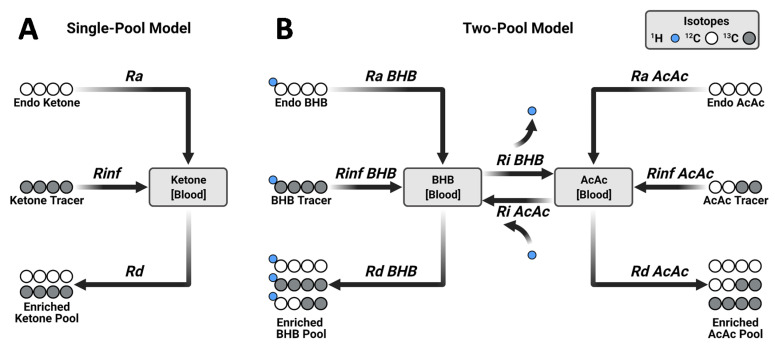
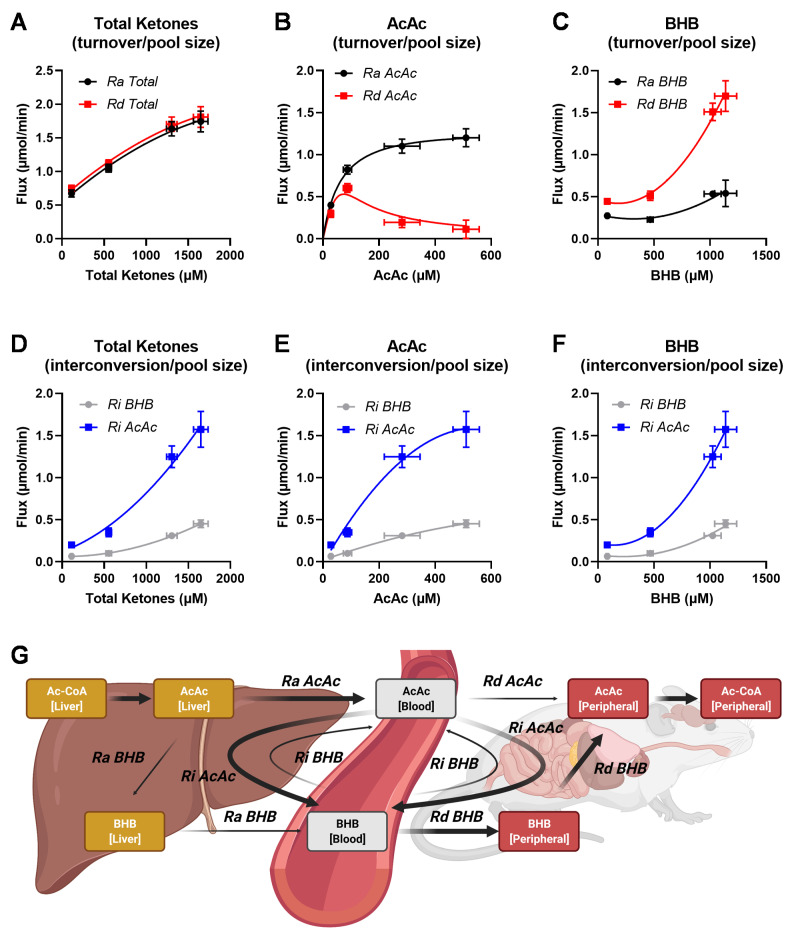
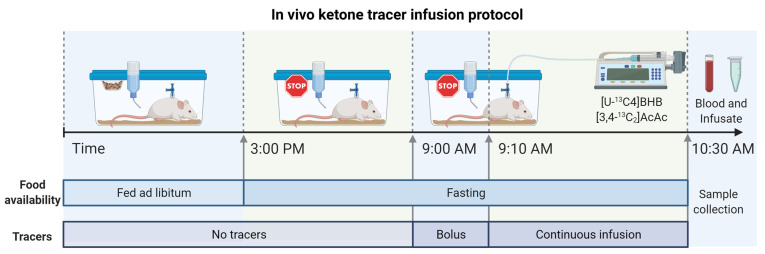
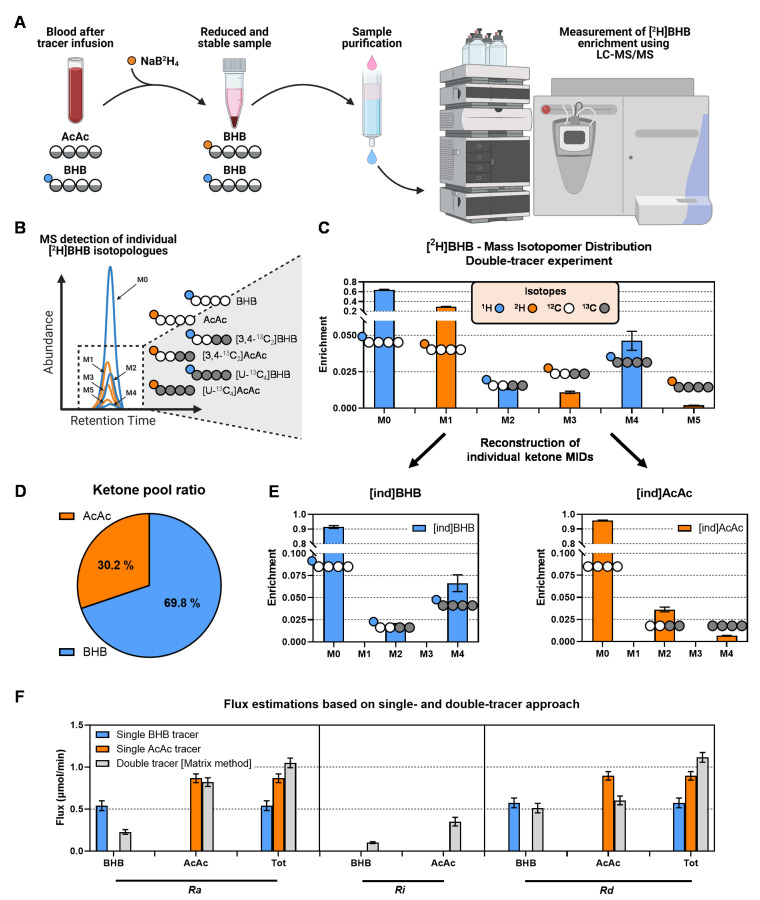
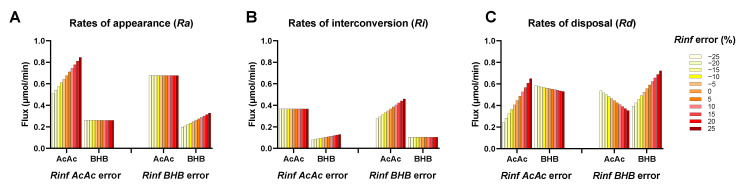
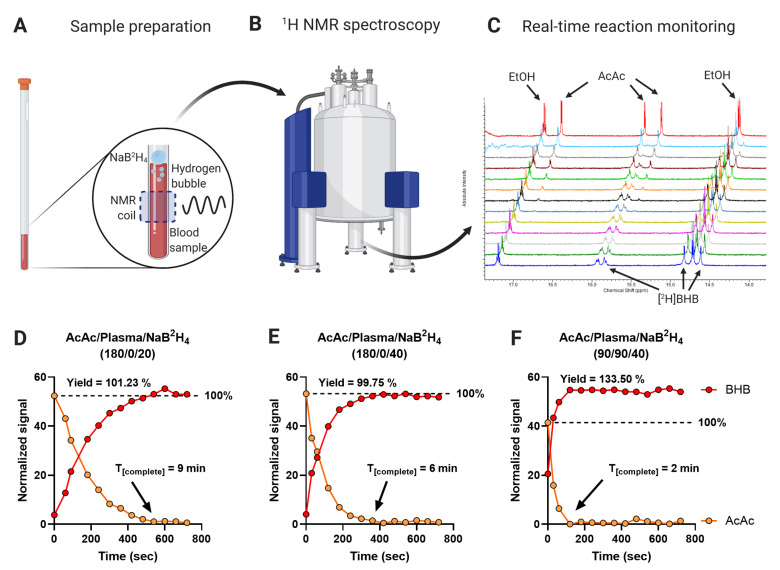
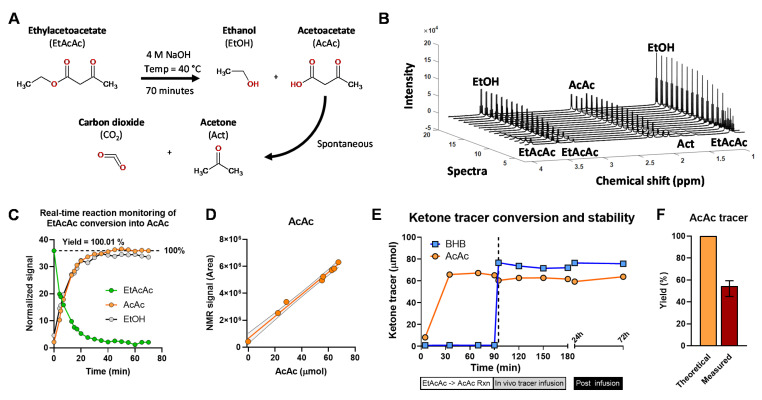
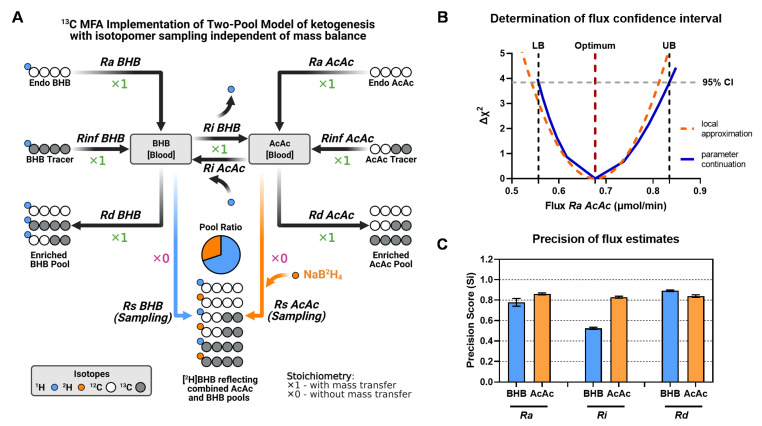
Ketogenesis occurs in liver mitochondria where acetyl-CoA molecules, derived from lipid oxidation, are condensed into acetoacetate (AcAc) and reduced to β-hydroxybutyrate (BHB). During carbohydrate scarcity, these two ketones are released into circulation at high rates and used as oxidative fuels in peripheral tissues. Despite their physiological relevance and emerging roles in a variety of diseases, endogenous ketone production is rarely measured in vivo using tracer approaches. Accurate determination of this flux requires a two-pool model, simultaneous BHB and AcAc tracers, and special consideration for the stability of the AcAc tracer and analyte. We describe the implementation of a two-pool model using a metabolic flux analysis (MFA) approach that simultaneously regresses liquid chromatography-tandem mass spectrometry (LC-MS/MS) ketone isotopologues and tracer infusion rates. Additionally, H NMR real-time reaction monitoring was used to evaluate AcAc tracer and analyte stability during infusion and sample analysis, which were critical for accurate flux calculations. The approach quantifies AcAc and BHB pool sizes and their rates of appearance, disposal, and exchange. Regression analysis provides confidence intervals and detects potential errors in experimental data. Complications for the physiological interpretation of individual ketone fluxes are discussed.
酮体生成发生在肝脏线粒体中,源自脂质氧化的乙酰辅酶A分子在此处缩合成乙酰乙酸(AcAc)并还原为β-羟基丁酸(BHB)。在碳水化合物缺乏期间,这两种酮以高速率释放到循环中,并在外周组织中用作氧化燃料。尽管它们具有生理相关性且在多种疾病中发挥着新出现的作用,但使用示踪剂方法在体内很少测量内源性酮的产生。准确测定这种通量需要一个双池模型、同时使用BHB和AcAc示踪剂,以及特别考虑AcAc示踪剂和分析物的稳定性。我们描述了使用代谢通量分析(MFA)方法实施双池模型,该方法同时对液相色谱 - 串联质谱(LC-MS/MS)酮同位素异构体和示踪剂输注速率进行回归分析。此外,使用核磁共振氢谱(H NMR)实时反应监测来评估输注和样品分析过程中AcAc示踪剂和分析物的稳定性,这对于准确的通量计算至关重要。该方法可量化AcAc和BHB池大小及其出现、处置和交换速率。回归分析提供置信区间并检测实验数据中的潜在误差。文中还讨论了个体酮通量生理解释的复杂性。