Luxembourg Centre for Systems Biomedicine, University of Luxembourg, L-4367 Esch-sur-Alzette, Luxembourg.
Luxembourg Centre for Neuropathology (LCNP), L-3555 Dudelange, Luxembourg.
Int J Mol Sci. 2021 Apr 28;22(9):4676. doi: 10.3390/ijms22094676.
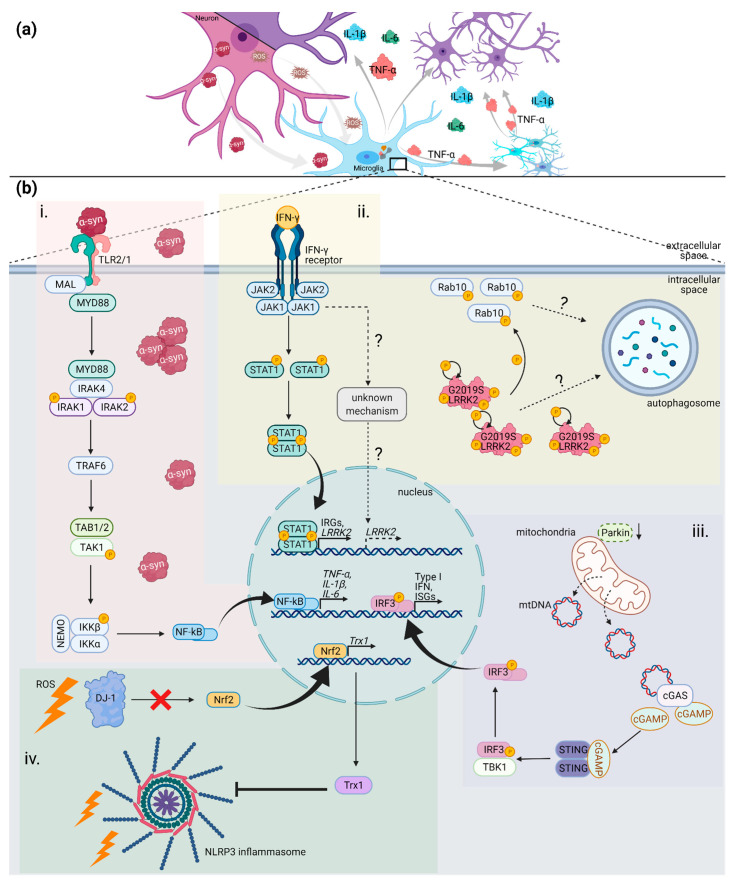
With the world's population ageing, the incidence of Parkinson's disease (PD) is on the rise. In recent years, inflammatory processes have emerged as prominent contributors to the pathology of PD. There is great evidence that microglia have a significant neuroprotective role, and that impaired and over activated microglial phenotypes are present in brains of PD patients. Thereby, PD progression is potentially driven by a vicious cycle between dying neurons and microglia through the instigation of oxidative stress, mitophagy and autophagy dysfunctions, a-synuclein accumulation, and pro-inflammatory cytokine release. Hence, investigating the involvement of microglia is of great importance for future research and treatment of PD. The purpose of this review is to highlight recent findings concerning the microglia-neuronal interplay in PD with a focus on human postmortem immunohistochemistry and single-cell studies, their relation to animal and iPSC-derived models, newly emerging technologies, and the resulting potential of new anti-inflammatory therapies for PD.
随着世界人口老龄化,帕金森病 (PD) 的发病率呈上升趋势。近年来,炎症过程已成为 PD 病理学的重要贡献因素。有大量证据表明,小胶质细胞具有重要的神经保护作用,而在 PD 患者的大脑中存在受损和过度激活的小胶质细胞表型。因此,PD 的进展可能是由死亡神经元和小胶质细胞之间的恶性循环驱动的,该循环通过引发氧化应激、线粒体自噬和自噬功能障碍、α-突触核蛋白积累和促炎细胞因子释放。因此,研究小胶质细胞的参与对于 PD 的未来研究和治疗非常重要。本综述的目的是强调最近关于 PD 中小胶质细胞-神经元相互作用的发现,重点是人类死后免疫组织化学和单细胞研究,以及它们与动物和 iPSC 衍生模型的关系、新兴技术,以及由此产生的针对 PD 的新抗炎治疗的潜力。