Department of Research and Development, MiZ Company Limited, 2-19-15 Ofuna, Kamakura, Kanagawa 247-0056, Japan.
Department of Molecular & Cell Biology, University of California, Berkeley, 3060 Valley Life Sciences Bldg #3140, Berkeley, CA 94720-3140, USA.
Int J Mol Sci. 2021 Apr 27;22(9):4566. doi: 10.3390/ijms22094566.
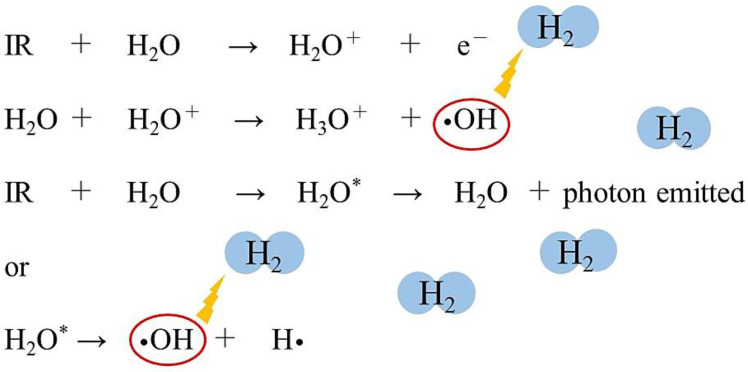
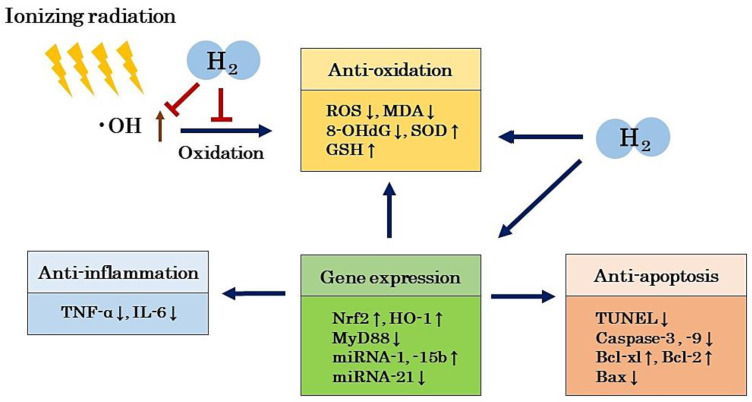
Although ionizing radiation (radiation) is commonly used for medical diagnosis and cancer treatment, radiation-induced damages cannot be avoided. Such damages can be classified into direct and indirect damages, caused by the direct absorption of radiation energy into DNA and by free radicals, such as hydroxyl radicals (•OH), generated in the process of water radiolysis. More specifically, radiation damage concerns not only direct damages to DNA, but also secondary damages to non-DNA targets, because low-dose radiation damage is mainly caused by these indirect effects. Molecular hydrogen (H) has the potential to be a radioprotective agent because it can selectively scavenge •OH, a reactive oxygen species with strong oxidizing power. Animal experiments and clinical trials have reported that H exhibits a highly safe radioprotective effect. This paper reviews previously reported radioprotective effects of H and discusses the mechanisms of H, not only as an antioxidant, but also in intracellular responses including anti-inflammation, anti-apoptosis, and the regulation of gene expression. In doing so, we demonstrate the prospects of H as a novel and clinically applicable radioprotective agent.
虽然电离辐射(辐射)常用于医学诊断和癌症治疗,但辐射诱导的损伤是不可避免的。这种损伤可以分为直接损伤和间接损伤,直接损伤是由于辐射能量直接被 DNA 吸收,间接损伤是由水辐射分解过程中产生的自由基(如羟自由基(•OH))引起的。更具体地说,辐射损伤不仅涉及 DNA 的直接损伤,还涉及非 DNA 靶标的继发损伤,因为低剂量辐射损伤主要是由这些间接效应引起的。氢气(H)有可能成为一种辐射防护剂,因为它可以选择性地清除具有强氧化能力的活性氧物种•OH。动物实验和临床试验报告表明,H 具有高度安全的辐射防护作用。本文综述了之前报道的 H 的辐射防护作用,并讨论了 H 的作用机制,不仅作为一种抗氧化剂,而且在包括抗炎、抗凋亡和基因表达调节在内的细胞内反应中。通过这样做,我们展示了 H 作为一种新型且临床适用的辐射防护剂的前景。