Hsieh Ming-Hong, Lu Hsueh-Ju, Lin Chiao-Wen, Lee Chia-Yi, Yang Shang-Jung, Wu Pei-Hsuan, Chen Mu-Kuan, Yang Shun-Fa
School of Medicine, Chung Shan Medical University, Taichung 402, Taiwan.
Department of Psychiatry, Chung Shan Medical University Hospital, Taichung 402, Taiwan.
J Pers Med. 2021 Apr 26;11(5):348. doi: 10.3390/jpm11050348.
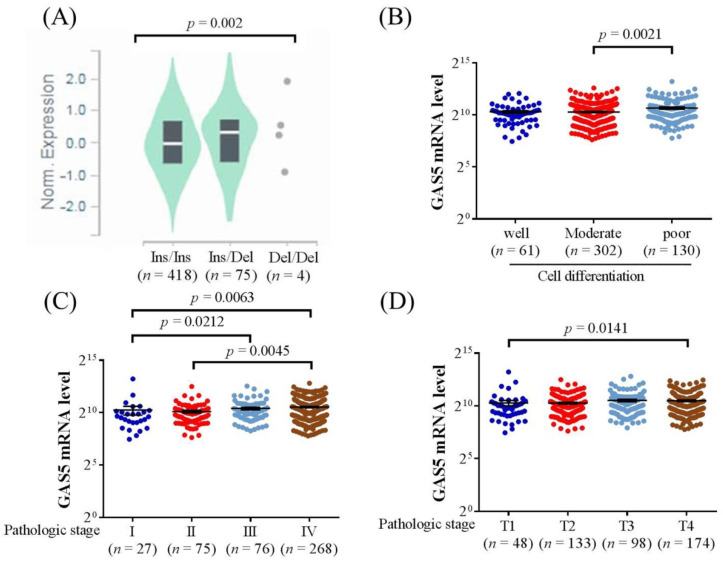
The long noncoding RNA, Growth arrest-specific 5 (GAS5) plays a crucial role in the development of oral cancer. However, potential genetic variants in that affect the susceptibility and progression of oral cancer have rarely been explored. In this study, two loci of single nucleotide polymorphisms (SNPs) (rs145204276 and rs55829688) were genotyped by using the TaqMan allelic discrimination in 1125 oral cancer patients and 1195 non-oral-cancer individuals. After statistical analyses, the distribution of both the SNP rs145204276 and SNP rs55829688 frequencies were similar between the study and control groups. However, the patients with SNP rs145204276 variants (Ins/Del or Del/Del) showed a higher tendency of moderate to poor cell differentiation of oral cancer (OR: 1.454, 95% CI: 1.041-2.031, = 0.028). Moreover, the SNP rs145204276 variants (Ins/Del or Del/Del) in the non-alcohol-drinking population were associated with significantly advanced tumor stage (OR: 1.500, 95% CI: 1.081-2.081, = 0.015) and larger tumor size (OR: 1.494, 95% CI: 1.076-2.074, = 0.016). Furthermore, individuals with the SNP rs145204276 variant were associated with a higher expression of GAS5 in the GTEx database ( = 0.002), and the higher GAS5 level was associated with poor cell differentiation, advanced tumor stage and larger tumor size in head and neck squamous cell carcinoma from the TCGA database (all < 0.05). In conclusion, the SNP rs145204276 variant is related to poor-differentiation cell status in oral cancer. Besides, the presence of the SNP rs145204276 variant is associated with a worse tumor stage and tumor size in oral cancer patients without alcohol drinking.
长链非编码RNA生长停滞特异性5(GAS5)在口腔癌的发生发展中起关键作用。然而,影响口腔癌易感性和进展的潜在基因变异鲜有研究。在本研究中,采用TaqMan等位基因分型法对1125例口腔癌患者和1195例非口腔癌个体的两个单核苷酸多态性(SNP)位点(rs145204276和rs55829688)进行基因分型。经统计学分析,研究组与对照组中SNP rs145204276和SNP rs55829688的频率分布相似。然而,携带SNP rs145204276变异(Ins/Del或Del/Del)的口腔癌患者出现中度至低度细胞分化的倾向更高(OR:1.454,95%CI:1.041 - 2.031,P = 0.028)。此外,在不饮酒人群中,SNP rs145204276变异(Ins/Del或Del/Del)与肿瘤分期显著进展(OR:1.500,95%CI:1.081 - 2.081,P = 0.015)和肿瘤体积较大(OR:1.494,95%CI:1.076 - 2.074,P = 0.016)相关。此外,在GTEx数据库中,携带SNP rs145204276变异的个体GAS5表达较高(P = 0.002),而在TCGA数据库的头颈部鳞状细胞癌中,较高的GAS5水平与细胞分化差、肿瘤分期进展和肿瘤体积较大相关(均P < )。总之,SNP rs145204276变异与口腔癌中低分化细胞状态相关。此外,在不饮酒的口腔癌患者中,SNP rs145204276变异的存在与更差的肿瘤分期和肿瘤体积相关。 (注:原文中“在TCGA数据库的头颈部鳞状细胞癌中,较高的GAS5水平与细胞分化差、肿瘤分期进展和肿瘤体积较大相关(均P < )”这里P值后面缺少具体数值,翻译时保留原文格式)