Jafari Ali, Sheikholeslami-Vatani Dariush, Khosrobakhsh Farnoosh, Khaledi Neda
Department of Physical Education and Sport Sciences, University of Kurdistan, Sanandaj, Iran.
Department of Cellular and Molecular Biology, Faculty of Science, University of Kurdistan, Sanandaj, Iran.
Front Physiol. 2021 Apr 13;12:640237. doi: 10.3389/fphys.2021.640237. eCollection 2021.
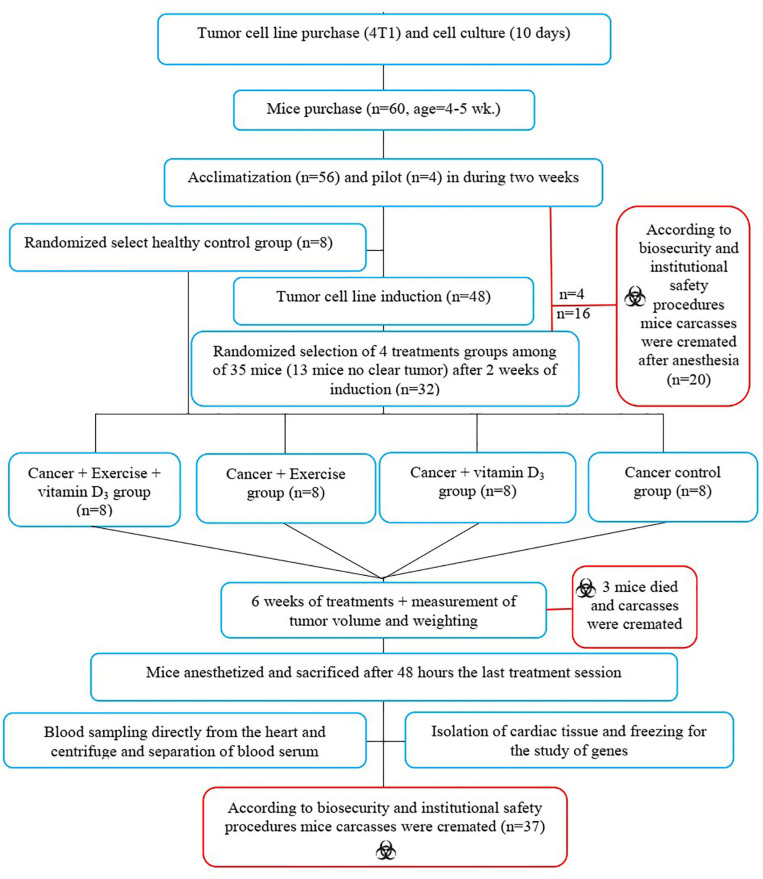
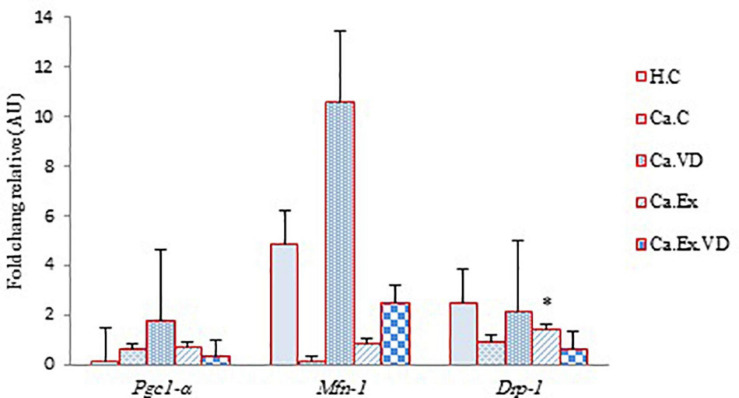
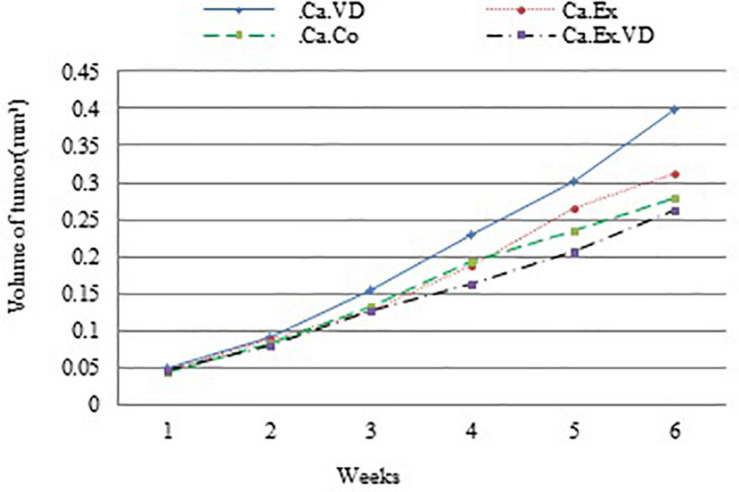
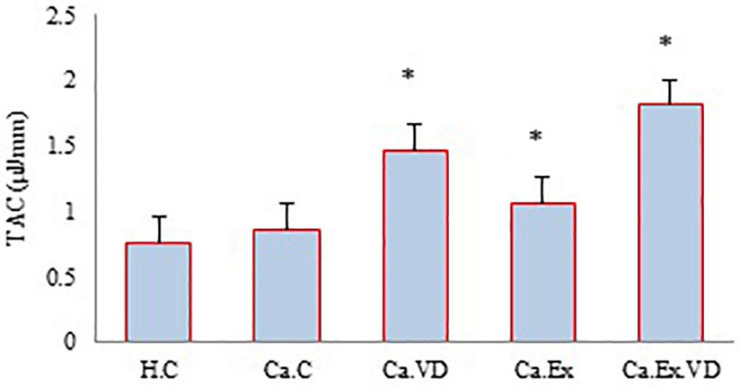
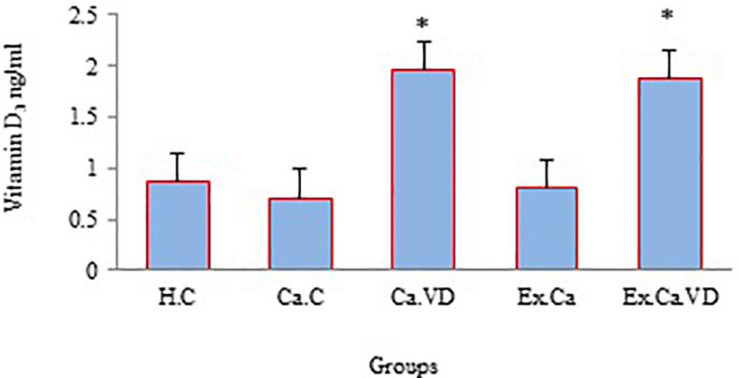
Both regular exercise training and vitamin D consumption are beneficial for patients with cancer. The study investigated the effects of interval exercise training (IET) or/and vitamin D supplementation on the gene expression involved in mitochondrial function of heart tissue, tumor size, and total antioxidant capacity (TAC) in breast cancer (BC) model mice. We assigned random 40 female NMRI mice to five equal groups ( = 8); the healthy control group (H.C), cancer control group (Ca.C), cancer with the vitamin D group (Ca.VD), cancer exercise group (Ca.Ex), and cancer exercise along with the vitamin D group (Ca.Ex.VD). Forty-eight hours after treatment, we anesthetized the animals and performed the isolation of heart tissue and blood serum for further studies. The results showed that the lowest mean body weight at the end of the treatments was related to Ca.C ( = 0.001). Vitamin D treatment alone has increased tumor volume growth by approximately 23%; in contrast, co-treatment with exercise and vitamin D inhibited tumor growth in mice ( = 0.001), compared with the cancer control (12%). TAC levels were higher in the group that received both vitamin D and exercise training (Ca.Ex.VD) than in the other treatment groups (Ca.VD and Ca.Ex) ( = 0.001). In cardiac tissue, vitamin D treatment induces an elevation significantly of the mRNA expression of α, , and genes ( = 0.001). The study has shown the overexpression of vitamin D in female mice, and synergistic effects of IET with vitamin D on weight loss controlling, antitumorigenesis, improvement of antioxidant defense, and the modulation of gene expression. The synergistic responses were likely by increasing mitochondrial fusion and TAC to control oxidative stress. We recommended being conducted further studies on mitochondrial dynamics and biogenesis focusing on risk factors of cardiovascular disease (CVD) in patients with BC.
规律的运动训练和维生素D的摄入对癌症患者均有益。本研究调查了间歇运动训练(IET)或/和补充维生素D对乳腺癌(BC)模型小鼠心脏组织线粒体功能相关基因表达、肿瘤大小和总抗氧化能力(TAC)的影响。我们将40只雌性NMRI小鼠随机分为五组(每组 = 8只);健康对照组(H.C)、癌症对照组(Ca.C)、癌症加维生素D组(Ca.VD)、癌症运动组(Ca.Ex)和癌症运动加维生素D组(Ca.Ex.VD)。治疗48小时后,我们对动物实施麻醉,并分离心脏组织和血清以进行进一步研究。结果显示,治疗结束时平均体重最低的是Ca.C组(P = 0.001)。单独使用维生素D治疗使肿瘤体积增长增加了约23%;相比之下,运动与维生素D联合治疗可抑制小鼠肿瘤生长(P = 0.001),与癌症对照组相比抑制率为12%。同时接受维生素D和运动训练的组(Ca.Ex.VD)的TAC水平高于其他治疗组(Ca.VD和Ca.Ex)(P = 0.001)。在心脏组织中,维生素D治疗显著诱导了α、β和γ基因的mRNA表达升高(P = 0.001)。该研究表明雌性小鼠中维生素D的过表达,以及IET与维生素D在控制体重减轻、抗肿瘤发生、改善抗氧化防御和调节基因表达方面的协同作用。这种协同反应可能是通过增加线粒体融合和TAC来控制氧化应激。我们建议针对BC患者心血管疾病(CVD)风险因素,进一步开展关于线粒体动力学和生物发生的研究。