Koomullil Roy, Tehrani Behnam, Goliwas Kayla, Wang Yong, Ponnazhagan Selvarangan, Berry Joel, Deshane Jessy
Department of Mechanical Engineering, University of Alabama at Birmingham, Birmingham, AL, United States.
Department of Medicine, Division of Pulmonary Allergy and Critical Care Medicine, University of Alabama at Birmingham, Birmingham, AL, United States.
Front Med (Lausanne). 2021 Apr 13;8:643793. doi: 10.3389/fmed.2021.643793. eCollection 2021.
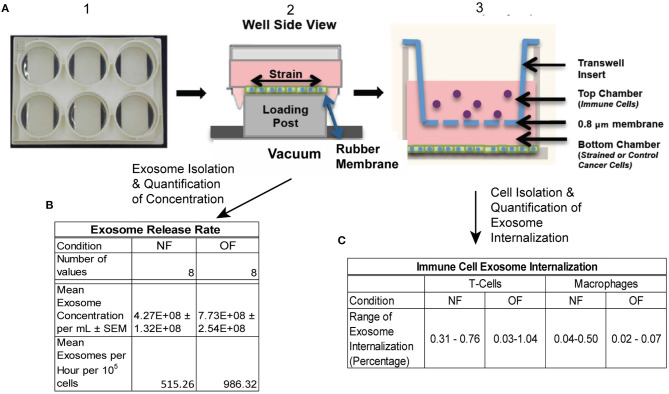
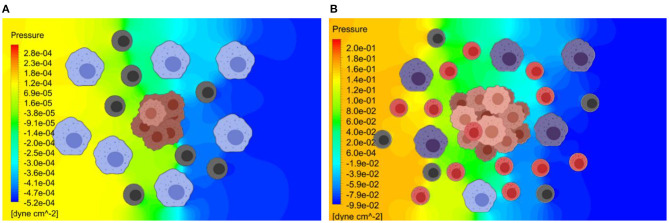
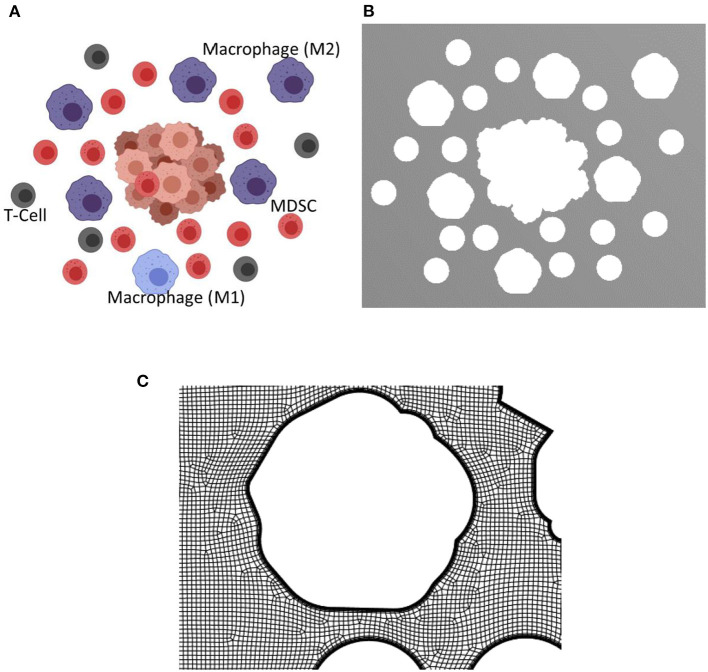
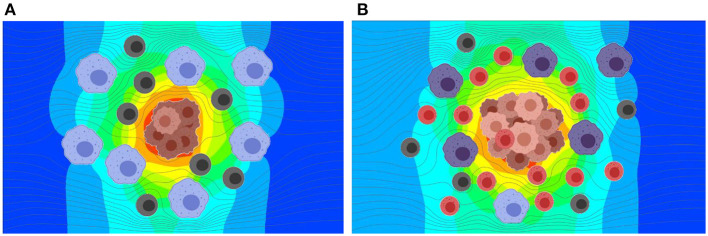
Cellular exosome-mediated crosstalk in tumor microenvironment (TME) is a critical component of anti-tumor immune responses. In addition to particle size, exosome transport and uptake by target cells is influenced by physical and physiological factors, including interstitial fluid pressure, and exosome concentration. These variables differ under both normal and pathological conditions, including cancer. The transport of exosomes in TME is governed by interstitial flow and diffusion. Based on these determinants, mathematical models were adapted to simulate the transport of exosomes in the TME with specified exosome release rates from the tumor cells. In this study, the significance of spatial relationship in exosome-mediated intercellular communication was established by treating their movement in the TME as a continuum using a transport equation, with advection due to interstitial flow and diffusion due to concentration gradients. To quantify the rate of release of exosomes by biomechanical forces acting on the tumor cells, we used a transwell platform with confluent triple negative breast cancer cells 4T1.2 seeded in BioFlex plates exposed to an oscillatory force. Exosome release rates were quantified from 4T1.2 cells seeded at the bottom of the well following the application of either no force or an oscillatory force, and these rates were used to model exosome transport in the transwell. The simulations predicted that a larger number of exosomes reached the membrane of the transwell for 4T1.2 cells exposed to the oscillatory force when compared to controls. Additionally, we simulated the interstitial fluid flow and exosome transport in a 2-dimensional TME with macrophages, T cells, and mixtures of these two populations at two different stages of a tumor growth. Computational simulations were carried out using the commercial computational simulation package, ANSYS/Fluent. The results of this study indicated higher exosome concentrations and larger interstitial fluid pressure at the later stages of the tumor growth. Quantifying the release of exosomes by cancer cells, their transport through the TME, and their concentration in TME will afford a deeper understanding of the mechanisms of these interactions and aid in deriving predictive models for therapeutic intervention.
细胞外泌体介导的肿瘤微环境(TME)中的细胞间通讯是抗肿瘤免疫反应的关键组成部分。除了颗粒大小外,外泌体被靶细胞转运和摄取还受物理和生理因素影响,包括组织液压力和外泌体浓度。这些变量在正常和病理条件下(包括癌症)有所不同。TME中外泌体的转运受组织液流动和扩散控制。基于这些决定因素,采用数学模型来模拟在肿瘤细胞具有特定外泌体释放速率的TME中外泌体的转运。在本研究中,通过使用传输方程将它们在TME中的移动视为连续介质,其中由于组织液流动产生平流,由于浓度梯度产生扩散,从而确立了外泌体介导的细胞间通讯中空间关系的重要性。为了量化作用于肿瘤细胞的生物力学力对外泌体释放速率的影响,我们使用了一个Transwell平台,该平台上接种了融合的三阴性乳腺癌细胞4T1.2,这些细胞被接种在暴露于振荡力的BioFlex板中。在施加无作用力或振荡力后,从接种在孔底部的4T1.2细胞中量化外泌体释放速率,并将这些速率用于模拟Transwell中外泌体的转运。模拟预测,与对照组相比,暴露于振荡力的4T1.2细胞有更多的外泌体到达Transwell膜。此外,我们在二维TME中模拟了肿瘤生长两个不同阶段巨噬细胞、T细胞以及这两种细胞群体混合物的组织液流动和外泌体转运。使用商业计算模拟软件包ANSYS/Fluent进行了计算模拟。本研究结果表明,在肿瘤生长后期外泌体浓度更高,组织液压力更大。量化癌细胞对外泌体的释放、它们在TME中的转运以及它们在TME中的浓度,将有助于更深入地理解这些相互作用的机制,并有助于推导治疗干预的预测模型。