Department of Psychology, University of Cambridge, Cambridge, UK.
Utrecht University, Utrecht, The Netherlands.
Sci Rep. 2021 Apr 30;11(1):9351. doi: 10.1038/s41598-021-88663-0.
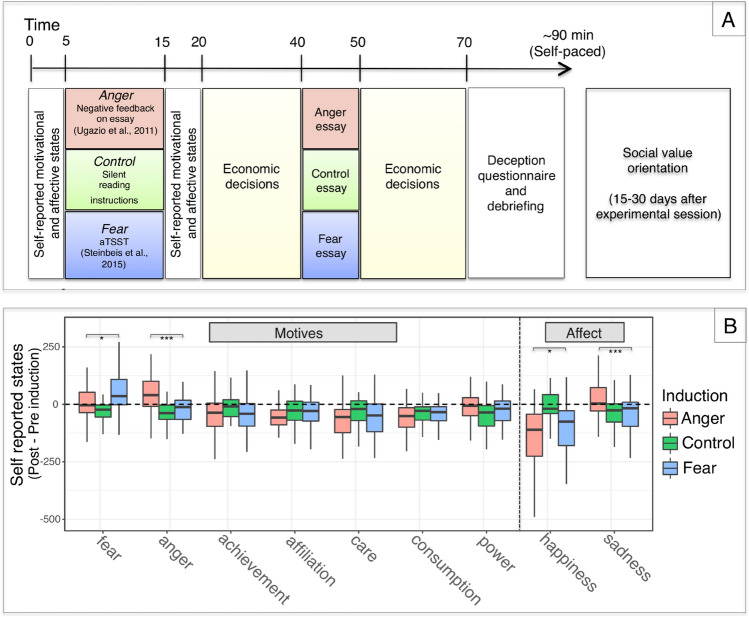
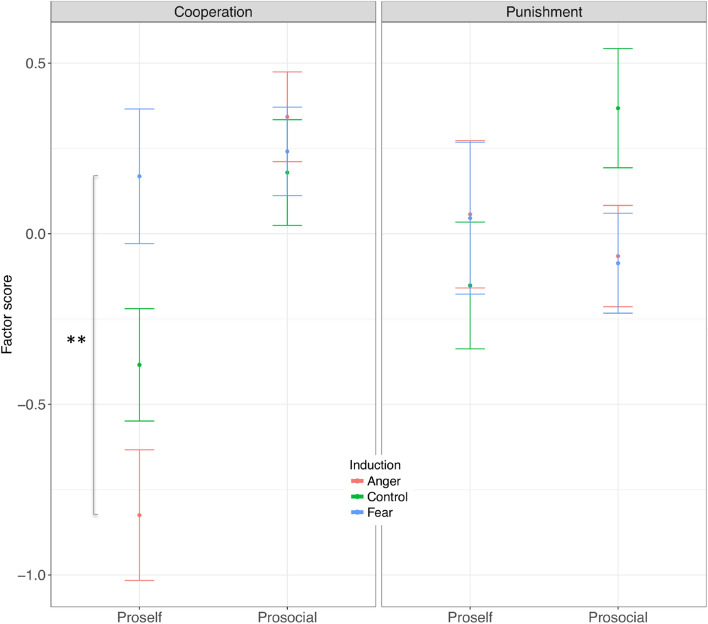
Cooperative decisions are well predicted by stable individual differences in social values but it remains unclear how they may be modulated by emotions such as fear and anger. Moving beyond specific decision paradigms, we used a suite of economic games and investigated how experimental inductions of fear or anger affect latent factors of decision making in individuals with selfish or prosocial value orientations. We found that, relative to experimentally induced anger, induced fear elicited higher scores on a cooperation factor, and that this effect was entirely driven by selfish participants. In fact, induced fear brought selfish individuals to cooperate similarly to prosocial individuals, possibly as a (selfish) mean to seek protection in others. These results suggest that two basic threat-related emotions, fear and anger, differentially affect a generalized form of cooperation and that this effect is buffered by prosocial value orientation.
合作决策可以通过个体在社会价值方面稳定的差异很好地预测,但情绪(如恐惧和愤怒)如何影响合作决策尚不清楚。本研究超越了特定的决策范式,使用了一系列经济博弈游戏,调查了在具有利己或亲社会价值取向的个体中,实验诱导的恐惧或愤怒如何影响决策的潜在因素。研究发现,与实验诱导的愤怒相比,实验诱导的恐惧在合作因素上得分更高,并且这种效应完全是由自私的参与者驱动的。事实上,实验诱导的恐惧使自私的个体合作程度与亲社会的个体相似,这可能是(自私的)寻求他人保护的一种手段。这些结果表明,两种基本的与威胁相关的情绪,恐惧和愤怒,对合作的一般形式有不同的影响,而这种影响被亲社会的价值取向所缓冲。