Department of Pathogen Biology, Nanjing Medical University, Nanjing, China.
Experimental Teaching Center of Basic Medicine, Nanjing University of Chinese Medicine, Nanjing, China.
Parasit Vectors. 2021 May 1;14(1):234. doi: 10.1186/s13071-021-04741-2.
The pathogens transmitted by mosquitoes to humans and animals cause several emerging and resurgent infectious diseases. Increasing insecticide resistance requires rational action to control the target vector population. Chitin is indispensable for insect growth and development and absent from vertebrates and higher plants. Chitin synthase A (CHSA) is a crucial enzyme in chitin synthesis; therefore, identifying and characterizing how CHSA determines chitin content may contribute to the development of novel vector control strategies.
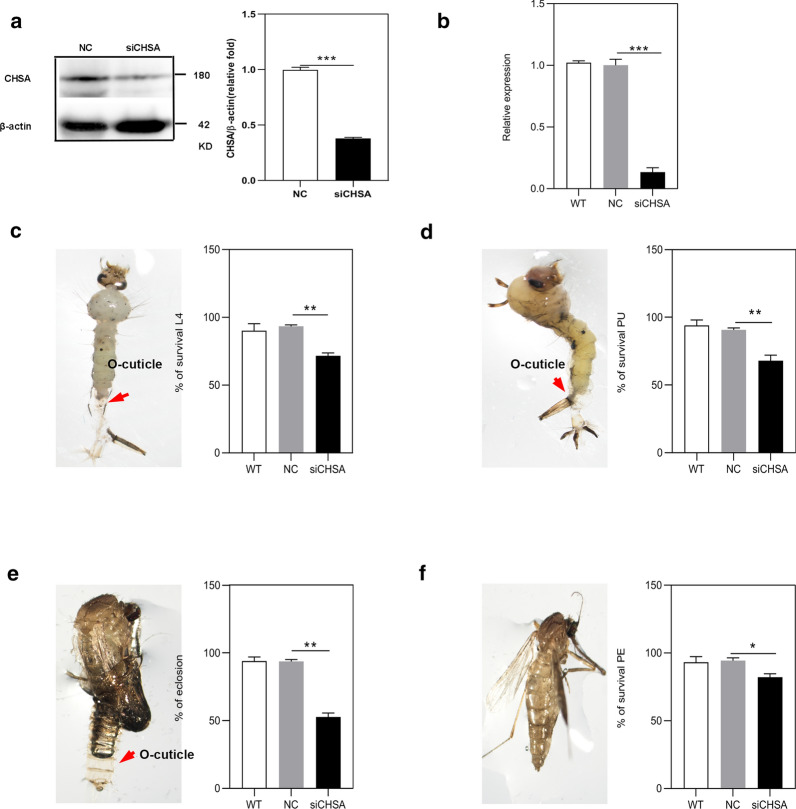
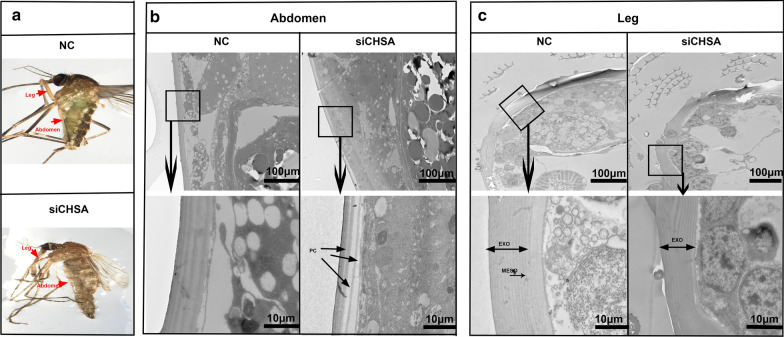
The injection of small interfering RNA targeting CHSA (siCHSA) to knockdown CHSA transcripts in larval, pupal and adult stages of Culex pipiens pallens resulted in the appearance of different lethal phenotypes. When larval and pupal stages were injected with siCHSA, CHSA knockdown prevented larval molting, pupation and adult eclosion, and affected the production of chitin and chitin degradation, which resulted in an ecdysis defect phenotype of mosquitoes. When siCHSA was injected into mosquitoes in the adult stage, CHSA knockdown also affected the laminar organization of the mesoderm and the formation of pseudo-orthogonal patterns of the large fibers of the endoderm.
We provide a systematic and comprehensive description of the effects of CHSA on morphogenesis and metamorphosis. The results show that CHSA not only affects chitin synthesis during molting, but also might be involved in chitin degradation. Our results further show that CHSA is important for the structural integrity of the adult mosquito cuticle.
蚊子传播给人类和动物的病原体导致了几种新发和再现的传染病。杀虫剂抗性的增加需要采取合理的行动来控制目标媒介种群。几丁质对于昆虫的生长和发育是必不可少的,而脊椎动物和高等植物则没有几丁质。几丁质合酶 A(CHSA)是几丁质合成的关键酶;因此,鉴定和描述 CHSA 如何决定几丁质含量可能有助于开发新的媒介控制策略。
注射靶向 CHSA 的小干扰 RNA(siCHSA)以敲低白纹伊蚊幼虫、蛹和成虫阶段的 CHSA 转录本,导致出现不同的致死表型。当幼虫和蛹期被注射 siCHSA 时,CHSA 敲低阻止了幼虫蜕皮、化蛹和成虫羽化,并影响了几丁质的产生和几丁质的降解,这导致了蚊子的蜕皮缺陷表型。当 siCHSA 被注射到成虫期的蚊子中时,CHSA 敲低也影响了中胚层的层状组织和内胚层大纤维的伪正交模式的形成。
我们提供了 CHSA 对形态发生和变态影响的系统和全面描述。结果表明,CHSA 不仅影响蜕皮过程中的几丁质合成,而且可能参与几丁质降解。我们的结果还表明,CHSA 对成年蚊子表皮的结构完整性很重要。