Wang Jarey H, Wahid Kareem A, van Dijk Lisanne V, Farahani Keyvan, Thompson Reid F, Fuller Clifton David
Medical Scientist Training Program, Baylor College of Medicine, Houston, TX, United States.
Department of Radiation Oncology, The University of Texas MD Anderson Cancer Center, Houston, TX, United States.
Clin Transl Radiat Oncol. 2021 Apr 7;28:97-115. doi: 10.1016/j.ctro.2021.03.006. eCollection 2021 May.
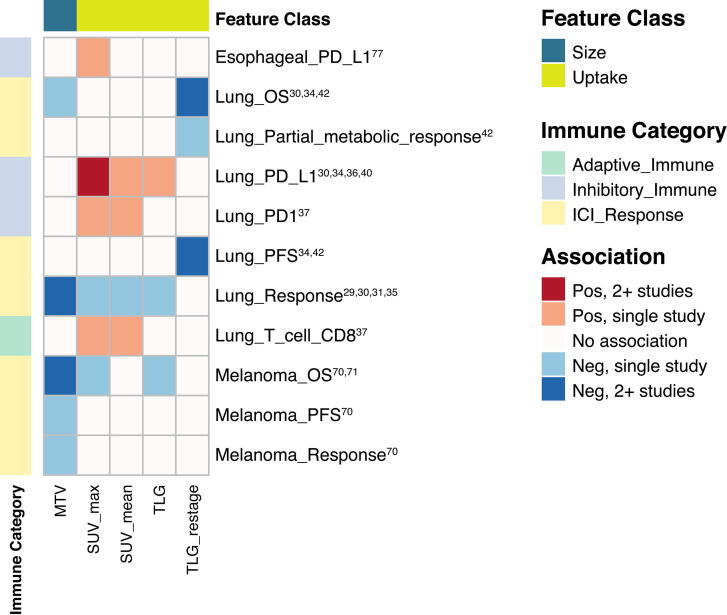
Immunotherapies are leading to improved outcomes for many cancers, including those with devastating prognoses. As therapies like immune checkpoint inhibitors (ICI) become a mainstay in treatment regimens, many concurrent challenges have arisen - for instance, delineating clinical responders from non-responders. Predicting response has proven to be difficult given a lack of consistent and accurate biomarkers, heterogeneity of the tumor microenvironment (TME), and a poor understanding of resistance mechanisms. For the most part, imaging data have remained an untapped, yet abundant, resource to address these challenges. In recent years, quantitative image analyses have highlighted the utility of medical imaging in predicting tumor phenotypes, prognosis, and therapeutic response. These studies have been fueled by an explosion of resources in high-throughput mining of image features (i.e. radiomics) and artificial intelligence. In this review, we highlight current progress in radiomics to understand tumor immune biology and predict clinical responses to immunotherapies. We also discuss limitations in these studies and future directions for the field, particularly if high-dimensional imaging data are to play a larger role in precision medicine.
免疫疗法正在改善许多癌症的治疗结果,包括那些预后极差的癌症。随着免疫检查点抑制剂(ICI)等疗法成为治疗方案的主流,许多并发挑战也随之出现——例如,区分临床应答者和无应答者。由于缺乏一致且准确的生物标志物、肿瘤微环境(TME)的异质性以及对耐药机制的了解不足,预测应答已被证明是困难的。在很大程度上,成像数据仍是应对这些挑战的未开发但丰富的资源。近年来,定量图像分析突出了医学成像在预测肿瘤表型、预后和治疗应答方面的效用。这些研究得益于图像特征高通量挖掘(即放射组学)和人工智能资源的激增。在本综述中,我们强调放射组学在理解肿瘤免疫生物学和预测免疫疗法临床应答方面的当前进展。我们还讨论了这些研究的局限性以及该领域的未来方向,特别是在高维成像数据要在精准医学中发挥更大作用的情况下。