Department of Microbiology, School of Public Health, Southern Medical University, Guangzhou, China.
Division of Clinical Microbiology, Department of Laboratory Medicine, Karolinska Institutet, Huddinge, Sweden.
Virulence. 2021 Dec;12(1):1296-1305. doi: 10.1080/21505594.2021.1922010.
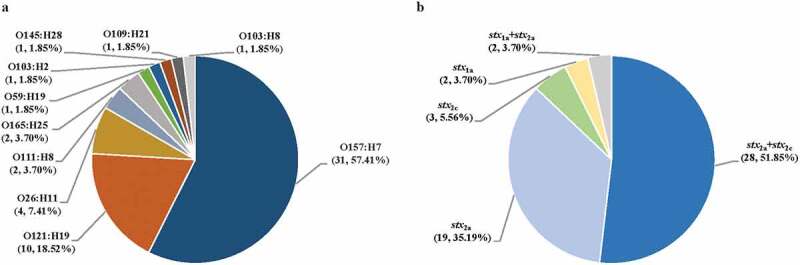
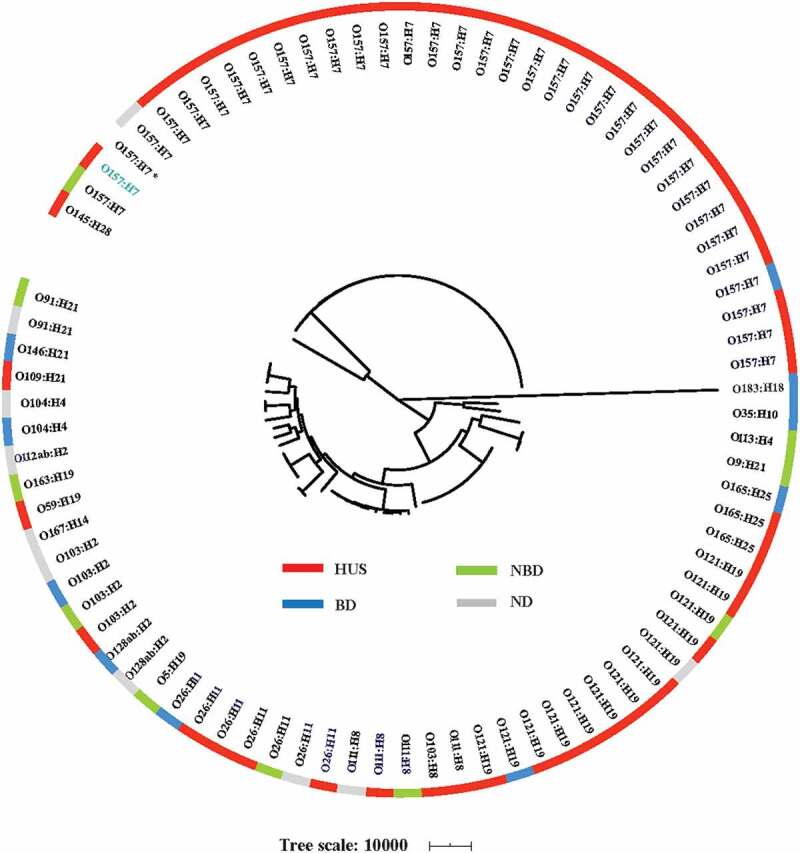
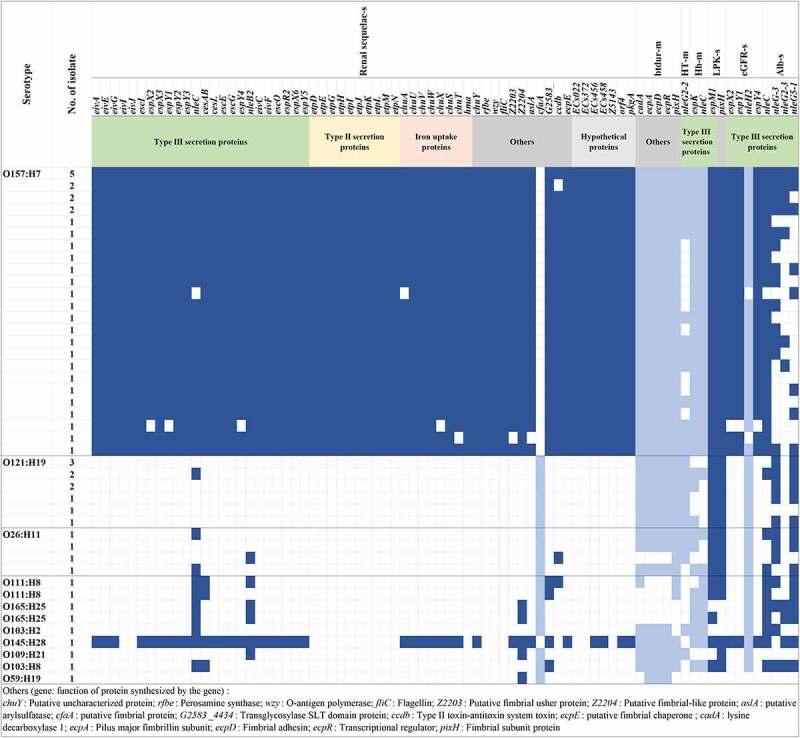
Shiga toxin-producing , a foodborne bacterial pathogen, has been linked to a broad spectrum of clinical outcomes ranging from asymptomatic carriage to fatal hemolytic uremic syndrome (HUS). Here, we collected clinical data and STEC strains from HUS patients from 1994 through 2018, whole-genome sequencing was performed to molecularly characterize HUS-associated STEC strains, statistical analysis was conducted to identify bacterial genetic factors associated with severe outcomes in HUS patients. O157:H7 was the most predominant serotype (57%) among 54 HUS-associated STEC strains, followed by O121:H19 (19%) and O26:H11 (7%). Notably, some non-predominant serotypes such as O59:H17 (2%) and O109:H21 (2%) also caused HUS. All O157:H7 strains with one exception belonged to clade 8. During follow-up at a median of 4 years, 41% of the patients had renal sequelae. Fifty-nine virulence genes were found to be statistically associated with severe renal sequelae, these genes encoded type II and type III secretion system effectors, chaperones, and other factors. Notably, virulence genes associated with severe clinical outcomes were significantly more prevalent in O157:H7 strains. In contrast, genes related to mild symptoms were evenly distributed across all serotypes. The whole-genome phylogeny indicated high genomic diversity among HUS-STEC strains. No distinct cluster was found between HUS and non-HUS STEC strains. The current study showed that O157:H7 remains the main cause of STEC-associated HUS, despite the rising importance of other non-O157 serotypes. Besides, O157:H7 is associated with severe renal sequelae in the follow-up, which could be a risk factor for long-term prognosis in HUS patients.
产志贺毒素的,一种食源性病原体,与广泛的临床结果相关,从无症状携带到致命性溶血性尿毒症综合征(HUS)。在这里,我们收集了 1994 年至 2018 年 HUS 患者的临床数据和 STEC 菌株,进行了全基因组测序以对与 HUS 相关的 STEC 菌株进行分子特征分析,进行了统计分析以确定与 HUS 患者严重后果相关的细菌遗传因素。O157:H7 是 54 株与 HUS 相关的 STEC 菌株中最主要的血清型(57%),其次是 O121:H19(19%)和 O26:H11(7%)。值得注意的是,一些非主要血清型,如 O59:H17(2%)和 O109:H21(2%)也导致了 HUS。除了一个例外,所有 O157:H7 菌株都属于 8 组。在中位 4 年的随访中,41%的患者有肾脏后遗症。发现 59 个毒力基因与严重的肾脏后遗症有统计学关联,这些基因编码 II 型和 III 型分泌系统效应物、伴侣蛋白和其他因素。值得注意的是,与严重临床结果相关的毒力基因在 O157:H7 菌株中更为普遍。相比之下,与轻度症状相关的基因在所有血清型中均匀分布。全基因组系统发育分析表明,HUS-STEC 菌株具有很高的基因组多样性。在 HUS 和非 HUS STEC 菌株之间没有发现明显的聚类。本研究表明,尽管其他非 O157 血清型的重要性不断上升,但 O157:H7 仍然是 STEC 相关 HUS 的主要原因。此外,O157:H7 与随访中的严重肾脏后遗症相关,这可能是 HUS 患者长期预后的一个危险因素。