Menon Suvidha, Liang Xiuyi, Vartak Richa, Patel Ketankumar, Di Stefano Antonio, Cacciatore Ivana, Marinelli Lisa, Billack Blase
Department of Pharmaceutical Sciences, College of Pharmacy and Health Sciences, St. John's University, 8000 Utopia Parkway, Jamaica, NY 11439, USA.
Department of Pharmacy, "G. D'Annunzio" University of Chieti-Pescara, 66100 Chieti Scalo, Italy.
Pharmaceutics. 2021 Apr 29;13(5):633. doi: 10.3390/pharmaceutics13050633.
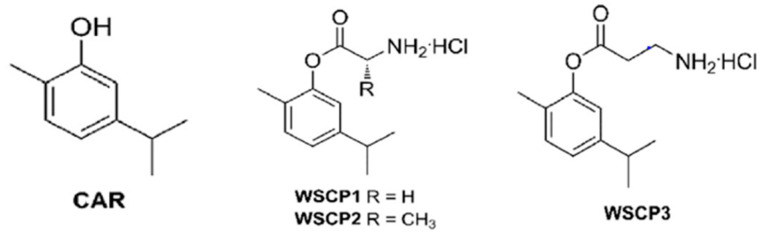
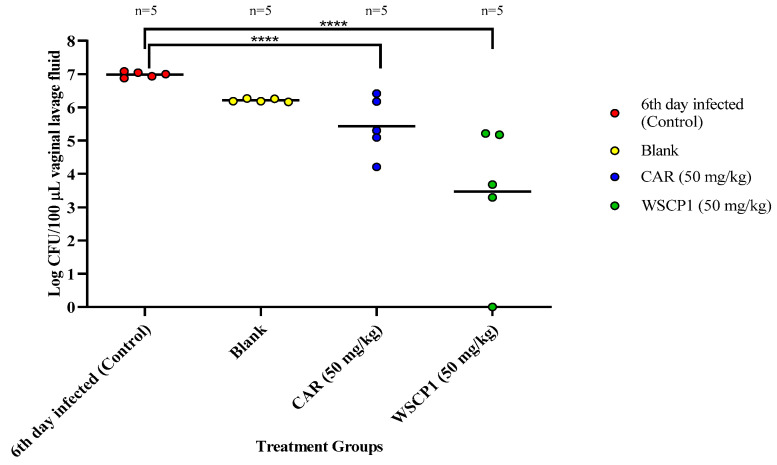
Carvacrol (CAR), a phenolic monoterpenoid, has been extensively investigated for its antimicrobial and antifungal activity. As a result of its poor physicochemical properties, water soluble carvacrol prodrugs (WSCPs) with improved water solubility were previously synthesized and found to possess antimicrobial activity. Here, three novel CAR analogs, WSCP1, WSCP2, and WSCP3, were tested against fluconazole (FLU)-sensitive and -resistant strains where they showed greater antifungal activity than CAR against . The probable mechanism by which the CAR prodrugs exert the antifungal activity was studied. Results from medium acidification assays demonstrated that the CAR and its synthetically designed prodrugs inhibit the yeast plasma membrane H+-ATPase (Pma1p), an essential target in fungi. In other words, in vitro data indicated that CAR analogs can prove to be a better alternative to CAR considering their improved water solubility. In addition, CAR and WSCP1 were developed into intravaginal formulations and administered at test doses of 50 mg/kg in a mouse model of vulvovaginal candidiasis (VVC). Whereas the CAR and WSCP1 formulations both exhibited antifungal efficacy in the mouse model of VVC, the WSCP1 formulation was superior to CAR, showing a remarkable decrease in infection by ~120-fold compared to the control (infected, untreated animals). Taken together, a synthetically designed prodrug of CAR, namely WSCP1, proved to be a possible solution for poorly water-soluble drugs, an inhibitor of an essential yeast pump in vitro and an effective and promising antifungal agent in vivo.
香芹酚(CAR)是一种酚类单萜,其抗菌和抗真菌活性已得到广泛研究。由于其理化性质不佳,先前合成了具有改善水溶性的水溶性香芹酚前药(WSCPs),并发现其具有抗菌活性。在此,对三种新型CAR类似物WSCP1、WSCP2和WSCP3针对氟康唑(FLU)敏感和耐药菌株进行了测试,结果显示它们比CAR对这些菌株具有更强的抗真菌活性。研究了CAR前药发挥抗真菌活性的可能机制。培养基酸化试验结果表明,CAR及其合成设计的前药可抑制酵母质膜H⁺-ATP酶(Pma1p),这是真菌中的一个重要靶点。换句话说,体外数据表明,考虑到其改善的水溶性,CAR类似物可能是CAR的更好替代品。此外,将CAR和WSCP1开发成阴道内制剂,并以50 mg/kg的测试剂量在小鼠外阴阴道念珠菌病(VVC)模型中给药。虽然CAR和WSCP1制剂在VVC小鼠模型中均表现出抗真菌疗效,但WSCP1制剂优于CAR,与对照组(感染但未治疗的动物)相比,感染显著降低了约120倍。综上所述,一种合成设计的CAR前药,即WSCP1,被证明是水溶性差的药物的一种可能解决方案,是体外酵母必需泵的抑制剂,也是体内一种有效且有前景的抗真菌剂。