Health Directorate, 1A-G Route de Trèves, L-2632 Findel, Luxembourg, Luxembourg.
Luxembourg Centre for Systems Biomedicine, University of Luxembourg, Esch-sur-Alzette and Belvaux, Luxembourg.
BMC Infect Dis. 2021 May 4;21(1):417. doi: 10.1186/s12879-021-06089-5.
Following a first wave in spring and gradual easing of lockdown, Luxembourg experienced an early second epidemic wave of SARS-CoV-2 before the start of summer school holidays on 15th July. This provided the opportunity to investigate the role of school-age children and school settings for transmission.
We compared the incidence of SARS-CoV-2 in school-age children, teachers and the general working population in Luxembourg during two epidemic waves: a spring wave from March-April 2020 corresponding to general lockdown with schools being closed and May-July 2020 corresponding to schools being open. We assessed the number of secondary transmissions occurring in schools between May and July 2020 using routine contact tracing data.
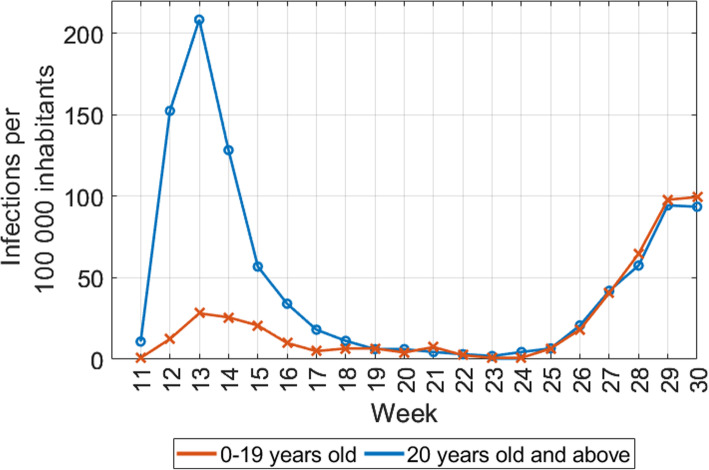
During the first wave in March-April 2020 when schools were closed, the incidence in pupils peaked at 28 per 100,000, while during the second wave in May-July 2020 when schools were open, incidence peaked 100 per 100,000. While incidence of SARS-CoV-2 was higher in adults than in children during the first spring wave, no significant difference was observed during the second wave in early summer. Between May and July 2020, we identified a total of 390 and 34 confirmed COVID-19 cases among 90,150 school-age children and 11,667 teachers, respectively. We further estimate that 179 primary cases caused 49 secondary cases in schools. While some small clusters of mainly student-to-student transmission within the same class were identified, we did not observe any large outbreaks with multiple generations of infection.
Transmission of SARS-CoV-2 within Luxembourg schools was limited during an early summer epidemic wave in 2020. Precautionary measures including physical distancing as well as easy access to testing, systematic contact tracing appears to have been successful in mitigating transmission within educational settings.
在春季出现第一波疫情并逐步放宽封锁之后,卢森堡在 7 月 15 日暑假开始前经历了 SARS-CoV-2 的早期第二波疫情。这为研究学龄儿童和学校环境在传播中的作用提供了机会。
我们比较了卢森堡 2020 年两次疫情期间学龄儿童、教师和一般劳动人口中 SARS-CoV-2 的发病率:春季波从 2020 年 3 月至 4 月,对应于学校关闭的全面封锁;5 月至 7 月,对应于学校开放。我们使用常规接触者追踪数据评估 2020 年 5 月至 7 月期间学校内发生的二次传播数量。
在 2020 年 3 月至 4 月学校关闭的第一波疫情中,学生发病率峰值为每 10 万人 28 例,而在 2020 年 5 月至 7 月学校开放的第二波疫情中,发病率峰值为每 10 万人 100 例。在第一波春季疫情中,SARS-CoV-2 的发病率在成人中高于儿童,但在初夏的第二波疫情中未观察到显著差异。在 2020 年 5 月至 7 月期间,我们共在 90150 名学龄儿童和 11667 名教师中发现了 390 例和 34 例确诊的 COVID-19 病例。我们进一步估计,179 例原发性病例导致学校内 49 例继发性病例。虽然在同一班级内发现了一些主要是学生之间传播的小聚集性病例,但我们没有观察到任何具有多代感染的大型暴发。
在 2020 年夏季早期的疫情中,卢森堡学校内的 SARS-CoV-2 传播受到限制。包括保持身体距离在内的预防措施以及易于进行检测、系统的接触者追踪,似乎成功地减轻了教育环境中的传播。