MMWR Morb Mortal Wkly Rep. 2020 Oct 2;69(39):1410-1415. doi: 10.15585/mmwr.mm6939e2.
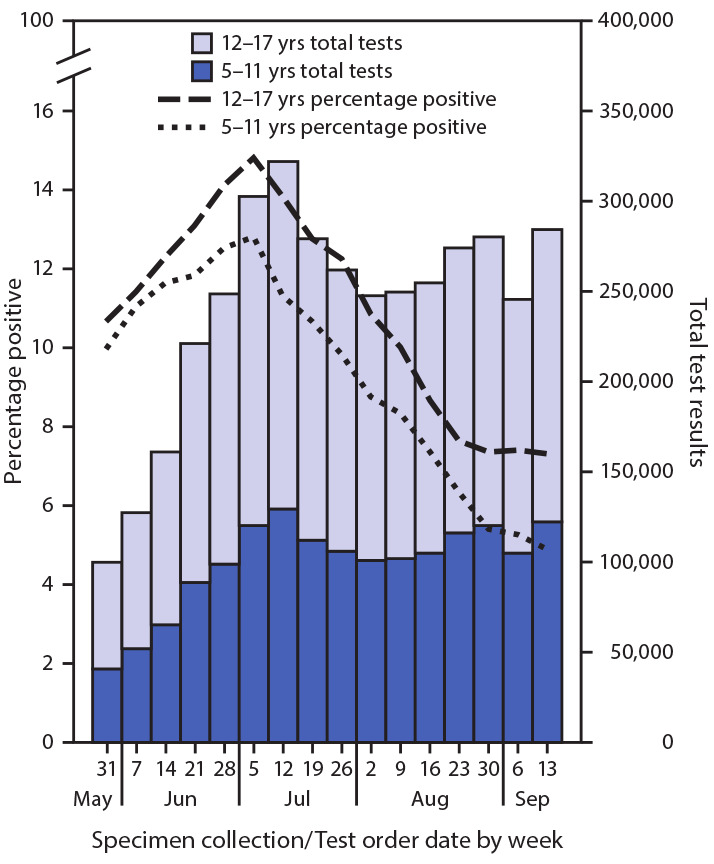
Approximately 56 million school-aged children (aged 5-17 years) resumed education in the United States in fall 2020.* Analysis of demographic characteristics, underlying conditions, clinical outcomes, and trends in weekly coronavirus disease 2019 (COVID-19) incidence during March 1-September 19, 2020 among 277,285 laboratory-confirmed cases in school-aged children in the United States might inform decisions about in-person learning and the timing and scaling of community mitigation measures. During May-September 2020, average weekly incidence (cases per 100,000 children) among adolescents aged 12-17 years (37.4) was approximately twice that of children aged 5-11 years (19.0). In addition, among school-aged children, COVID-19 indicators peaked during July 2020: weekly percentage of positive SARS-CoV-2 test results increased from 10% on May 31 to 14% on July 5; SARS-CoV-2 test volume increased from 100,081 tests on May 31 to 322,227 on July 12, and COVID-19 incidence increased from 13.8 per 100,000 on May 31 to 37.9 on July 19. During July and August, test volume and incidence decreased then plateaued; incidence decreased further during early September and might be increasing. Percentage of positive test results decreased during August and plateaued during September. Underlying conditions were more common among school-aged children with severe outcomes related to COVID-19: among school-aged children who were hospitalized, admitted to an intensive care unit (ICU), or who died, 16%, 27%, and 28%, respectively, had at least one underlying medical condition. Schools and communities can implement multiple, concurrent mitigation strategies and tailor communications to promote mitigation strategies to prevent COVID-19 spread. These results can provide a baseline for monitoring trends and evaluating mitigation strategies.
大约 5600 万学龄儿童(5-17 岁)于 2020 年秋季在美国重新开始接受教育。* 对 2020 年 3 月 1 日至 9 月 19 日期间美国 277285 例学龄儿童实验室确诊的 COVID-19 病例的人口统计学特征、潜在条件、临床结果和每周发病率进行分析,可能有助于制定有关面对面学习以及社区缓解措施的时间和规模的决策。在 2020 年 5 月至 9 月期间,12-17 岁青少年的每周平均发病率(每 10 万名儿童中的病例数)(37.4)约为 5-11 岁儿童的两倍(19.0)。此外,在学龄儿童中,COVID-19 指标在 2020 年 7 月达到峰值:每周 SARS-CoV-2 检测阳性结果的百分比从 5 月 31 日的 10%增加到 7 月 5 日的 14%;SARS-CoV-2 检测量从 5 月 31 日的 100081 次增加到 7 月 12 日的 322227 次,COVID-19 的发病率从 5 月 31 日的每 10 万人 13.8 例增加到 7 月 19 日的 37.9 例。在 7 月和 8 月期间,检测量和发病率下降后趋于平稳;9 月初发病率进一步下降,可能呈上升趋势。阳性检测结果的百分比在 8 月下降并在 9 月趋于平稳。在与 COVID-19 相关的严重后果的学龄儿童中,更常见潜在疾病:在住院、入住重症监护病房(ICU)或死亡的学龄儿童中,分别有 16%、27%和 28%有至少一种潜在的医疗条件。学校和社区可以实施多种同时进行的缓解策略,并调整沟通方式以促进缓解策略,以防止 COVID-19 的传播。这些结果可以为监测趋势和评估缓解策略提供基线。