Social, Behavioral, and Evaluation Sciences Team, Office of the Director, National Center for Emerging and Zoonotic Infectious Diseases, Centers for Disease Control and Prevention, Atlanta, GA, USA.
BMC Public Health. 2024 Jun 10;24(1):1561. doi: 10.1186/s12889-024-18142-4.
People's decisions to engage in protective health behaviors, such as mask wearing during the COVID-19 pandemic, are influenced by environmental and social contexts. Previous research on mask wearing used a single question about general mask usage in public, which may not reflect actual behavior in every setting. The likelihood of wearing a mask during one activity is also related to the likelihood of wearing a mask in another or avoiding an activity entirely. This analysis compared responses between a general question and activity-specific questions and identified patterns of mask-wearing behavior across activities.
Online, opt-in, cross-sectional surveys were conducted every 2 months from November 2020 to May 2021 (n = 2508), with quota sampling and weighting to achieve a representative sample of the U.S.
Respondents were asked how frequently they wore a mask in public and during 12 specific activities including: on public transportation, while shopping, and attending social gatherings indoors and outdoors. Spearman's rank order correlation was used to compare the frequency of mask wearing reported using a general question versus an activity specific question. Additionally, a latent class analysis was conducted to identify patterns of mask wearing behavior across activities.
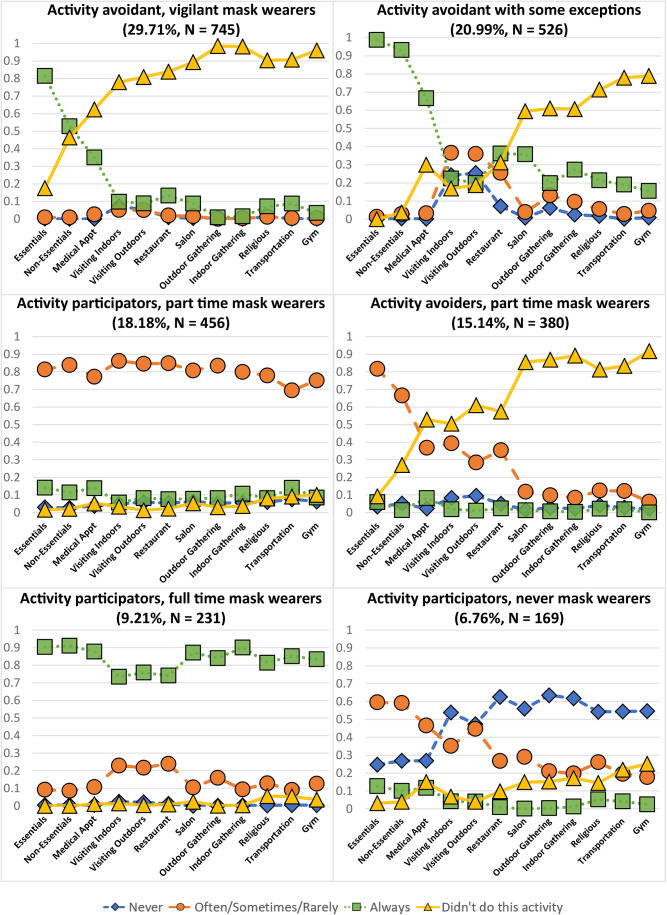
There was little to no correlation (r = .16-0.33) between respondents' general attitudes towards mask wearing and their reported frequency of mask wearing in different activities. Latent class analysis identified six distinct groups based on their mask wearing behaviors and avoidance of certain activities. The largest group (29%) avoided ten of the twelve activities and always wore a mask during activities that could not be avoided. Additional groups included those who avoided most activities but made exceptions when around friends or family (20%), part time mask wearers (18%), and never mask wearers (6%).
The findings suggest that activity-specific questions provide more accurate and useful information than a single general question. Specific, context based, questions allow for analyses that consider the nuances of people's decision-making regarding engaging in protective health behaviors, such as mask wearing, thus enabling public health professionals to create targeted guidelines and messages.
人们是否参与保护健康的行为,例如在 COVID-19 大流行期间佩戴口罩,受到环境和社会背景的影响。之前关于口罩佩戴的研究使用了一个关于在公共场合普遍佩戴口罩的单一问题,这可能无法反映每个环境中的实际行为。在一项活动中佩戴口罩的可能性也与在另一项活动中佩戴口罩或完全避免某项活动的可能性有关。本分析比较了一般问题和特定活动问题之间的回答,并确定了跨活动的口罩佩戴行为模式。
从 2020 年 11 月至 2021 年 5 月,每隔两个月进行一次在线、自选、横断面调查(n=2508),采用配额抽样和加权,以实现美国代表性样本。
受访者被问及他们在公共场合和 12 项特定活动中佩戴口罩的频率,包括:在公共交通工具上、购物时以及在室内和室外参加社交聚会。使用 Spearman 秩相关比较使用一般问题和特定活动问题报告的口罩佩戴频率。此外,还进行了潜在类别分析,以确定跨活动的口罩佩戴行为模式。
受访者对佩戴口罩的一般态度与其在不同活动中报告的口罩佩戴频率之间几乎没有相关性(r=0.16-0.33)。潜在类别分析根据他们的口罩佩戴行为和避免某些活动确定了六个不同的群体。最大的群体(29%)避免了 12 项活动中的 10 项,并且在无法避免的活动中始终佩戴口罩。其他群体包括那些避免大多数活动但在与朋友或家人在一起时会破例的群体(20%)、兼职口罩佩戴者(18%)和从不佩戴口罩的群体(6%)。
研究结果表明,特定活动的问题比单一的一般问题提供更准确和有用的信息。具体的、基于背景的问题允许进行分析,考虑人们参与保护健康行为(如佩戴口罩)的决策细微差别,从而使公共卫生专业人员能够制定有针对性的指导方针和信息。