Altamura Claudia, Corbelli Ilenia, de Tommaso Marina, Di Lorenzo Cherubino, Di Lorenzo Giorgio, Di Renzo Antonio, Filippi Massimo, Jannini Tommaso B, Messina Roberta, Parisi Pasquale, Parisi Vincenzo, Pierelli Francesco, Rainero Innocenzo, Raucci Umberto, Rubino Elisa, Sarchielli Paola, Li Linxin, Vernieri Fabrizio, Vollono Catello, Coppola Gianluca
Headache and Neurosonology Unit, Neurology, Campus Bio-Medico University Hospital, Rome, Italy.
Clinica Neurologica, Dipartimento di Medicina, Ospedale S.M. Misericordia, Università degli Studi di Perugia, Perugia, Italy.
Front Hum Neurosci. 2021 Apr 20;15:640574. doi: 10.3389/fnhum.2021.640574. eCollection 2021.
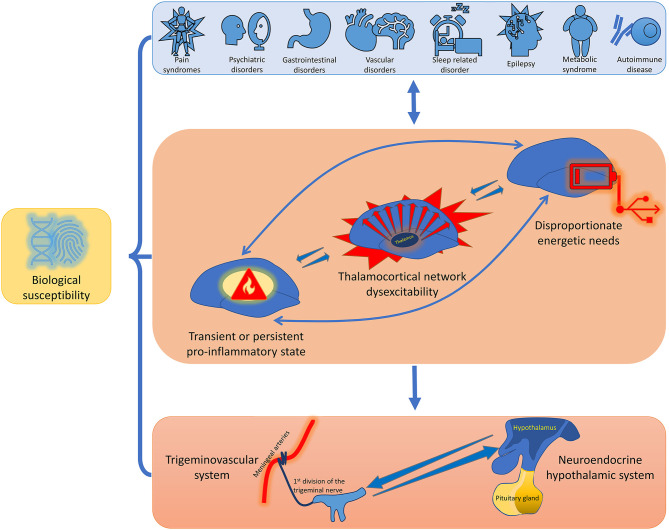
Despite that it is commonly accepted that migraine is a disorder of the nervous system with a prominent genetic basis, it is comorbid with a plethora of medical conditions. Several studies have found bidirectional comorbidity between migraine and different disorders including neurological, psychiatric, cardio- and cerebrovascular, gastrointestinal, metaboloendocrine, and immunological conditions. Each of these has its own genetic load and shares some common characteristics with migraine. The bidirectional mechanisms that are likely to underlie this extensive comorbidity between migraine and other diseases are manifold. Comorbid pathologies can induce and promote thalamocortical network dysexcitability, multi-organ transient or persistent pro-inflammatory state, and disproportionate energetic needs in a variable combination, which in turn may be causative mechanisms of the activation of an ample defensive system with includes the trigeminovascular system in conjunction with the neuroendocrine hypothalamic system. This strategy is designed to maintain brain homeostasis by regulating homeostatic needs, such as normal subcortico-cortical excitability, energy balance, osmoregulation, and emotional response. In this light, the treatment of migraine should always involves a multidisciplinary approach, aimed at identifying and, if necessary, eliminating possible risk and comorbidity factors.
尽管人们普遍认为偏头痛是一种具有显著遗传基础的神经系统疾病,但它常与多种医学病症并存。多项研究发现偏头痛与包括神经、精神、心脑血管、胃肠道、代谢内分泌和免疫病症在内的不同疾病之间存在双向共病关系。这些疾病各自都有其遗传负荷,且与偏头痛有一些共同特征。偏头痛与其他疾病之间这种广泛共病关系背后可能的双向机制是多方面的。共病病理可通过多种可变组合诱导并促进丘脑皮质网络兴奋性异常、多器官短暂或持续的促炎状态以及不成比例的能量需求,这反过来可能是激活包括三叉神经血管系统与神经内分泌下丘脑系统在内的广泛防御系统的致病机制。这种策略旨在通过调节稳态需求来维持脑内稳态,如正常的皮质下 - 皮质兴奋性、能量平衡、渗透压调节和情绪反应。鉴于此,偏头痛的治疗应始终采用多学科方法,旨在识别并在必要时消除可能的风险和共病因素。