Almeshari Wadha K, Alsubaie Alanoud K, Alanazi Reham I, Almalki Yara A, Masud Nazish, Mahmoud Sami H
College of Medicine, King Saud bin Abdulaziz University for Health Sciences, Riyadh, Saudi Arabia.
King Abdullah International Medical and Research Center, Riyadh, Saudi Arabia.
Depress Res Treat. 2021 Apr 17;2021:6652133. doi: 10.1155/2021/6652133. eCollection 2021.
Polycystic ovarian syndrome (PCOS) is an endocrinopathic disorder commonly affecting women in the reproductive age. These women have a possibility of developing depression and anxiety due to biochemical changes, concerns regarding physical appearance, and social pressure from infertility. Thus, the connection between PCOS, anxiety, and depression has a possible impact on patients' quality of life. This study is aimed at assessing depression and anxiety symptoms among PCOS patients and their association with different socioeconomic aspects.
A cross-sectional study was conducted to assess depression and anxiety symptoms on 250 PCOS patients which were selected through consecutive sampling technique. Arabic versions of the HAM-A and HAM-D questionnaires were used alongside a demographic sheet to determine the socioeconomic and fertility status.
Prevalence of anxiety symptoms was reported among 100 (40%) of women and was found to be significantly higher in single women with a prevalence of 59 (48%) (2 = 5.8, value <0.01). Also, lower-income status and unemployment were associated with a significantly higher prevalence of anxiety 18 (67%) (2 = 10.3, value =0.03) and 71 (45%) (2 = 4.5, value =0.03) women, respectively. Depressive symptoms were reported among 122 (49%) participants.
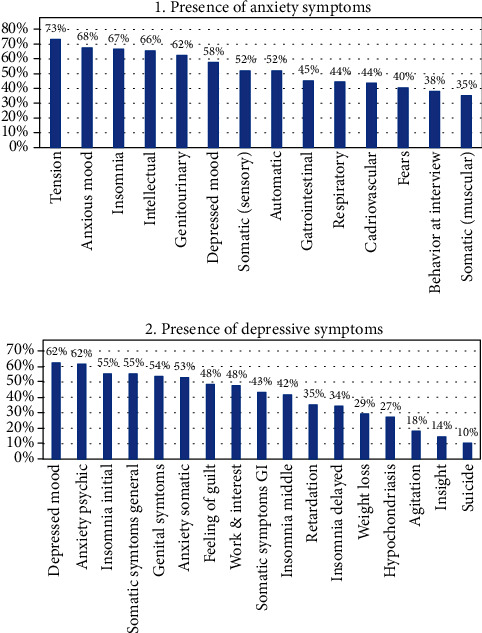
Single marital status, low income, and unemployment were predictors of anxiety. Tension was noted to be the most common anxiety symptom among participants while depressed mood and psychological anxiety were the most reported depressive symptoms. It is important to note the link between anxiety, PCOS, and depression when deciding treatment plans for affected women.
多囊卵巢综合征(PCOS)是一种常见于育龄女性的内分泌疾病。由于生化变化、对外表的担忧以及不孕带来的社会压力,这些女性有可能出现抑郁和焦虑。因此,PCOS、焦虑和抑郁之间的联系可能会对患者的生活质量产生影响。本研究旨在评估PCOS患者的抑郁和焦虑症状及其与不同社会经济因素的关联。
采用横断面研究,通过连续抽样技术选取250例PCOS患者,评估其抑郁和焦虑症状。使用阿拉伯语版的汉密尔顿焦虑量表(HAM - A)和汉密尔顿抑郁量表(HAM - D)问卷以及一份人口统计学表格来确定社会经济和生育状况。
100名(40%)女性报告有焦虑症状,其中单身女性的焦虑症状患病率显著更高,为59名(48%)(χ² = 5.8,P值<0.01)。此外,低收入状态和失业分别与焦虑患病率显著升高相关,焦虑患病率分别为18名(67%)(χ² = 10.3,P值 = 0.03)和71名(45%)(χ² = 4.5,P值 = 0.03)女性。122名(49%)参与者报告有抑郁症状。
单身婚姻状况、低收入和失业是焦虑的预测因素。紧张被认为是参与者中最常见的焦虑症状,而情绪低落和心理焦虑是最常报告的抑郁症状。在为受影响女性制定治疗方案时,注意焦虑、PCOS和抑郁之间的联系很重要。