Hospital of the University of Pennsylvania, Philadelphia, Pennsylvania.
Hospital of the University of Pennsylvania, Philadelphia, Pennsylvania.
Fertil Steril. 2019 Nov;112(5):930-938.e1. doi: 10.1016/j.fertnstert.2019.06.018. Epub 2019 Aug 5.
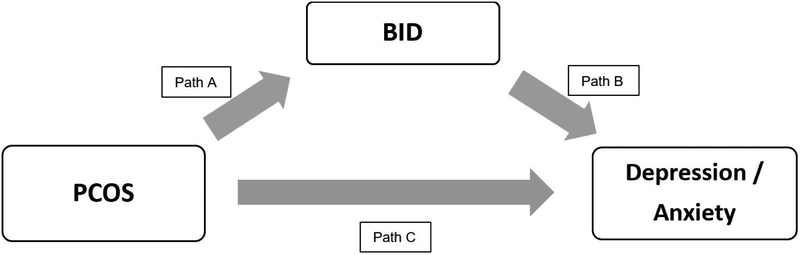
To evaluate differences in body-image distress (BID) scores between women with polycystic ovary syndrome (PCOS) and controls and whether BID mediates anxiety and depression.
Cross-sectional study.
Academic institution.
PATIENT(S): Reproductive-aged women with PCOS (n = 189) and controls (n = 225).
Administering the Multidimensional Body-Self Relations-Appearance Subscale (MBSRQ-AS), Stunkard Figure Rating Scale (FRS), Hospital Anxiety and Depression Scale (HADS), and PCOS quality of life survey (MPCOS-Q).
MAIN OUTCOME MEASURE(S): BID, depression, and anxiety scores and mediation of depression and anxiety scores by BID.
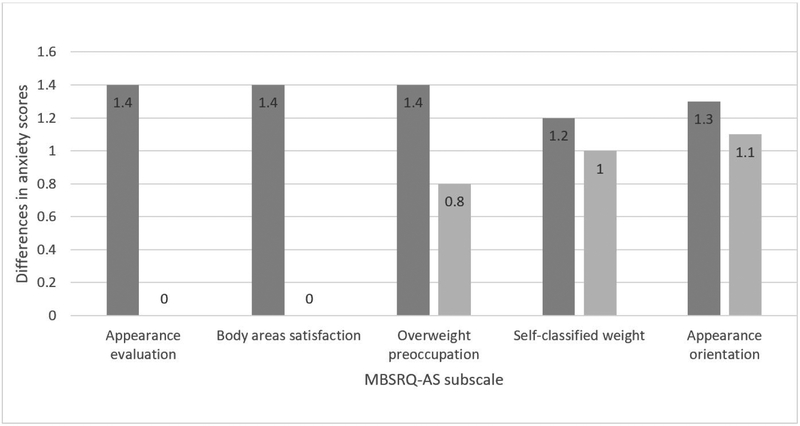
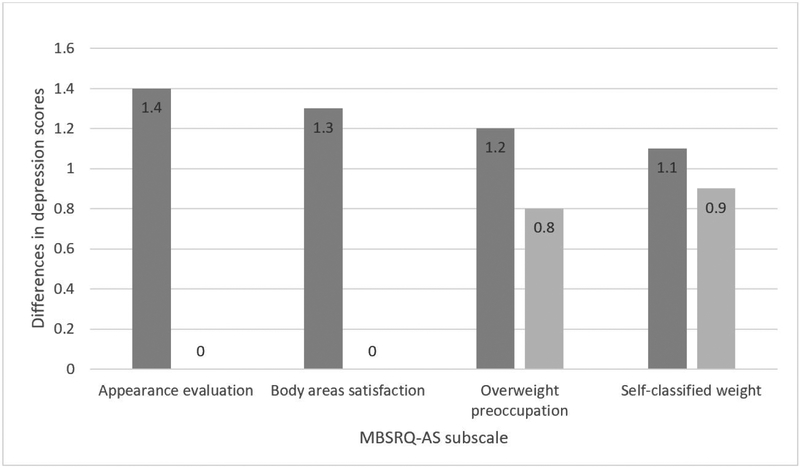
RESULT(S): Women with PCOS had worse BID scores on all five MBSRQ-AS subscales adjusted for age, body mass index, race, pregnancy history, income, and employment, and larger differences on the FRS compared with the control women. In multivariable regression models, the prevalence of depressive (28% vs. 19.2%) and anxiety (76.5% vs. 56.5%) symptoms were also statistically significantly higher in women with PCOS compared with the controls. Most MBSRQ-AS subscale scores statistically significantly correlated with depression, anxiety, and quality of life scores. The association between PCOS/control status and higher anxiety and depression scores was completely mediated by the appearance evaluation and body areas satisfaction subscales and partially mediated by overweight preoccupation, appearance orientation, and self-classified weight.
CONCLUSION(S): Women with PCOS have increased BID and depressive and anxiety symptoms. In our study different aspects of BID either fully or partially mediated the association between PCOS/control status and depression and anxiety scores, suggesting that therapeutic interventions targeted at improving body image may decrease depressive and anxiety symptoms.
评估多囊卵巢综合征(PCOS)患者与对照组之间的体像困扰(BID)评分差异,以及 BID 是否会导致焦虑和抑郁。
横断面研究。
学术机构。
患有 PCOS 的育龄期妇女(n=189)和对照组(n=225)。
使用多维身体自我关系-外貌量表(MBSRQ-AS)、斯塔克德体型评分量表(FRS)、医院焦虑抑郁量表(HADS)和多囊卵巢综合征生活质量调查(MPCOS-Q)进行评估。
BID、抑郁和焦虑评分,以及 BID 对抑郁和焦虑评分的中介作用。
在调整年龄、体重指数、种族、妊娠史、收入和就业状况后,与对照组相比,PCOS 患者的所有 MBSRQ-AS 子量表的 BID 评分均更差,FRS 评分差异更大。在多变量回归模型中,与对照组相比,PCOS 患者的抑郁(28%比 19.2%)和焦虑(76.5%比 56.5%)症状的患病率也具有统计学意义。大多数 MBSRQ-AS 子量表评分与抑郁、焦虑和生活质量评分呈统计学显著相关。PCOS/对照组状态与更高的焦虑和抑郁评分之间的关联完全由外貌评价和身体部位满意度子量表介导,部分由超重关注、外貌取向和自我分类体重介导。
PCOS 患者的 BID 以及抑郁和焦虑症状增加。在我们的研究中,BID 的不同方面完全或部分介导了 PCOS/对照组状态与抑郁和焦虑评分之间的关联,这表明针对改善体像的治疗干预可能会降低抑郁和焦虑症状。