Ye Sisi, Hu Yuanbo, Chen Chenbin, Chen Sian, Tong Xinya, Zhu Huanbo, Deng Bo, Hu Xianjing, Sun Xiangwei, Chen Xiadong, Shi Xinyu, Gu Ruihong, Xie Wangkai, Guo Gangqiang, Xing Dong, Shen Xian, Xue Xiangyang, Shen Shurong
Department of Medical Microbiology and Immunology, Wenzhou Medical University, Wenzhou, China.
Department of Precision Medical Center Laboratory, The First Affiliated Hospital of Wenzhou Medical University, Wenzhou, China.
Front Oncol. 2021 Apr 20;11:614925. doi: 10.3389/fonc.2021.614925. eCollection 2021.
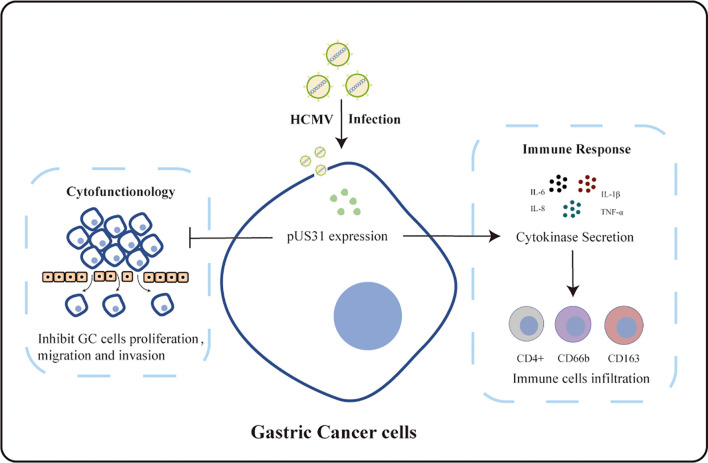
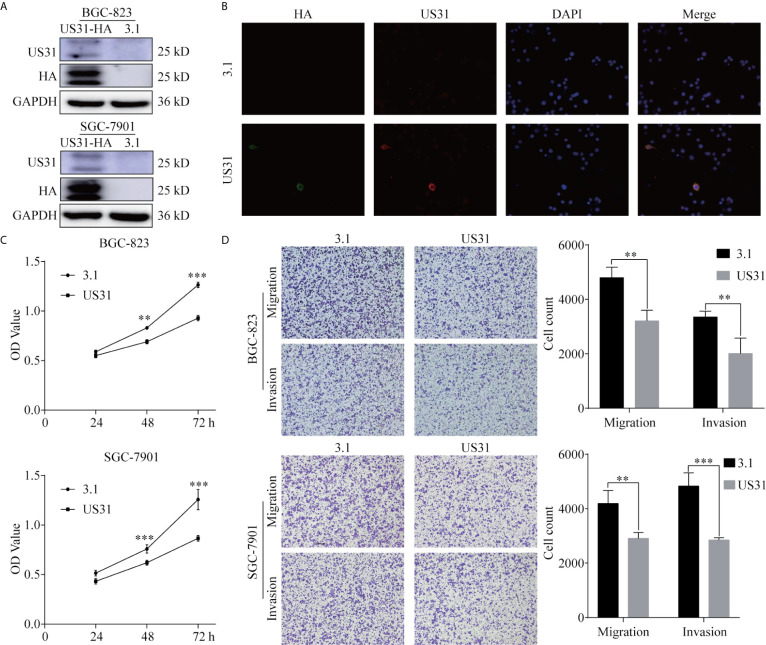
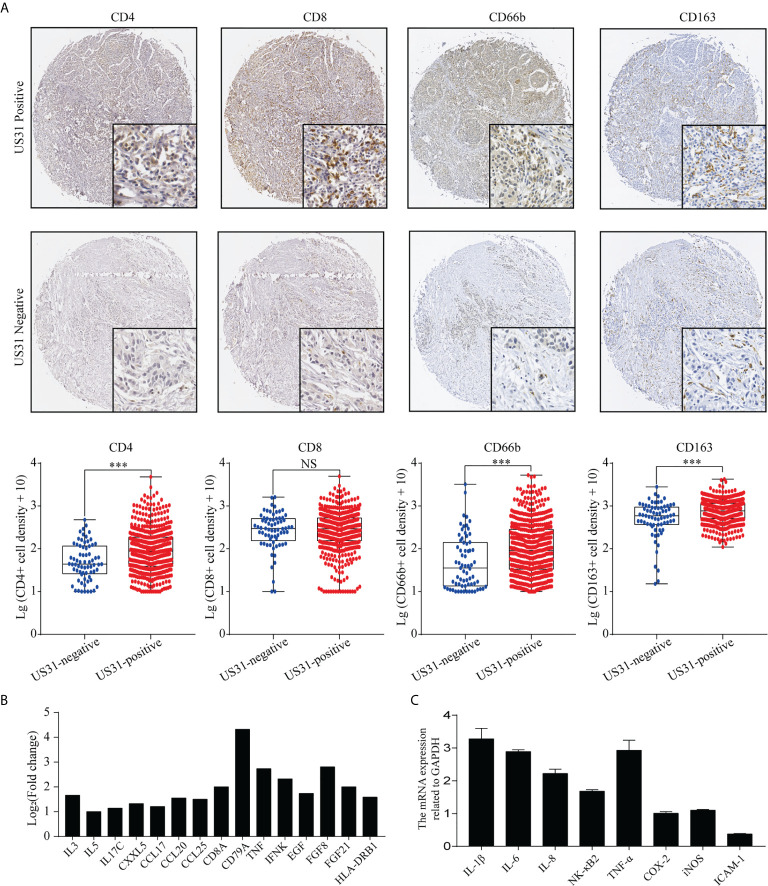
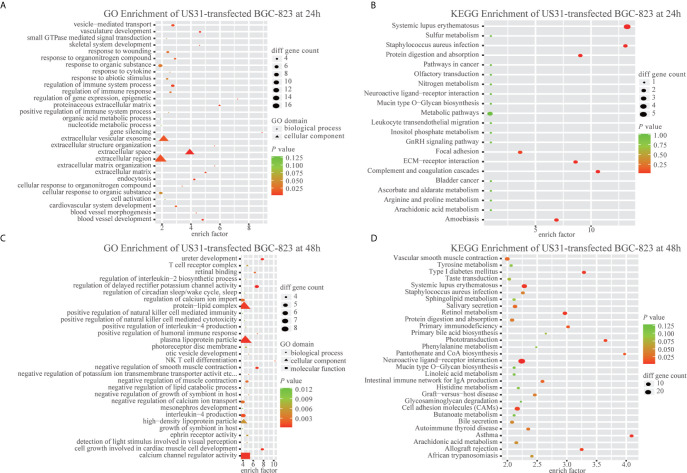
Human cytomegalovirus (HCMV) is an oncogenic virus associated with tumorigenesis. Our previous study revealed that the HCMV US31 gene interacted with NF-κB2 and mediated inflammation through macrophages. However, there are few reports on the role of US31 in gastric cancer (GC). The aim of this study was to investigate the expression of the US31 gene in GC tissue and assess its role in the occurrence and development of GC. US31 expression in 573 cancer tissues was analyzed using immunohistochemistry. Results showed that US31 was significantly associated with tumor size ( = 0.005) and distant metastasis ( < 0.001). Higher US31 expression indicated better overall survival in GC patients. Overexpression of US31 significantly inhibited the proliferation, migration, and invasion of GC cells ( < 0.05). Furthermore, expression levels of CD4, CD66b, and CD166 were positively correlated with US31, suggesting that it was involved in regulating the tumor immune microenvironment of GC. RNA sequencing, along with quantitative real-time polymerase chain reaction, confirmed that the expression of US31 promoted immune activation and secretion of inflammatory cytokines. Overall, US31 inhibited the malignant phenotype and regulated tumor immune cell infiltration in GC; these results suggest that US31 could be a potential prognostic factor for GC and may open the door for a new immunotherapy strategy.
人巨细胞病毒(HCMV)是一种与肿瘤发生相关的致癌病毒。我们之前的研究表明,HCMV US31基因与NF-κB2相互作用,并通过巨噬细胞介导炎症反应。然而,关于US31在胃癌(GC)中的作用报道较少。本研究旨在探讨US31基因在GC组织中的表达情况,并评估其在GC发生发展中的作用。采用免疫组织化学方法分析了573例癌组织中US31的表达。结果显示,US31与肿瘤大小(P = 0.005)和远处转移(P < 0.001)显著相关。US31表达较高表明GC患者的总生存期较好。US31的过表达显著抑制了GC细胞的增殖、迁移和侵袭(P < 0.05)。此外,CD4、CD66b和CD166的表达水平与US31呈正相关,表明其参与调节GC的肿瘤免疫微环境。RNA测序以及定量实时聚合酶链反应证实,US31的表达促进了免疫激活和炎性细胞因子的分泌。总体而言,US31抑制了GC的恶性表型并调节了肿瘤免疫细胞浸润;这些结果表明,US31可能是GC的一个潜在预后因素,并可能为新的免疫治疗策略打开大门。