College of Horticulture and Plant Protection, Yangzhou University, Yangzhou, JS, 225009, China.
Department of Microbiology and Plant Pathology, Institute for Integrative Genome Biology, University of California, 900 University Avenue, Riverside, CA, 92521, USA.
New Phytol. 2021 Oct;232(2):705-718. doi: 10.1111/nph.17436. Epub 2021 May 30.
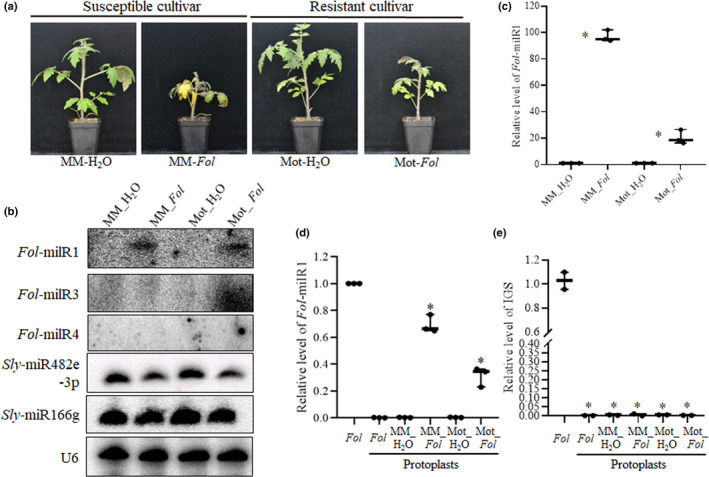
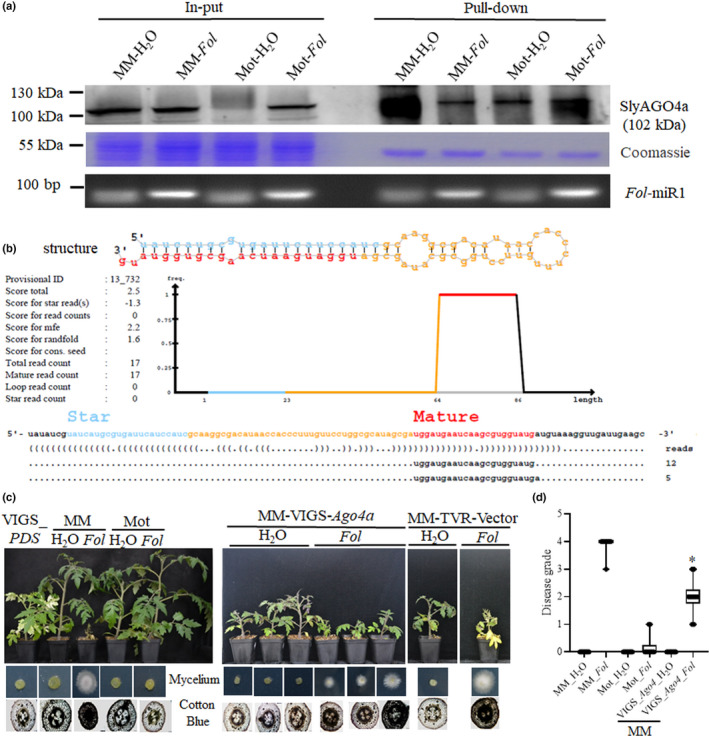
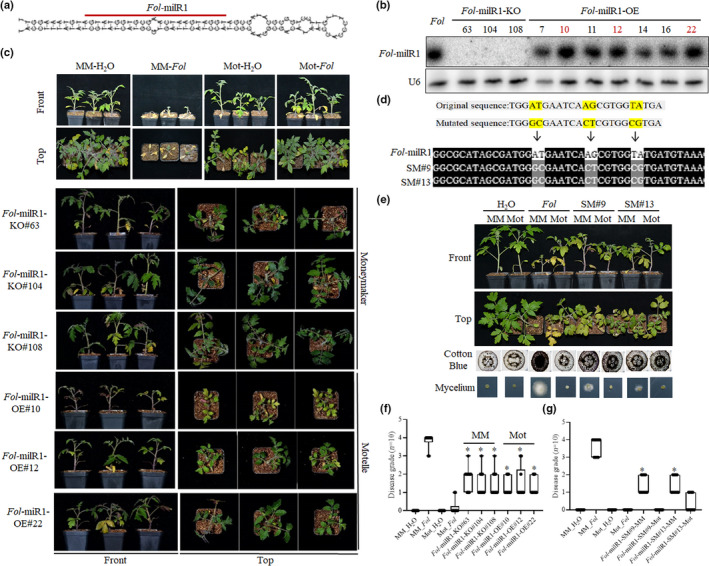
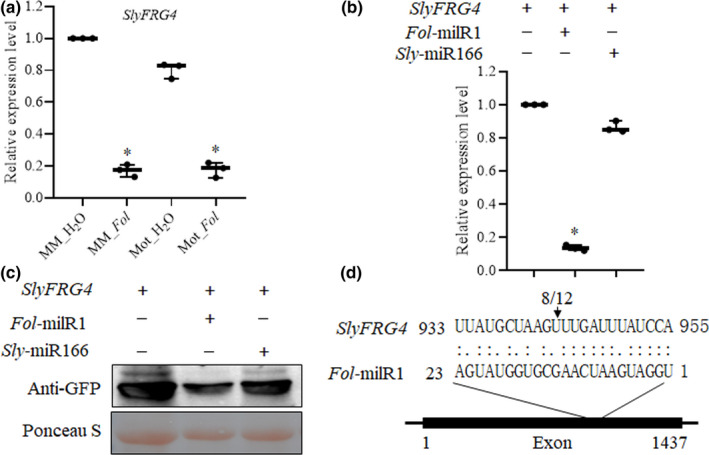
Although it is well known that miRNAs play crucial roles in multiple biological processes, there is currently no evidence indicating that milRNAs from Fusarium oxysporum f. sp. lycopersici (Fol) interfere with tomato resistance during infection. Here, using sRNA-seq, we demonstrate that Fol-milR1, a trans-kingdom small RNA, is exported into tomato cells after infection. The knockout strain ∆Fol-milR1 displays attenuated pathogenicity to the susceptible tomato cultivar 'Moneymaker'. On the other hand, Fol-milR1 overexpression strains exhibit enhanced virulence against the resistant cultivar 'Motelle'. Several tomato mRNAs are predicted targets of Fol-milR1. Among these genes, Solyc06g007430 (encoding the CBL-interacting protein kinase, SlyFRG4) is regulated at the posttranscriptional level by Fol-milR1. Furthermore, SlyFRG4 loss-of-function alleles created using CRISPR/Cas9 in tomato ('Motelle') exhibit enhanced disease susceptibility to Fol, further supporting the idea that SlyFRG4 is essential for tomato wilt disease resistance. Notably, our results using immunoprecipitation with specific antiserum suggest that Fol-milR1 interferes with the host immunity machinery by binding to tomato ARGONAUTE 4a (SlyAGO4a). Furthermore, virus-induced gene silenced (VIGS) knock-down SlyAGO4a plants exhibit reduced susceptibility to Fol. Together, our findings support a model in which Fol-milR1 is an sRNA fungal effector that suppresses host immunity by silencing a disease resistance gene, thus providing a novel virulence strategy to achieve infection.
虽然已知 miRNAs 在多种生物过程中发挥着关键作用,但目前尚无证据表明来自茄镰孢(Fusarium oxysporum f. sp. lycopersici,Fol)的 milRNAs 在感染过程中会干扰番茄的抗性。在这里,我们使用 sRNA-seq 表明,跨物种的小 RNA Fol-milR1 在感染后被输出到番茄细胞中。敲除 Fol-milR1 的突变株 ∆Fol-milR1 对易感番茄品种 'Moneymaker' 的致病性减弱。另一方面,Fol-milR1 过表达菌株对抗性品种 'Motelle' 的毒力增强。几个番茄 mRNAs 是 Fol-milR1 的预测靶标。在这些基因中,Solyc06g007430(编码 CBL 相互作用蛋白激酶,SlyFRG4)被 Fol-milR1 在转录后水平调控。此外,使用 CRISPR/Cas9 在番茄('Motelle')中创建的 SlyFRG4 功能丧失等位基因对 Fol 表现出增强的易感性,进一步支持 SlyFRG4 对番茄枯萎病抗性至关重要的观点。值得注意的是,我们使用特异性抗血清进行免疫沉淀的结果表明,Fol-milR1 通过与番茄 ARGONAUTE 4a(SlyAGO4a)结合来干扰宿主免疫机制。此外,病毒诱导的基因沉默(VIGS)敲低 SlyAGO4a 植物对 Fol 的敏感性降低。总之,我们的研究结果支持这样一种模型,即 Fol-milR1 是一种 sRNA 真菌效应子,通过沉默抗病基因来抑制宿主免疫,从而为实现感染提供了一种新的毒力策略。