The Division of Child and Adolescent Psychiatry in the Department of Psychiatry, Vagelos College of Physicians & Surgeons, Columbia University Irving Medical Center, New York, NY 10032, USA.
The Division of Child and Adolescent Psychiatry in the Department of Psychiatry, Vagelos College of Physicians & Surgeons, Columbia University Irving Medical Center, New York, NY 10032, USA.
Environ Int. 2021 Oct;155:106516. doi: 10.1016/j.envint.2021.106516. Epub 2021 May 6.
Prenatal exposure to environmental tobacco smoke (ETS) is associated with increased attention problems in children, however, the effects of such exposure on children's brain structure and function have not been studied. Herein, we probed effects of prenatal ETS on children's cognitive control circuitry and behavior.
Forty-one children (7-9 years) recruited from a prospective longitudinal birth cohort of non-smoking mothers completed structural and task-functional magnetic resonance imaging to evaluate effects of maternal ETS exposure, measured by maternal prenatal urinary cotinine. Attention problems and externalizing behaviors were measured by parent report on the Child Behavior Checklist.
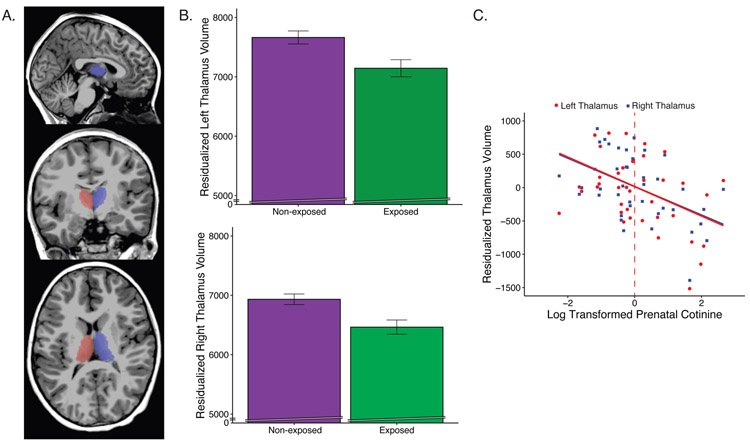
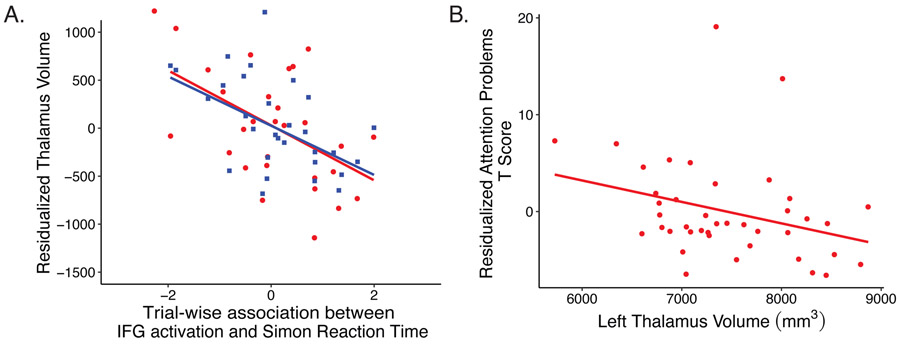
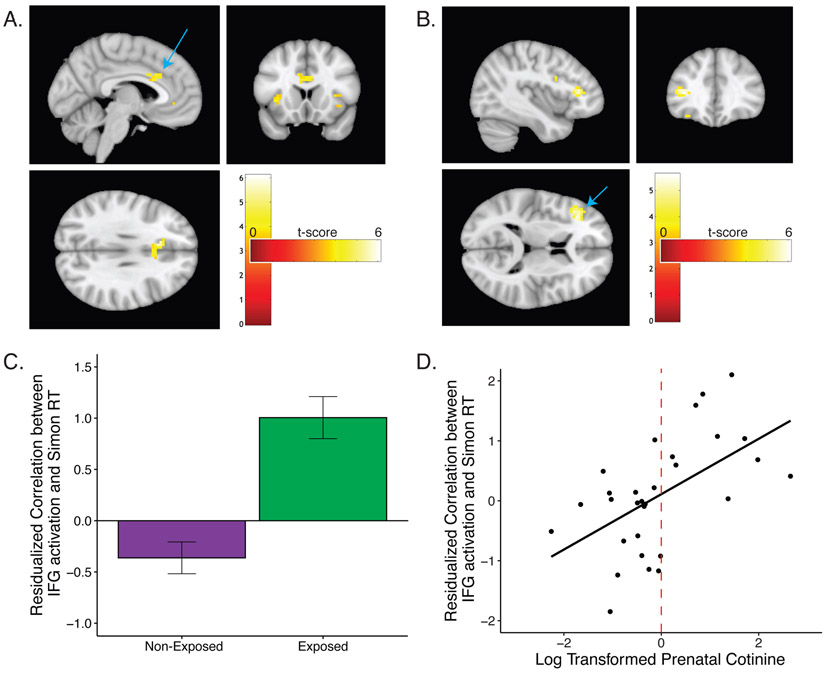
Compared to non-exposed children, exposed children had smaller left and right thalamic and inferior frontal gyrus (IFG) volumes, with large effect sizes (p-FDR < .05, Cohen's D range from 0.79 to 1.07), and increased activation in IFG during the resolution of cognitive conflict measured with the Simon Spatial Incompatibility Task (38 voxels; peak t(25) = 5.25, p-FWE = .005). Reduced thalamic volume was associated with increased IFG activation and attention problems, reflecting poor cognitive control. Mediation analyses showed a trend toward left thalamic volume mediating the association between exposure and attention problems (p = .05).
Our findings suggest that maternal ETS exposure during pregnancy has deleterious effects on the structure and function of cognitive control circuitry which in turn affects attentional capacity in school-age children. These findings are consistent with prior findings documenting the effects of active maternal smoking on chidlren's neurodevleoment, pointing to the neurotixicity of nicotine regardless of exposure pathway.
产前接触环境烟草烟雾(ETS)与儿童注意力问题增加有关,但这种暴露对儿童大脑结构和功能的影响尚未得到研究。在此,我们探讨了产前 ETS 对儿童认知控制回路和行为的影响。
从一个不吸烟母亲的前瞻性纵向出生队列中招募了 41 名儿童(7-9 岁),他们完成了结构和任务功能磁共振成像,以评估母体产前尿可替宁测量的母体 ETS 暴露对认知控制回路的影响。通过父母对儿童行为检查表的报告评估注意力问题和外化行为。
与未暴露的儿童相比,暴露的儿童的左、右侧丘脑和下额回(IFG)体积较小,具有较大的效应量(p-FDR<0.05,Cohen's D 范围为 0.79-1.07),并且在解决认知冲突时 IFG 的激活增加了使用 Simon 空间不兼容任务(38 个体素;峰值 t(25)=5.25,p-FWE=0.005)。丘脑体积减少与 IFG 激活和注意力问题增加相关,反映出认知控制不佳。中介分析表明,左丘脑体积在暴露与注意力问题之间的关联中存在中介作用的趋势(p=0.05)。
我们的研究结果表明,母亲在怀孕期间接触 ETS 会对认知控制回路的结构和功能产生有害影响,进而影响学龄儿童的注意力能力。这些发现与先前记录母亲吸烟对儿童神经发育影响的发现一致,表明尼古丁的神经毒性与暴露途径无关。