Killgore William D S, Cloonan Sara A, Taylor Emily C, Dailey Natalie S
Social, Cognitive, and Affective Neuroscience Lab, Department of Psychiatry, University of Arizona College of Medicine, Tucson, AZ, United States.
Front Psychiatry. 2021 Apr 22;12:561898. doi: 10.3389/fpsyt.2021.561898. eCollection 2021.
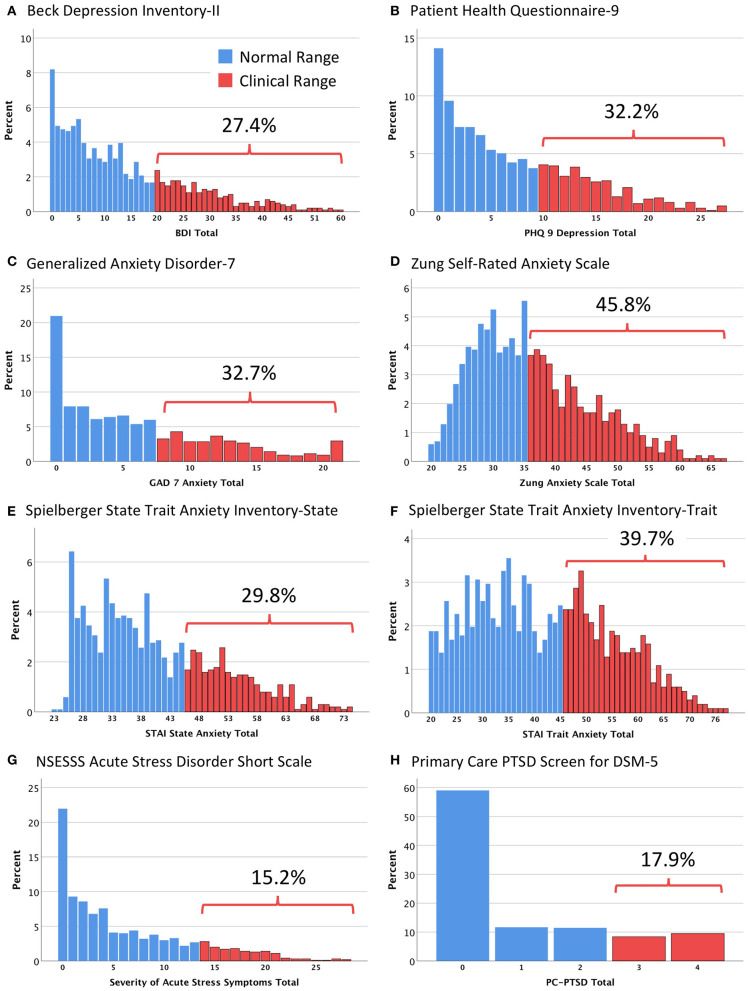
By March 2020, the World Health Organization declared the COVID-19 crisis as a worldwide pandemic and many local governments instituted stay-at-home orders and closed non-essential businesses. Within the United States, tens of millions of workers lost their jobs and financial security during the first few weeks of the national response, in an attempt to slow the global pandemic. Because of the enormity of the pandemic and its potential impact on mental health, the objective of the present study was to document the prevalence of mental health problems and their association with pandemic-related job loss during the third week of the nationwide shutdown. Mental health was assessed via online questionnaires among a representative sample of 1,013 U.S. adults on April 9-10, 2020. Rates of clinically significant mental health outcomes were compared between participants who lost their job as a result of COVID-19 restrictions (17.4%) vs. those who did not (82.6%). Bivariate multiple logistic regression identified factors that were predictive of, and protective against, mental health problems. The prevalence of clinically significant symptoms was significantly higher than prior population estimates, ranging from 27 to 32% for depression, 30 to 46% for anxiety disorders, 15 to 18% for acute/post-traumatic stress, 25% for insomnia, and 18% for suicidal ideation. Prevalence estimates were 1.5-1.7 times higher for those who reported job loss due to COVID-19 restrictions than those who did not. Mental health problems were predicted by worry over financial instability, insomnia, social isolation, and alcohol consumption, while getting outside more often, perceived social support, and older age were protective against these problems. During the first 3 weeks of lockdowns/stay-at-home restrictions, mental health problems, including depression, anxiety, insomnia, and acute stress reactions were notably elevated relative to prior population estimates. Job loss related to the nationwide shutdown was particularly associated with poorer mental health. These findings provide a baseline of mental health functioning during the first weeks of the national emergency and lockdown orders in response to COVID-19.
到2020年3月,世界卫生组织宣布新冠疫情为全球大流行,许多地方政府发布了居家令并关闭了非必要的企业。在美国,为了减缓全球疫情,数千万工人在国家应对措施的头几周失去了工作和经济保障。鉴于疫情的严重性及其对心理健康的潜在影响,本研究的目的是记录在全国停工的第三周心理健康问题的患病率及其与疫情相关失业的关联。2020年4月9日至10日,通过在线问卷对1013名美国成年人的代表性样本进行了心理健康评估。比较了因新冠疫情限制而失业的参与者(17.4%)和未失业的参与者(82.6%)之间具有临床意义的心理健康结果发生率。双变量多元逻辑回归确定了预测心理健康问题和预防心理健康问题的因素。具有临床意义的症状患病率显著高于先前的人群估计,抑郁症为27%至32%,焦虑症为30%至46%,急性/创伤后应激为15%至18%,失眠为25%,自杀意念为18%。报告因新冠疫情限制而失业的人的患病率估计比未失业的人高1.5至1.7倍。对金融不稳定的担忧、失眠、社会隔离和饮酒会预测心理健康问题,而更多地外出、感知到的社会支持和年龄较大则可预防这些问题。在封锁/居家限制的前三周,心理健康问题,包括抑郁症、焦虑症、失眠和急性应激反应相对于先前的人群估计显著增加。与全国停工相关的失业尤其与较差的心理健康有关。这些发现为应对新冠疫情的国家紧急状态和封锁令的头几周的心理健康功能提供了一个基线。