Division of Rheumatology & Clinical Immunology, University of Pittsburgh, Pittsburgh, PA, United States.
Front Immunol. 2021 Apr 21;12:671068. doi: 10.3389/fimmu.2021.671068. eCollection 2021.
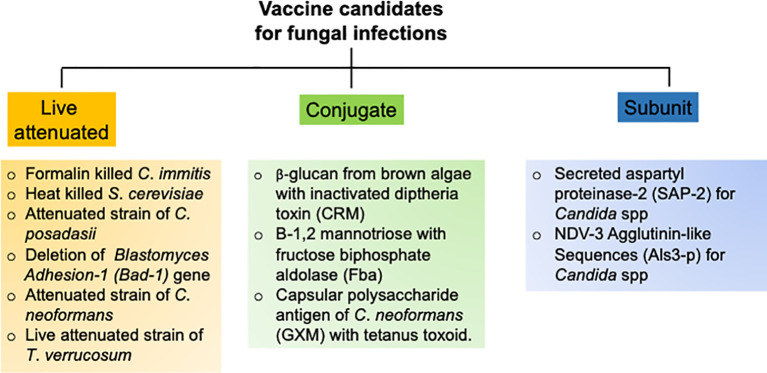
The invasive fungal infections (IFIs) are a major cause of mortality due to infectious disease worldwide. Majority of the IFIs are caused by opportunistic fungi including , and species. Lack of approved antifungal vaccines and the emergence of antifungal drug-resistant strains pose major constraints in controlling IFIs. A comprehensive understanding of the host immune response is required to develop novel fungal vaccines to prevent death from IFIs. In this review, we have discussed the challenges associated with the development of antifungal vaccines. We mentioned how host-pathogen interactions shape immunological memory and development of long-term protective immunity to IFIs. Furthermore, we underscored the contribution of long-lived innate and adaptive memory cells in protection against IFIs and summarized the current vaccine strategies.
侵袭性真菌感染(IFI)是全球传染病死亡的主要原因。大多数 IFI 是由机会性真菌引起的,包括 、 和 等物种。缺乏经过批准的抗真菌疫苗和抗真菌药物耐药株的出现,给 IFI 的控制带来了重大限制。为了开发预防 IFI 死亡的新型真菌疫苗,需要全面了解宿主免疫反应。在这篇综述中,我们讨论了开发抗真菌疫苗所面临的挑战。我们提到了宿主-病原体相互作用如何塑造免疫记忆和对 IFI 的长期保护性免疫的发展。此外,我们强调了长寿先天和适应性记忆细胞在预防 IFI 中的作用,并总结了当前的疫苗策略。