• 文献检索
  • 文档翻译
  • 深度研究
  • 学术资讯
  • Suppr Zotero 插件Zotero 插件
  • 邀请有礼
  • 套餐&价格
  • 历史记录
应用&插件
Suppr Zotero 插件Zotero 插件浏览器插件Mac 客户端Windows 客户端微信小程序
定价
高级版会员购买积分包购买API积分包
服务
文献检索文档翻译深度研究API 文档MCP 服务
关于我们
关于 Suppr公司介绍联系我们用户协议隐私条款
关注我们

Suppr 超能文献

核心技术专利:CN118964589B侵权必究
粤ICP备2023148730 号-1Suppr @ 2026

文献检索

告别复杂PubMed语法,用中文像聊天一样搜索,搜遍4000万医学文献。AI智能推荐,让科研检索更轻松。

立即免费搜索

文件翻译

保留排版,准确专业,支持PDF/Word/PPT等文件格式,支持 12+语言互译。

免费翻译文档

深度研究

AI帮你快速写综述,25分钟生成高质量综述,智能提取关键信息,辅助科研写作。

立即免费体验

使用混合学习技术通过计算机断层扫描图像预测新型冠状病毒肺炎

Prediction of COVID-19 with Computed Tomography Images using Hybrid Learning Techniques.

作者信息

Perumal Varalakshmi, Narayanan Vasumathi, Rajasekar Sakthi Jaya Sundar

机构信息

Department of Computer Technology, MIT Campus, Anna University, Chennai, India.

Melmaruvathur Adhiparasakthi Institute of Medical Sciences and Research, Melmaruvathur, Chengalpattu District, India.

出版信息

Dis Markers. 2021 Apr 22;2021:5522729. doi: 10.1155/2021/5522729. eCollection 2021.

DOI:10.1155/2021/5522729
PMID:33968281
原文链接:https://pmc.ncbi.nlm.nih.gov/articles/PMC8063851/
Abstract

Reverse Transcription Polymerase Chain Reaction (RT-PCR) used for diagnosing COVID-19 has been found to give low detection rate during early stages of infection. Radiological analysis of CT images has given higher prediction rate when compared to RT-PCR technique. In this paper, hybrid learning models are used to classify COVID-19 CT images, Community-Acquired Pneumonia (CAP) CT images, and normal CT images with high specificity and sensitivity. The proposed system in this paper has been compared with various machine learning classifiers and other deep learning classifiers for better data analysis. The outcome of this study is also compared with other studies which were carried out recently on COVID-19 classification for further analysis. The proposed model has been found to outperform with an accuracy of 96.69%, sensitivity of 96%, and specificity of 98%.

摘要

用于诊断新型冠状病毒肺炎(COVID-19)的逆转录聚合酶链反应(RT-PCR)在感染早期的检测率较低。与RT-PCR技术相比,CT图像的放射学分析具有更高的预测率。本文采用混合学习模型对COVID-19 CT图像、社区获得性肺炎(CAP)CT图像和正常CT图像进行分类,具有较高的特异性和敏感性。本文提出的系统与各种机器学习分类器和其他深度学习分类器进行了比较,以进行更好的数据分析。本研究的结果还与最近进行的其他关于COVID-19分类的研究进行了比较,以作进一步分析。结果发现,所提出的模型表现出色,准确率为96.69%,敏感性为96%,特异性为98%。
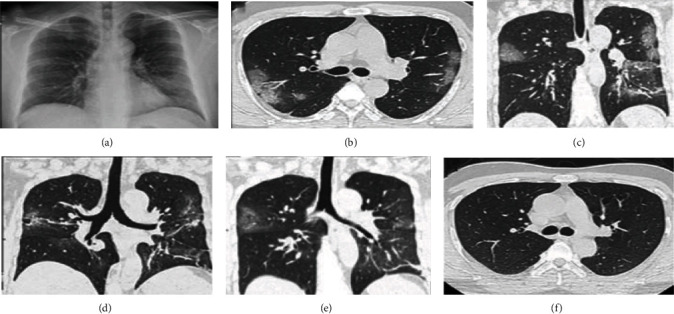
https://cdn.ncbi.nlm.nih.gov/pmc/blobs/6946/8063851/303de79be9fe/DM2021-5522729.009.jpg
https://cdn.ncbi.nlm.nih.gov/pmc/blobs/6946/8063851/60e185ae6d39/DM2021-5522729.001.jpg
https://cdn.ncbi.nlm.nih.gov/pmc/blobs/6946/8063851/c7e09a2331c1/DM2021-5522729.002.jpg
https://cdn.ncbi.nlm.nih.gov/pmc/blobs/6946/8063851/6d40342e45f3/DM2021-5522729.003.jpg
https://cdn.ncbi.nlm.nih.gov/pmc/blobs/6946/8063851/1dadc9873189/DM2021-5522729.004.jpg
https://cdn.ncbi.nlm.nih.gov/pmc/blobs/6946/8063851/1931a46a1ef7/DM2021-5522729.005.jpg
https://cdn.ncbi.nlm.nih.gov/pmc/blobs/6946/8063851/2ce3e044d3d9/DM2021-5522729.006.jpg
https://cdn.ncbi.nlm.nih.gov/pmc/blobs/6946/8063851/fc60d0d1d182/DM2021-5522729.007.jpg
https://cdn.ncbi.nlm.nih.gov/pmc/blobs/6946/8063851/b07667bc6872/DM2021-5522729.008.jpg
https://cdn.ncbi.nlm.nih.gov/pmc/blobs/6946/8063851/303de79be9fe/DM2021-5522729.009.jpg
https://cdn.ncbi.nlm.nih.gov/pmc/blobs/6946/8063851/60e185ae6d39/DM2021-5522729.001.jpg
https://cdn.ncbi.nlm.nih.gov/pmc/blobs/6946/8063851/c7e09a2331c1/DM2021-5522729.002.jpg
https://cdn.ncbi.nlm.nih.gov/pmc/blobs/6946/8063851/6d40342e45f3/DM2021-5522729.003.jpg
https://cdn.ncbi.nlm.nih.gov/pmc/blobs/6946/8063851/1dadc9873189/DM2021-5522729.004.jpg
https://cdn.ncbi.nlm.nih.gov/pmc/blobs/6946/8063851/1931a46a1ef7/DM2021-5522729.005.jpg
https://cdn.ncbi.nlm.nih.gov/pmc/blobs/6946/8063851/2ce3e044d3d9/DM2021-5522729.006.jpg
https://cdn.ncbi.nlm.nih.gov/pmc/blobs/6946/8063851/fc60d0d1d182/DM2021-5522729.007.jpg
https://cdn.ncbi.nlm.nih.gov/pmc/blobs/6946/8063851/b07667bc6872/DM2021-5522729.008.jpg
https://cdn.ncbi.nlm.nih.gov/pmc/blobs/6946/8063851/303de79be9fe/DM2021-5522729.009.jpg

相似文献

1
Prediction of COVID-19 with Computed Tomography Images using Hybrid Learning Techniques.使用混合学习技术通过计算机断层扫描图像预测新型冠状病毒肺炎
Dis Markers. 2021 Apr 22;2021:5522729. doi: 10.1155/2021/5522729. eCollection 2021.
2
Automated system for classification of COVID-19 infection from lung CT images based on machine learning and deep learning techniques.基于机器学习和深度学习技术的 COVID-19 肺部 CT 影像感染自动分类系统。
Sci Rep. 2022 Oct 18;12(1):17417. doi: 10.1038/s41598-022-20804-5.
3
Large-scale screening to distinguish between COVID-19 and community-acquired pneumonia using infection size-aware classification.利用感染大小感知分类进行大规模筛选,以区分 COVID-19 和社区获得性肺炎。
Phys Med Biol. 2021 Mar 17;66(6):065031. doi: 10.1088/1361-6560/abe838.
4
Assisting scalable diagnosis automatically via CT images in the combat against COVID-19.通过 CT 图像协助 COVID-19 疫情的大规模诊断。
Sci Rep. 2021 Feb 18;11(1):4145. doi: 10.1038/s41598-021-83424-5.
5
COVIDiag: a clinical CAD system to diagnose COVID-19 pneumonia based on CT findings.COVIDiag:一种基于 CT 表现诊断 COVID-19 肺炎的临床 CAD 系统。
Eur Radiol. 2021 Jan;31(1):121-130. doi: 10.1007/s00330-020-07087-y. Epub 2020 Aug 1.
6
Screening of COVID-19 based on the extracted radiomics features from chest CT images.基于胸部 CT 图像提取的放射组学特征对 COVID-19 进行筛查。
J Xray Sci Technol. 2021;29(2):229-243. doi: 10.3233/XST-200831.
7
Analysis of COVID-19 Infections on a CT Image Using DeepSense Model.基于 DeepSense 模型的 CT 图像中 COVID-19 感染分析。
Front Public Health. 2020 Nov 20;8:599550. doi: 10.3389/fpubh.2020.599550. eCollection 2020.
8
Early clinical and CT features of COVID-19 and community-acquired pneumonia from a fever observation ward in Ningbo, China.中国宁波发热观察病房中 COVID-19 和社区获得性肺炎的早期临床和 CT 特征。
Singapore Med J. 2022 Apr;63(4):219-224. doi: 10.11622/smedj.2021004. Epub 2021 Jan 21.
9
Classification of COVID-19 patients from chest CT images using multi-objective differential evolution-based convolutional neural networks.基于多目标差分进化卷积神经网络的胸部 CT 图像 COVID-19 患者分类。
Eur J Clin Microbiol Infect Dis. 2020 Jul;39(7):1379-1389. doi: 10.1007/s10096-020-03901-z. Epub 2020 Apr 27.
10
Classification of COVID-19 from community-acquired pneumonia: Boosting the performance with capsule network and maximum intensity projection image of CT scans.基于胶囊网络和 CT 扫描最大密度投影图像对社区获得性肺炎中 COVID-19 的分类:提高性能。
Comput Biol Med. 2023 Mar;154:106567. doi: 10.1016/j.compbiomed.2023.106567. Epub 2023 Jan 23.

引用本文的文献

1
Using fused Contourlet transform and neural features to spot COVID19 infections in CT scan images.利用融合轮廓波变换和神经特征在CT扫描图像中发现新冠病毒感染情况。
Intell Syst Appl. 2023 Feb;17:200182. doi: 10.1016/j.iswa.2023.200182. Epub 2023 Jan 13.
2
Classification of Severity of Lung Parenchyma Using Saliency and Discrete Cosine Transform Energy in Computed Tomography of Patients With COVID-19.利用显著性和离散余弦变换能量对新冠肺炎患者计算机断层扫描中的肺实质严重程度进行分类
Int J Telemed Appl. 2025 Jan 6;2025:4420410. doi: 10.1155/ijta/4420410. eCollection 2025.
3
Learning without forgetting by leveraging transfer learning for detecting COVID-19 infection from CT images.

本文引用的文献

1
COVID-19 Detection Through Transfer Learning Using Multimodal Imaging Data.利用多模态成像数据通过迁移学习进行新冠病毒疾病检测
IEEE Access. 2020 Aug 14;8:149808-149824. doi: 10.1109/ACCESS.2020.3016780. eCollection 2020.
2
Classification of COVID-19 in chest X-ray images using DeTraC deep convolutional neural network.使用DeTraC深度卷积神经网络对胸部X光图像中的新冠肺炎进行分类。
Appl Intell (Dordr). 2021;51(2):854-864. doi: 10.1007/s10489-020-01829-7. Epub 2020 Sep 5.
3
Automatic detection of coronavirus disease (COVID-19) using X-ray images and deep convolutional neural networks.
利用迁移学习从 CT 图像中检测 COVID-19 感染,实现无遗忘学习。
Sci Rep. 2023 May 25;13(1):8516. doi: 10.1038/s41598-023-34908-z.
4
Deep-Learning-Based COVID-19 Diagnosis and Implementation in Embedded Edge-Computing Device.基于深度学习的新冠病毒疾病诊断及在嵌入式边缘计算设备中的实现
Diagnostics (Basel). 2023 Apr 3;13(7):1329. doi: 10.3390/diagnostics13071329.
5
Combined Cloud-Based Inference System for the Classification of COVID-19 in CT-Scan and X-Ray Images.用于CT扫描和X光图像中COVID-19分类的基于云的联合推理系统
New Gener Comput. 2023;41(1):61-84. doi: 10.1007/s00354-022-00195-x. Epub 2022 Nov 20.
6
CVD-HNet: Classifying Pneumonia and COVID-19 in Chest X-ray Images Using Deep Network.CVD-HNet:使用深度网络对胸部X光图像中的肺炎和新冠肺炎进行分类
Wirel Pers Commun. 2022;126(4):3279-3303. doi: 10.1007/s11277-022-09864-y. Epub 2022 Jun 19.
7
Review and classification of AI-enabled COVID-19 CT imaging models based on computer vision tasks.基于计算机视觉任务的人工智能赋能 COVID-19 CT 成像模型的回顾与分类。
Comput Biol Med. 2022 Feb;141:105123. doi: 10.1016/j.compbiomed.2021.105123. Epub 2021 Dec 18.
8
Role of Artificial Intelligence in COVID-19 Detection.人工智能在 COVID-19 检测中的作用。
Sensors (Basel). 2021 Dec 1;21(23):8045. doi: 10.3390/s21238045.
9
Detection of COVID-19 findings by the local interpretable model-agnostic explanations method of types-based activations extracted from CNNs.通过基于卷积神经网络(CNNs)提取的基于类型激活的局部可解释模型无关解释方法检测2019冠状病毒病(COVID-19)结果。
Biomed Signal Process Control. 2022 Jan;71:103128. doi: 10.1016/j.bspc.2021.103128. Epub 2021 Sep 2.
使用X射线图像和深度卷积神经网络自动检测冠状病毒病(COVID-19)。
Pattern Anal Appl. 2021;24(3):1207-1220. doi: 10.1007/s10044-021-00984-y. Epub 2021 May 9.
4
Deep Learning Enables Accurate Diagnosis of Novel Coronavirus (COVID-19) With CT Images.深度学习利用 CT 图像准确诊断新型冠状病毒(COVID-19)。
IEEE/ACM Trans Comput Biol Bioinform. 2021 Nov-Dec;18(6):2775-2780. doi: 10.1109/TCBB.2021.3065361. Epub 2021 Dec 8.
5
Diagnosis of COVID-19 using CT scan images and deep learning techniques.使用 CT 扫描图像和深度学习技术诊断 COVID-19。
Emerg Radiol. 2021 Jun;28(3):497-505. doi: 10.1007/s10140-020-01886-y. Epub 2021 Feb 1.
6
COVID-CAPS: A capsule network-based framework for identification of COVID-19 cases from X-ray images.COVID-CAPS:一种基于胶囊网络的从X射线图像识别新冠肺炎病例的框架。
Pattern Recognit Lett. 2020 Oct;138:638-643. doi: 10.1016/j.patrec.2020.09.010. Epub 2020 Sep 16.
7
Covid-19: automatic detection from X-ray images utilizing transfer learning with convolutional neural networks.新冠病毒(Covid-19):利用卷积神经网络的迁移学习从 X 光图像中自动检测。
Phys Eng Sci Med. 2020 Jun;43(2):635-640. doi: 10.1007/s13246-020-00865-4. Epub 2020 Apr 3.
8
Evolution of Computed Tomography Manifestations in Five Patients Who Recovered from Coronavirus Disease 2019 (COVID-19) Pneumonia.5例新型冠状病毒肺炎(COVID-19)康复患者的计算机断层扫描表现演变
Korean J Radiol. 2020 May;21(5):614-619. doi: 10.3348/kjr.2020.0157. Epub 2020 Mar 13.
9
Radiological findings from 81 patients with COVID-19 pneumonia in Wuhan, China: a descriptive study.中国武汉 81 例新冠肺炎患者的放射学特征:一项描述性研究。
Lancet Infect Dis. 2020 Apr;20(4):425-434. doi: 10.1016/S1473-3099(20)30086-4. Epub 2020 Feb 24.
10
Correlation of Chest CT and RT-PCR Testing for Coronavirus Disease 2019 (COVID-19) in China: A Report of 1014 Cases.中国 2019 年冠状病毒病(COVID-19)的胸部 CT 与 RT-PCR 检测的相关性:1014 例报告。
Radiology. 2020 Aug;296(2):E32-E40. doi: 10.1148/radiol.2020200642. Epub 2020 Feb 26.