Schmidt Stefanie J, Barblan Lara P, Lory Irina, Landolt Markus A
Department of Clinical Psychology and Psychotherapy, University of Bern, Bern, Switzerland.
Division of Child and Adolescent Health Psychology, Department of Psychology, University of Zurich, Zurich, Switzerland.
Eur J Psychotraumatol. 2021 Apr 16;12(1):1901407. doi: 10.1080/20008198.2021.1901407.
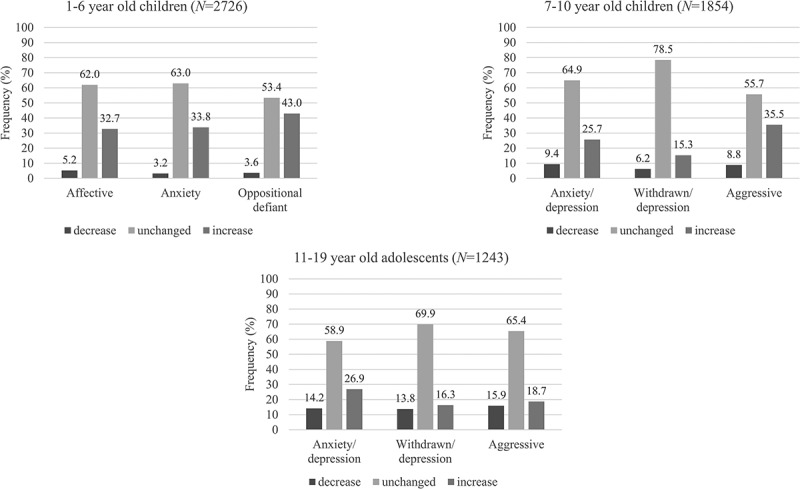
: Children and adolescents are affected in various ways by the lockdown measures due to the COVID-19 pandemic. Therefore, it is crucial to better understand the effects of the COVID-19 pandemic on mental health in this age-group. : The objective was to investigate and compare the effects of the COVID-19 pandemic on mental health in three age groups (1-6 years, 7-10 years, 11-19 years) and to examine the associations with psychological factors. : An anonymous online survey was conducted from 9 April to 11 May 2020 during the acute phase of major lockdown measures. In this cross-sectional study, children and adolescents aged between 1 and 19 years were recruited as a population-based sample. They were eligible if they were residents in Austria, Germany, Liechtenstein or Switzerland, were parents/caregivers of a child aged between 1 and 10 years or adolescents ≥11 years, had sufficient German language skills and provided informed consent. : Among 5823 participants, between 2.2% and 9.9% reported emotional and behavioural problems above the clinical cut-off and between 15.3% and 43.0% reported an increase in these problems during the pandemic. Significant age-related effects were found regarding the type and frequency of problems (χ ≥50.2, ≤ 0.001). While preschoolers (1-6 years) had the largest increase in oppositional-defiant behaviours, adolescents reported the largest increase in emotional problems. Adolescents experienced a significantly larger decrease in emotional and behavioural problems than both preschoolers and school-children. Sociodemographic variables, exposure to and appraisal of COVID-19, psychotherapy before COVID-19 and parental mental health significantly predicted change in problem-scores (F ≥ 3.69, ≤ 0.001). : A substantial proportion of children and adolescents experience age-related mental health problems during the COVID-19 pandemic. These problems should be monitored, and support should be offered to risk-groups to improve communication, emotion regulation and appraisal style.
由于新冠疫情实施的封锁措施以多种方式影响着儿童和青少年。因此,更深入了解新冠疫情对这个年龄段心理健康的影响至关重要。
目的是调查和比较新冠疫情对三个年龄组(1至6岁、7至10岁、11至19岁)心理健康的影响,并研究其与心理因素的关联。
在主要封锁措施的急性期,于2020年4月9日至5月11日进行了一项匿名在线调查。在这项横断面研究中,招募了1至19岁的儿童和青少年作为基于人群的样本。他们符合条件的标准是:居住在奥地利、德国、列支敦士登或瑞士;是1至10岁儿童的父母/照料者或11岁及以上青少年的父母/照料者;具备足够的德语能力并提供知情同意书。
在5823名参与者中,2.2%至9.9%的人报告有高于临床临界值的情绪和行为问题,15.3%至43.0%的人报告在疫情期间这些问题有所增加。在问题类型和频率方面发现了显著的年龄相关效应(χ≥50.2,P≤0.001)。虽然学龄前儿童(1至6岁)的对立违抗行为增加幅度最大,但青少年报告的情绪问题增加幅度最大。青少年在情绪和行为问题上的减少幅度明显大于学龄前儿童和学龄儿童。社会人口统计学变量、对新冠疫情的接触和认知、新冠疫情之前的心理治疗以及父母的心理健康状况显著预测了问题得分的变化(F≥3.69,P≤0.001)。
在新冠疫情期间,相当一部分儿童和青少年经历了与年龄相关的心理健康问题。这些问题应受到监测,应向风险群体提供支持,以改善沟通、情绪调节和认知方式。