Faculty of Economics and Business, University of Talca, Talca, Chile.
Front Public Health. 2021 Apr 21;9:626852. doi: 10.3389/fpubh.2021.626852. eCollection 2021.
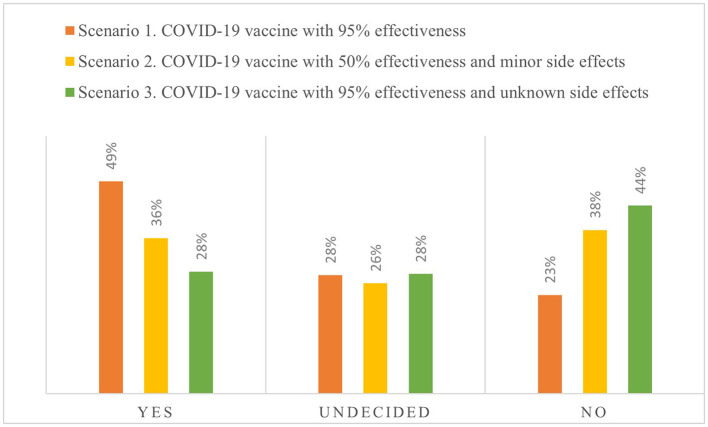
Considering the global prevalence of coronavirus disease 2019 (COVID-19), a vaccine is being developed to control the disease as a complementary solution to hygiene measures-and better, in social terms, than social distancing. Given that a vaccine will eventually be produced, information will be needed to support a potential campaign to promote vaccination. The aim of this study was to determine the variables affecting the likelihood of refusal and indecision toward a vaccine against COVID-19 and to determine the acceptance of the vaccine for different scenarios of effectiveness and side effects. A multinomial logistic regression method based on the Health Belief Model was used to estimate the current methodology, using data obtained by an online anonymous survey of 370 respondents in Chile. The results indicate that 49% of respondents were willing to be vaccinated, with 28% undecided or 77% of individuals who would potentially be willing to be inoculated. The main variables that explained the probability of rejection or indecision were associated with the severity of COVID-19, such as, the side effects and effectiveness of the vaccine; perceived benefits, including immunity, decreased fear of contagion, and the protection of oneself and the environment; action signals, such as, responses from ones' family and the government, available information, and specialists' recommendations; and susceptibility, including the contagion rate per 1,000 inhabitants and relatives with COVID-19, among others. Our analysis of hypothetical vaccine scenarios revealed that individuals preferred less risky vaccines in terms of fewer side effects, rather than effectiveness. Additionally, the variables that explained the indecision toward or rejection of a potential COVID-19 vaccine could be used in designing public health policies. We discovered that it is necessary to formulate specific, differentiated vaccination-promotion strategies for the anti-vaccine and undecided groups based on the factors that explain the probability of individuals refusing or expressing hesitation toward vaccination.
考虑到 2019 年冠状病毒病(COVID-19)在全球的流行,正在开发疫苗作为控制疾病的补充措施——在社交方面比社交距离更好。鉴于最终将生产疫苗,将需要信息来支持潜在的疫苗接种宣传活动。本研究的目的是确定影响拒绝和对 COVID-19 疫苗犹豫不决的可能性的变量,并确定对不同有效性和副作用方案的疫苗的接受程度。使用基于健康信念模型的多变量逻辑回归方法来估计当前的方法,使用智利 370 名受访者通过在线匿名调查获得的数据。结果表明,49%的受访者愿意接种疫苗,28%的受访者犹豫不决,77%的潜在愿意接种疫苗的人。解释拒绝或犹豫不决概率的主要变量与 COVID-19 的严重程度相关,例如疫苗的副作用和有效性;感知益处,包括免疫力、降低对传染的恐惧以及保护自己和环境;行动信号,例如来自家庭和政府的反应、可用信息和专家建议;以及易感性,包括每 1000 名居民的感染率和患有 COVID-19 的亲属等。我们对假设的疫苗情况进行了分析,发现人们更喜欢副作用较少的风险较低的疫苗,而不是有效性。此外,解释对潜在 COVID-19 疫苗犹豫不决或拒绝的变量可用于制定公共卫生政策。我们发现,有必要根据解释个人拒绝或对疫苗犹豫不决的概率的因素,为反疫苗接种者和犹豫不决者制定具体的、有区别的疫苗推广策略。