Medical Zoology Pole, Institut Pasteur de Dakar, Dakar, Sénégal.
Institute of Molecular Biology and Biotechnology, Foundation for Research and Technology Crete, Greece.
PLoS Negl Trop Dis. 2021 May 10;15(5):e0009393. doi: 10.1371/journal.pntd.0009393. eCollection 2021 May.
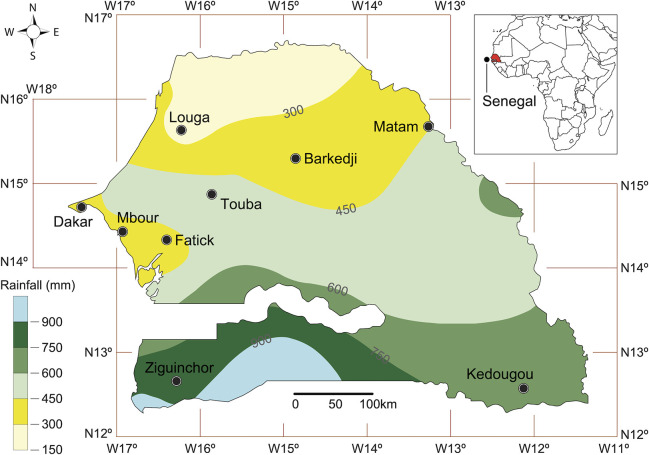
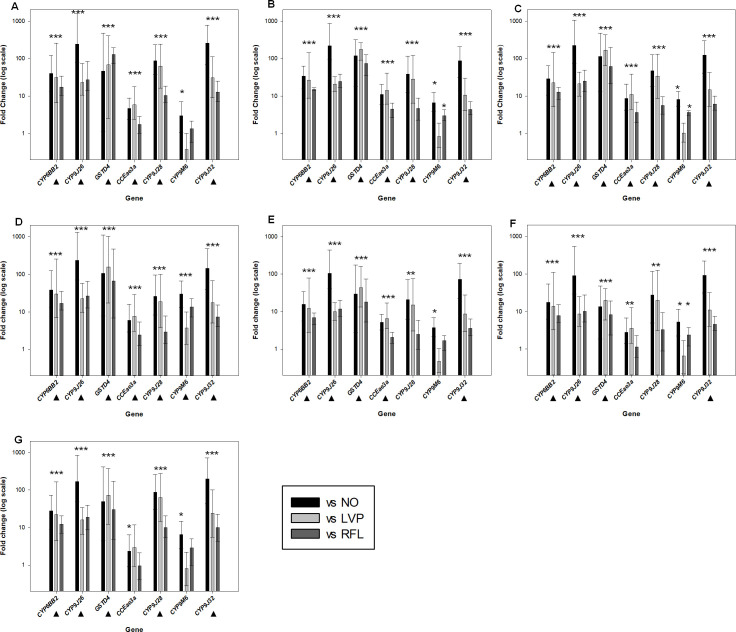
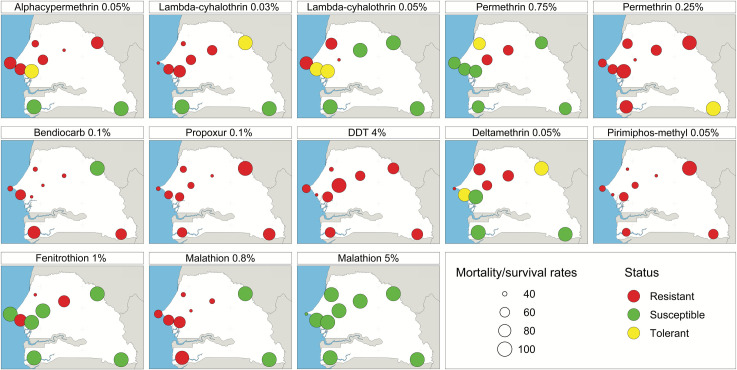
Aedes aegypti is the main epidemic vector of arboviruses in Africa. In Senegal, control activities are mainly limited to mitigation of epidemics, with limited information available for Ae. aegypti populations. A better understanding of the current Ae. aegypti susceptibility status to various insecticides and relevant resistance mechanisms involved is needed for the implementation of effective vector control strategies. The present study focuses on the detection of insecticide resistance and reveals the related mechanisms in Ae. aegypti populations from Senegal. Bioassays were performed on Ae. aegypti adults from nine Senegalese localities (Matam, Louga, Barkedji, Ziguinchor, Mbour, Fatick, Dakar, Kédougou and Touba). Mosquitoes were exposed to four classes of insecticides using the standard WHO protocols. Resistance mechanisms were investigated by genotyping for pyrethroid target site resistance mutations (V1016G, V1016I, F1534C and S989P) and measuring gene expression levels of key detoxification genes (CYP6BB2, CYP9J26, CYP9J28, CYP9J32, CYP9M6, CCEae3a and GSTD4). All collected populations were resistant to DDT and carbamates except for the ones in Matam (Northern region). Resistance to permethrin was uniformly detected in mosquitoes from all areas. Except for Barkédji and Touba, all populations were characterized by a susceptibility to 0.75% Permethrin. Susceptibility to type II pyrethroids was detected only in the Southern regions (Kédougou and Ziguinchor). All mosquito populations were susceptible to 5% Malathion, but only Kédougou and Matam mosquitoes were susceptible to 0.8% Malathion. All populations were resistant to 0.05% Pirimiphos-methyl, whereas those from Louga, Mbour and Barkédji, also exhibited resistance to 1% Fenitrothion. None of the known target site pyrethroid resistance mutations was present in the mosquito samples included in the genotyping analysis (performed in > 1500 samples). In contrast, a remarkably high (20-70-fold) overexpression of major detoxification genes was observed, suggesting that insecticide resistance is mostly mediated through metabolic mechanisms. These data provide important evidence to support dengue vector control in Senegal.
埃及伊蚊是非洲虫媒病毒的主要流行媒介。在塞内加尔,控制活动主要限于减轻疫情,关于埃及伊蚊种群的信息有限。为了实施有效的病媒控制策略,需要更好地了解当前埃及伊蚊对各种杀虫剂的敏感性状况和相关的抗性机制。本研究重点关注埃及伊蚊种群的杀虫剂抗性检测,并揭示了塞内加尔埃及伊蚊种群的相关机制。在九个塞内加尔地方(马塔姆、卢加、巴克尔迪、济金绍尔、姆布尔、法蒂克、达喀尔、凯杜古和图巴)进行了成蚊生物测定。使用世界卫生组织标准方案对蚊子进行了四类杀虫剂的接触试验。通过基因分型检测到与拟除虫菊酯靶标抗性突变(V1016G、V1016I、F1534C 和 S989P)和关键解毒基因(CYP6BB2、CYP9J26、CYP9J28、CYP9J32、CYP9M6、CCEae3a 和 GSTD4)的表达水平来研究抗性机制。除了马塔姆(北部地区)外,所有采集的种群对滴滴涕和氨基甲酸酯类均具有抗性。除了巴克尔迪和图巴外,所有地区的蚊子均对 0.75%的氯菊酯表现出抗性。仅在南部地区(凯杜古和济金绍尔)检测到对 II 型拟除虫菊酯的敏感性。所有蚊子种群对 5%马拉硫磷均敏感,但只有凯杜古和马塔姆的蚊子对 0.8%马拉硫磷敏感。所有种群对 0.05%吡虫啉均有抗性,而卢加、姆布尔和巴克尔迪的种群对 1%的毒死蜱也有抗性。在基因分型分析中(在 > 1500 个样本中进行),未发现蚊子样本中存在已知的靶标拟除虫菊酯抗性突变。相反,主要解毒基因的过表达非常显著(20-70 倍),表明杀虫剂抗性主要通过代谢机制介导。这些数据为支持塞内加尔登革热病媒控制提供了重要证据。