Kasman Kasman, Ishak Hasanuddin, Alam Gemini, Amiruddin Ridwan, Hastutiek Poedji, Arsin Andi A, Nasir Sudirman, Ridha Muhammad R, Wahid Isra
Doctoral Program in Public Health Sciences, Faculty of Public Health, Universitas Hasanuddin, Makassar, Indonesia.
Department of Epidemiology, Faculty of Public Health, Universitas Islam Kalimantan, Banjarmasin, Indonesia.
Narra J. 2025 Apr;5(1):e1819. doi: 10.52225/narra.v5i1.1819. Epub 2025 Apr 17.
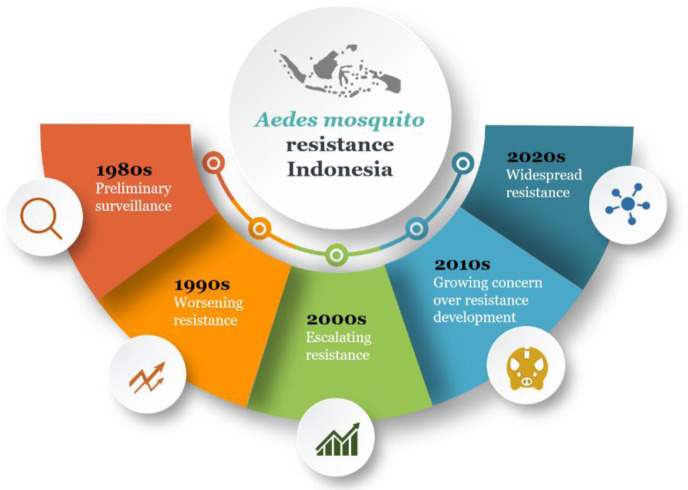
Dengue fever remains a major public health threat in Indonesia, exacerbated by rising insecticide resistance in Strategies relying on chemical insecticides, while initially effective, have led to widespread resistance in mosquito populations. This resistance is particularly pronounced in areas such as Java, where the extensive use of insecticides, including organophosphates and pyrethroids, has been documented. To address this challenge, one promising alternative is the utilization of biolarvicides derived from local Indonesian plant materials. Biolarvicides are environmentally friendly, safe, and have the potential to mitigate the adverse impacts associated with chemical insecticides. Numerous studies have explored the larvicidal properties of indigenous plants native to Indonesia, demonstrating their efficacy against The aim of this study was to examine insecticide resistance in mosquitoes across Indonesia, highlighting geographical variations and underexplored regions, and exploring plant- based biolarvicides as sustainable alternatives. Biolarvicides derived from native Indonesian plants could be eco-friendly alternative for dengue vector management. Their integration into existing control strategies could significantly enhance efforts to control dengue while reducing the environmental and health risks posed by chemical insecticides.
登革热仍然是印度尼西亚的一个主要公共卫生威胁,由于蚊虫抗药性上升而加剧。依赖化学杀虫剂的策略虽然最初有效,但已导致蚊虫种群产生广泛抗药性。这种抗药性在爪哇等地区尤为明显,在这些地区,包括有机磷和拟除虫菊酯在内的杀虫剂的大量使用已有记录。为应对这一挑战,一个有前景的替代方法是利用源自印度尼西亚当地植物材料的生物杀幼虫剂。生物杀幼虫剂对环境友好、安全,并有减轻与化学杀虫剂相关的不利影响的潜力。许多研究探讨了印度尼西亚本土植物的杀幼虫特性,证明了它们对登革热媒介的有效性。本研究的目的是检测印度尼西亚各地蚊虫的抗药性,突出地理差异和未充分探索的地区,并探索基于植物的生物杀幼虫剂作为可持续替代方案。源自印度尼西亚本土植物的生物杀幼虫剂可能是登革热媒介管理的环保替代方案。将它们纳入现有控制策略可显著加强登革热控制工作,同时降低化学杀虫剂对环境和健康造成的风险。