Bekana Teshome, Berhe Nega, Eguale Tadesse, Aemero Mulugeta, Medhin Girmay, Tulu Begna, G/Hiwot Yirgalem, Liang Song, Hu Wei, Erko Berhanu
Aklilu Lemma Institute of Pathobiology, Addis Ababa University, Addis Ababa, Ethiopia.
Department of Biomedical Sciences, Faculty of Public Health and Medical Science, Mettu University, Mettu, Ethiopia.
Trop Med Health. 2021 May 11;49(1):35. doi: 10.1186/s41182-021-00326-y.
Schistosomiasis and fascioliasis are digenean parasitic infections and are among the neglected tropical diseases that have both medical and veterinary importance. They are found mainly in areas having limited access to safe water supply and improved sanitation.
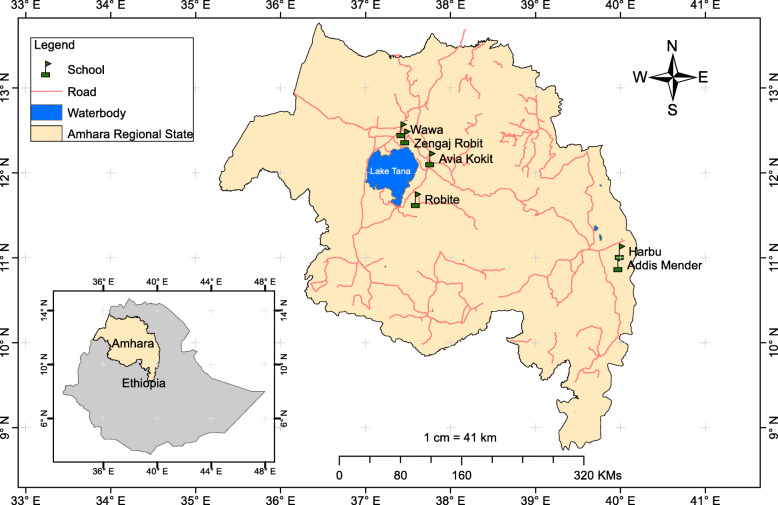
A cross-sectional study was conducted to determine the prevalence of Schistosoma mansoni and Fasciola species infections and to identify associated risk factors among school children in Amhara Regional State, Ethiopia. Stool specimens were collected from 798 children (419 males, 379 females) and processed using Kato-Katz and formol-ether concentration techniques. A semi-structured questionnaire was used to collect socio-demographic and other exposure information to explore potential risk factors for the infections.
The overall prevalence of S. mansoni and Fasciola species infections was 25.6% (95% confidence interval (CI): 22.5-28.6) and 5.5% (95% CI: 3.9-7.1), respectively. S. mansoni was present in all surveyed schools with the prevalence ranging from 12.8% (16/125; 95% CI = 5.6-20.0) to 39.7% (64/161; 95% CI = 32.2-47.2) while Fasciola species was identified in five schools with the prevalence ranging from 2.5% (4/160; 95% CI = 0.001-4.9) to 9.8% (13/133; 95% CI = 4.7-14.8). The prevalence of S. mansoni infection was significantly associated with swimming in rivers (Adjusted odds ratio (AOR): 1.79, 95% CI, 1.22-2.62; P=0.003), bathing in open freshwater bodies (AOR, 2.02; 95% CI, 1.39-2.94; P<0.001) and engaging in irrigation activities (AOR, 1.69; 95% CI, 1.19-2.39; P=0.004), and was higher in children attending Addis Mender (AOR, 2.56; 95% CI, 1.20-5.46; P=0.015 ) and Harbu schools (AOR, 3.53; 95% CI, 1.64-7.59; P=0.001). Fasciola species infection was significantly associated with consumption of raw vegetables (AOR, 2.47; 95% CI, 1.23-4.97; P=0.011) and drinking water from unimproved sources (AOR, 2.28; 95% CI, 1.11-4.70; P=0.026).
Both intestinal schistosomiasis and human fascioliasis are prevalent in the study area, affecting school children. Behaviors and access to unimproved water and sanitation are among significant risk factors. The findings are instrumental for targeted interventions.
血吸虫病和肝片吸虫病是双口吸虫寄生虫感染,属于被忽视的热带疾病,对医学和兽医领域均具有重要意义。它们主要在安全供水和卫生条件改善受限的地区被发现。
开展了一项横断面研究,以确定埃塞俄比亚阿姆哈拉州学龄儿童中曼氏血吸虫和肝片吸虫属感染的患病率,并识别相关风险因素。从798名儿童(419名男性,379名女性)收集粪便标本,并采用加藤-厚涂片法和甲醛乙醚浓缩技术进行处理。使用半结构化问卷收集社会人口统计学和其他暴露信息,以探究感染的潜在风险因素。
曼氏血吸虫和肝片吸虫属感染的总体患病率分别为25.6%(95%置信区间(CI):22.5 - 28.6)和5.5%(95%CI:3.9 - 7.1)。在所有接受调查的学校均发现了曼氏血吸虫,患病率从12.8%(16/125;95%CI = 5.6 - 20.0)到39.7%(64/161;95%CI = 32.2 - 47.2)不等,而在五所学校发现了肝片吸虫属,患病率从2.5%(4/160;95%CI = 0.001 - 4.9)到9.8%(13/133;95%CI = 4.7 - 14.8)不等。曼氏血吸虫感染的患病率与在河中游泳(调整优势比(AOR):1.79,95%CI,1.22 - 2.62;P = 0.003)、在露天淡水体中沐浴(AOR,2.02;95%CI,1.39 - 2.94;P < 0.001)以及从事灌溉活动(AOR,1.69;95%CI,1.19 - 2.39;P = 0.004)显著相关,并且在就读于阿迪斯门德学校(AOR,2.56;95%CI,1.20 - 5.46;P = 0.015)和哈尔布学校的儿童中更高(AOR,3.53;95%CI,1.64 - 7.59;P = 0.001)。肝片吸虫属感染与食用生蔬菜(AOR,2.47;95%CI,1.23 - 4.97;P = 0.011)和饮用未改善水源的水(AOR,2.28;95%CI,1.11 - 4.70;P = 0.026)显著相关。
肠道血吸虫病和人体肝片吸虫病在研究地区均普遍存在,影响学龄儿童。行为以及使用未改善的水和卫生设施是重要的风险因素。这些发现有助于进行有针对性的干预。