Department of Nursing, University of Jaén, Jaén, Spain.
Emergency Medical Drone Co-operative, Jaén, Spain.
PLoS One. 2021 May 11;16(5):e0242947. doi: 10.1371/journal.pone.0242947. eCollection 2021.
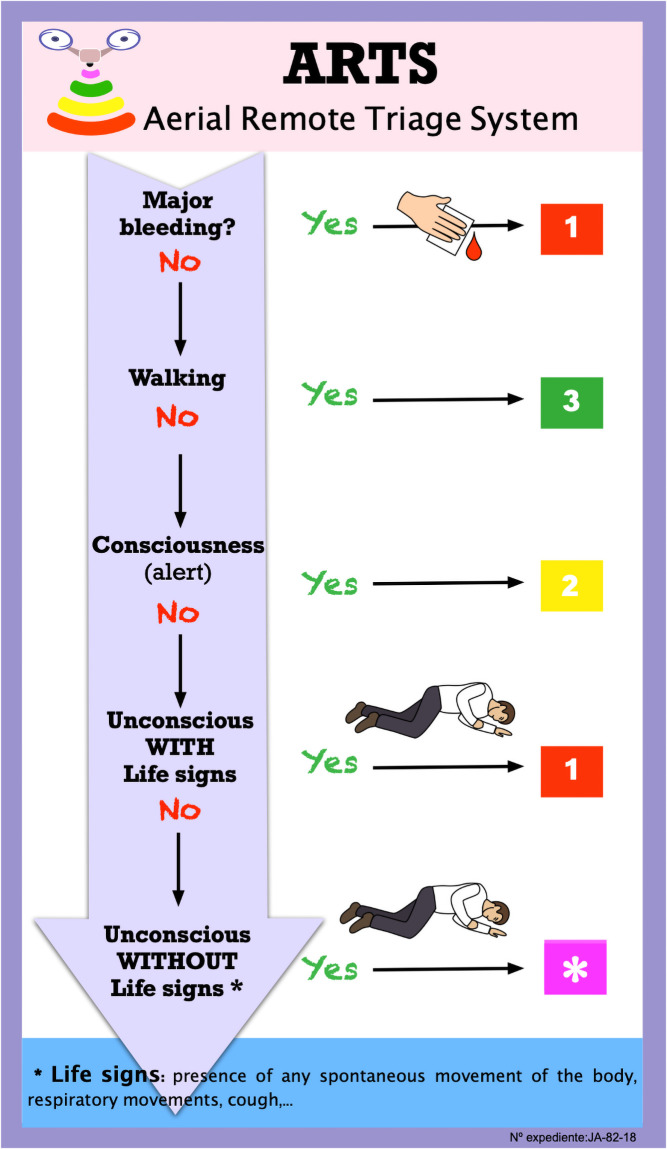
The use of drones for triage in mass-casualty incidents has recently emerged as a promising technology. However, there is no triage system specifically adapted to a remote usage. Our study aimed to develop a remote triage procedure using drones. The research was performed in three stages: literature review, the development of a remote triage algorithm using drones and evaluation of the algorithm by experts. Qualitative synthesis and the calculation of content validity ratios were done to achieve the Aerial Remote Triage System. This algorithm assesses (in this order): major bleeding, walking, consciousness and signs of life; and then classify the injured people into several priority categories: priority 1 (red), priority 2 (yellow), priority 3 (green) and priority * (violet). It includes the possibility to indicate save-living interventions to injured people and bystanders, like the compression of bleeding injuries or the adoption of the recovery position. The Aerial Remote Triage System may be a useful way to perform triage by drone in complex emergencies when it is difficult to access to the scene due to physical, chemical or biological risks.
利用无人机对大规模伤亡事件进行分诊最近已成为一种很有前途的技术。然而,目前还没有专门针对远程使用的分诊系统。我们的研究旨在开发一种使用无人机的远程分诊程序。研究分三个阶段进行:文献回顾、使用无人机开发远程分诊算法以及专家对算法进行评估。采用定性综合和计算内容有效性比的方法来实现空中远程分诊系统。该算法按以下顺序评估:大出血、行走、意识和生命体征;然后将受伤人员分为几个优先类别:1 级(红色)、2 级(黄色)、3 级(绿色)和*级(紫色)。它包括对受伤人员和旁观者进行救生干预的可能性,如对出血损伤进行按压或采取恢复体位。在由于物理、化学或生物风险而难以进入现场的复杂紧急情况下,空中远程分诊系统可能是一种通过无人机进行分诊的有用方法。