Division of Evolution and Genomic Sciences, School of Biological Sciences, University of Manchester, Manchester, United Kingdom.
Department of Animal and Plant Sciences, University of Sheffield, Sheffield, United Kingdom.
mBio. 2021 May 11;12(3):e00558-21. doi: 10.1128/mBio.00558-21.
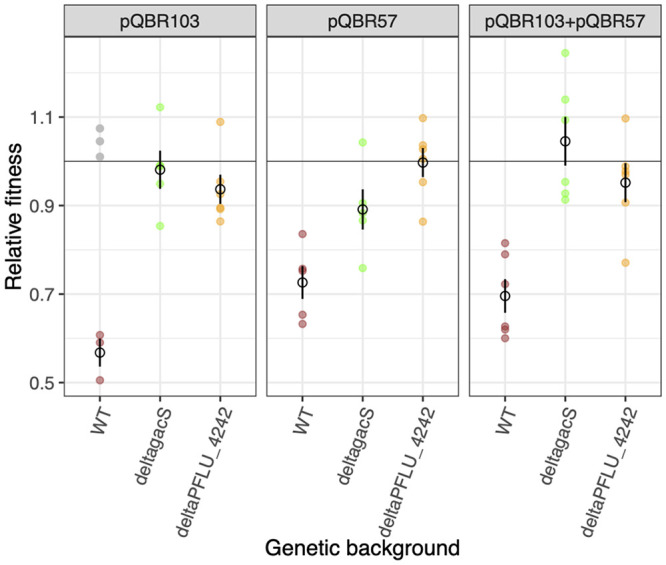
Plasmids play an important role in bacterial evolution by transferring niche-adaptive functional genes between lineages, thus driving genomic diversification. Bacterial genomes commonly contain multiple, coexisting plasmid replicons, which could fuel adaptation by increasing the range of gene functions available to selection and allowing their recombination. However, plasmid coexistence is difficult to explain because the acquisition of plasmids typically incurs high fitness costs for the host cell. Here, we show that plasmid coexistence was stably maintained without positive selection for plasmid-borne gene functions and was associated with compensatory evolution to reduce fitness costs. In contrast, with positive selection, plasmid coexistence was unstable despite compensatory evolution. Positive selection discriminated between differential fitness benefits of functionally redundant plasmid replicons, retaining only the more beneficial plasmid. These data suggest that while the efficiency of negative selection against plasmid fitness costs declines over time due to compensatory evolution, positive selection to maximize plasmid-derived fitness benefits remains efficient. Our findings help to explain the forces structuring bacterial genomes: coexistence of multiple plasmids in a genome is likely to require either rare positive selection in nature or nonredundancy of accessory gene functions among the coexisting plasmids. Bacterial genomes often contain multiple coexisting plasmids that provide important functions like antibiotic resistance. Using lab experiments, we show that such plasmid coexistence within a genome is stable only in environments where the function they encode is useless but is unstable if the function is useful and beneficial for bacterial fitness. Where competing plasmids perform the same useful function, only the most beneficial plasmid is kept by the cell, a process that is similar to competitive exclusion in ecological communities. This process helps explain how bacterial genomes are structured: bacterial genomes expand in size by acquiring multiple plasmids when selection is relaxed but subsequently contract during periods of strong selection for the useful plasmid-encoded function.
质粒通过在谱系之间转移适应小生境的功能基因,在细菌进化中发挥重要作用,从而推动基因组多样化。细菌基因组通常包含多个共存的质粒复制子,这可以通过增加可供选择的基因功能范围并允许它们重组来促进适应性。然而,质粒共存很难解释,因为获得质粒通常会给宿主细胞带来很高的适应成本。在这里,我们表明,即使没有质粒携带基因功能的正选择,质粒共存也能稳定维持,并且与降低适应成本的补偿进化有关。相比之下,即使存在补偿进化,有正选择时质粒共存也不稳定。正选择区分了功能冗余的质粒复制子的不同适应优势,只保留更有利的质粒。这些数据表明,虽然随着时间的推移,补偿进化降低了对质粒适应成本的负选择效率,但为了最大化质粒衍生的适应优势,正选择仍然有效。我们的研究结果有助于解释细菌基因组的结构形成力量:基因组中多个质粒的共存很可能需要在自然环境中存在稀有正选择,或者共存质粒中的辅助基因功能不是冗余的。细菌基因组通常包含多个共存的质粒,这些质粒提供了重要的功能,如抗生素抗性。通过实验室实验,我们表明,在编码功能无用的环境中,这种基因组内的质粒共存是稳定的,但如果功能对细菌适应有利且有益,则这种共存是不稳定的。当竞争质粒执行相同的有用功能时,只有最有益的质粒被细胞保留,这个过程类似于生态群落中的竞争排除。这个过程有助于解释细菌基因组是如何构建的:当选择放松时,细菌基因组通过获取多个质粒来扩大大小,但随后在对有用质粒编码功能进行强选择的时期内收缩。