Health Management Center, Shandong Provincial Hospital Affiliated to Shandong First Medical University, Jinan, 250021, Shandong, China.
Sci Rep. 2021 May 11;11(1):10036. doi: 10.1038/s41598-021-89494-9.
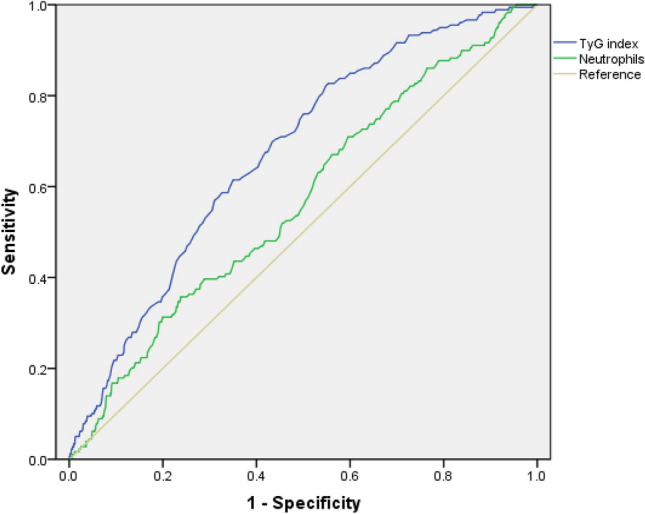
Triglyceride glucose (TyG) index and inflammatory markers are reported to have a positive association with metabolic syndrome (MetS). However, no previous study has assessed the value of TyG index and inflammatory markers as predictors of metabolic syndrome in the same study. This study looks at the comparison of the triglyceride index and blood leukocyte indices as predictors of metabolic syndrome in the Chinese population. The study cohort involved 1542 Chinese population without metabolic syndrome. The subjects underwent comprehensive routine health examination in 2011 and returned for a follow-up examination in 2016. Metabolic syndrome was defined according to Chinese Diabetes Society criteria, using body mass index for the replacement of waist circumference. TyG index, total leukocytes, neutrophils, lymphocytes, and neutrophil-to-lymphocyte ratio (NLR) were measured. Adjust d logistic models were used to assess the relationship between TyG index, blood leukocyte indices, and incident MetS. Receiver operating characteristic (ROC) curves were performed to determine the predictive value of TyG index and blood leukocyte indices for MetS. Results from multivariate logistic regression analysis showed that, in the adjusted model, the subjects with the highest quartile of TyG index and neutrophils had a 3.894- and 1.663-fold increased incidence of MetS (P < 0.0001 and P = 0.027), respectively. No significant association was observed between total leukocytes, lymphocytes, NLR with incident MetS. ROC analysis showed that the AUC of TyG index and neutrophils were 0.674 and 0.568 for incident MetS, respectively. TyG index rather than blood leukocyte indices may have the strongest predictive value in MetS development over a 5-year period.
甘油三酯葡萄糖(TyG)指数和炎症标志物与代谢综合征(MetS)呈正相关。然而,以前没有研究评估 TyG 指数和炎症标志物作为预测代谢综合征的指标在同一研究中的价值。本研究比较了甘油三酯指数和血液白细胞指数作为预测中国人群代谢综合征的指标。研究队列包括 1542 名无代谢综合征的中国人群。受试者于 2011 年接受全面常规健康检查,并于 2016 年进行随访检查。代谢综合征的定义根据中国糖尿病协会的标准,采用体重指数代替腰围。测量 TyG 指数、总白细胞、中性粒细胞、淋巴细胞和中性粒细胞与淋巴细胞比值(NLR)。采用调整后的逻辑模型评估 TyG 指数、血液白细胞指数与新发代谢综合征的关系。进行接收者操作特征(ROC)曲线以确定 TyG 指数和血液白细胞指数对代谢综合征的预测价值。多变量逻辑回归分析结果表明,在调整后的模型中,TyG 指数和中性粒细胞最高四分位数的受试者发生代谢综合征的风险分别增加了 3.894 倍和 1.663 倍(P<0.0001 和 P=0.027)。总白细胞、淋巴细胞、NLR 与新发代谢综合征无显著相关性。ROC 分析显示,TyG 指数和中性粒细胞对新发代谢综合征的 AUC 分别为 0.674 和 0.568。在 5 年内,TyG 指数而不是血液白细胞指数可能对代谢综合征的发生具有最强的预测价值。