Queensland Brain Institute, The University of Queensland, Brisbane, QLD 4072, Australia.
Electrical Engineering & Computer Science, University of Missouri, Columbia, MO 65211 USA.
Cell Rep. 2021 May 11;35(6):109106. doi: 10.1016/j.celrep.2021.109106.
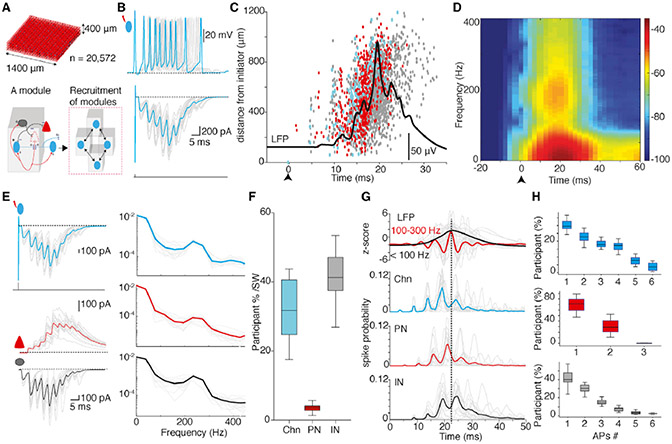
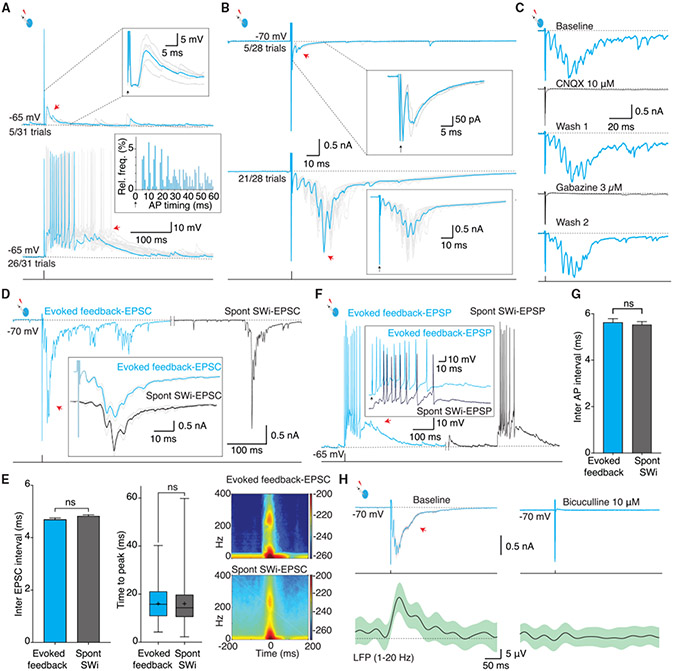
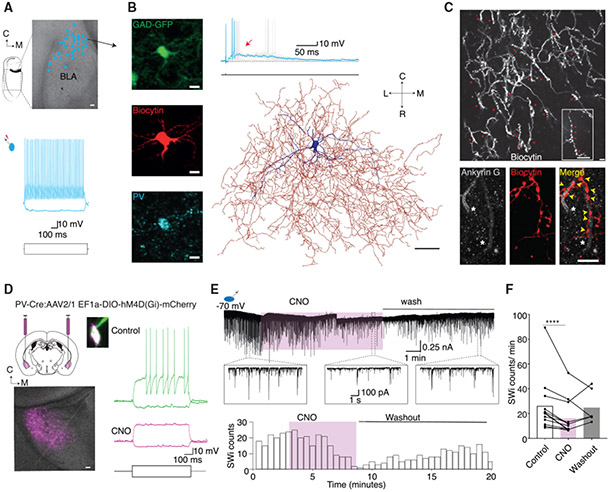
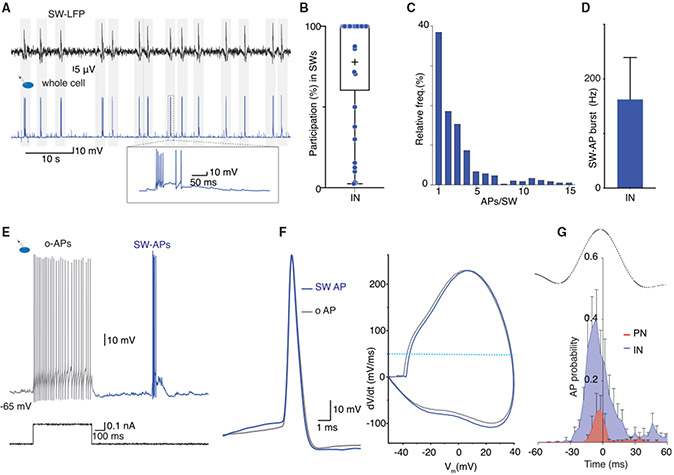
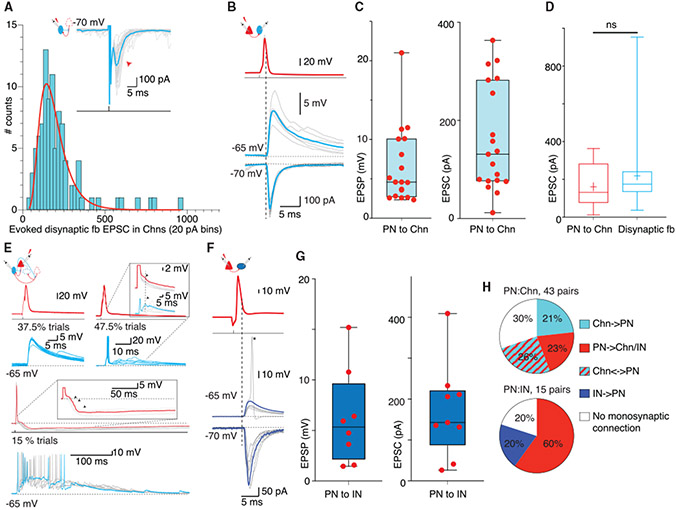
Synchronized activity in neural circuits, detected as oscillations in the extracellular field potential, has been associated with learning and memory. Neural circuits in the basolateral amygdala (BLA), a mid-temporal lobe structure, generate oscillations in specific frequency bands to mediate emotional memory functions. However, how BLA circuits generate oscillations in distinct frequency bands is not known. Of these, sharp-waves (SWs) are repetitive, brief transitions that contain a low-frequency (<20 Hz) envelope, often coupled with ripples (100-300 Hz), have been associated with memory consolidation. Here, we show that SWs are retained in the BLA ex vivo and generated by local circuits. We demonstrate that an action potential in a chandelier interneuron is sufficient to initiate SWs through local circuits. Using a physiologically constrained model, we show that microcircuits organized as chandelier-interneuron-driven modules reproduce SWs and associated cellular events, revealing a functional role for chandelier interneurons and microcircuits for SW generation.
神经回路的同步活动,以细胞外场电位的振荡形式检测到,与学习和记忆有关。中颞叶结构基底外侧杏仁核(BLA)中的神经回路在特定频带中产生振荡,以介导情绪记忆功能。然而,BLA 回路如何在不同的频带中产生振荡尚不清楚。其中,尖波(SWs)是重复性的短暂过渡,包含低频(<20 Hz)包络,通常与涟漪(100-300 Hz)耦合,与记忆巩固有关。在这里,我们表明 SW 在 BLA 离体中被保留,并由局部回路产生。我们证明,一个篮状细胞中间神经元的动作电位足以通过局部回路引发 SW。使用生理约束模型,我们表明组织为篮状细胞中间神经元驱动模块的微电路再现了 SW 和相关的细胞事件,揭示了篮状细胞中间神经元和微电路在 SW 产生中的功能作用。