• 文献检索
  • 文档翻译
  • 深度研究
  • 学术资讯
  • Suppr Zotero 插件Zotero 插件
  • 邀请有礼
  • 套餐&价格
  • 历史记录
应用&插件
Suppr Zotero 插件Zotero 插件浏览器插件Mac 客户端Windows 客户端微信小程序
定价
高级版会员购买积分包购买API积分包
服务
文献检索文档翻译深度研究API 文档MCP 服务
关于我们
关于 Suppr公司介绍联系我们用户协议隐私条款
关注我们

Suppr 超能文献

核心技术专利:CN118964589B侵权必究
粤ICP备2023148730 号-1Suppr @ 2026

文献检索

告别复杂PubMed语法,用中文像聊天一样搜索,搜遍4000万医学文献。AI智能推荐,让科研检索更轻松。

立即免费搜索

文件翻译

保留排版,准确专业,支持PDF/Word/PPT等文件格式,支持 12+语言互译。

免费翻译文档

深度研究

AI帮你快速写综述,25分钟生成高质量综述,智能提取关键信息,辅助科研写作。

立即免费体验

癌症连体网络:用于预测模型训练期间未见过的原发性和转移性肿瘤类型的一次性学习。

CancerSiamese: one-shot learning for predicting primary and metastatic tumor types unseen during model training.

作者信息

Mostavi Milad, Chiu Yu-Chiao, Chen Yidong, Huang Yufei

机构信息

Greehey Children's Cancer Research Institute, University of Texas Health San Antonio, San Antonio, TX, 78229, USA.

Department of Electrical and Computer Engineering, University of Texas at San Antonio, San Antonio, TX, 78249, USA.

出版信息

BMC Bioinformatics. 2021 May 12;22(1):244. doi: 10.1186/s12859-021-04157-w.

DOI:10.1186/s12859-021-04157-w
PMID:33980137
原文链接:https://pmc.ncbi.nlm.nih.gov/articles/PMC8117642/
Abstract

BACKGROUND

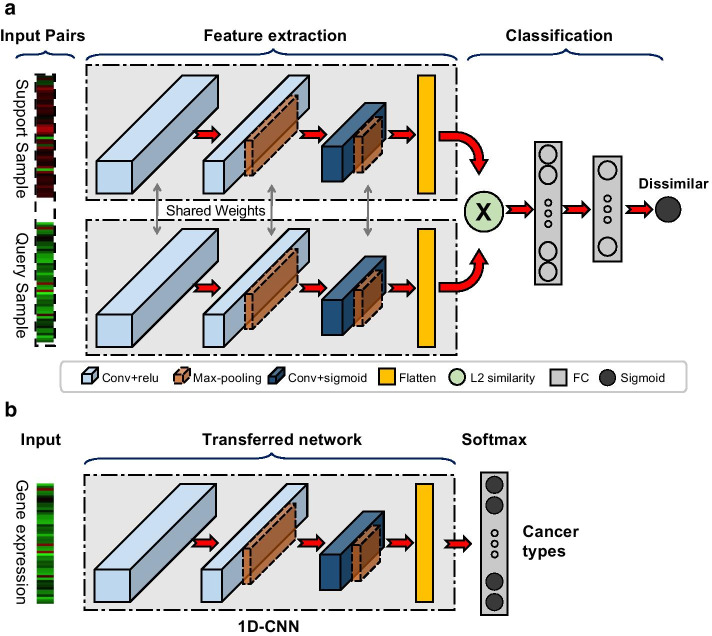
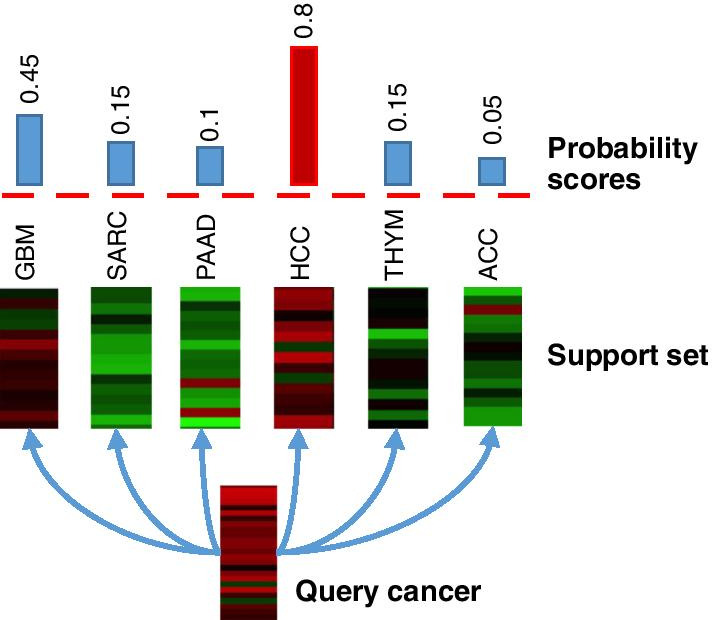
The state-of-the-art deep learning based cancer type prediction can only predict cancer types whose samples are available during the training where the sample size is commonly large. In this paper, we consider how to utilize the existing training samples to predict cancer types unseen during the training. We hypothesize the existence of a set of type-agnostic expression representations that define the similarity/dissimilarity between samples of the same/different types and propose a novel one-shot learning model called CancerSiamese to learn this common representation. CancerSiamese accepts a pair of query and support samples (gene expression profiles) and learns the representation of similar or dissimilar cancer types through two parallel convolutional neural networks joined by a similarity function.

RESULTS

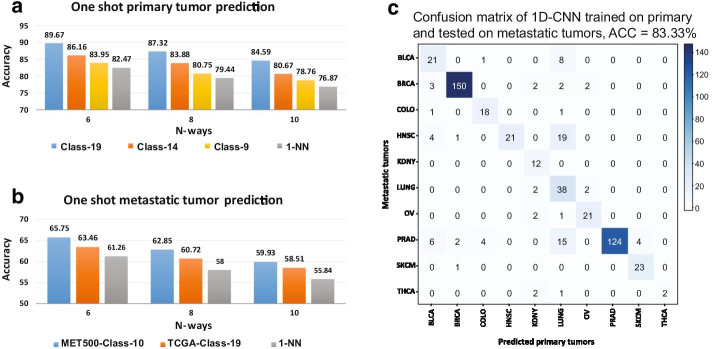
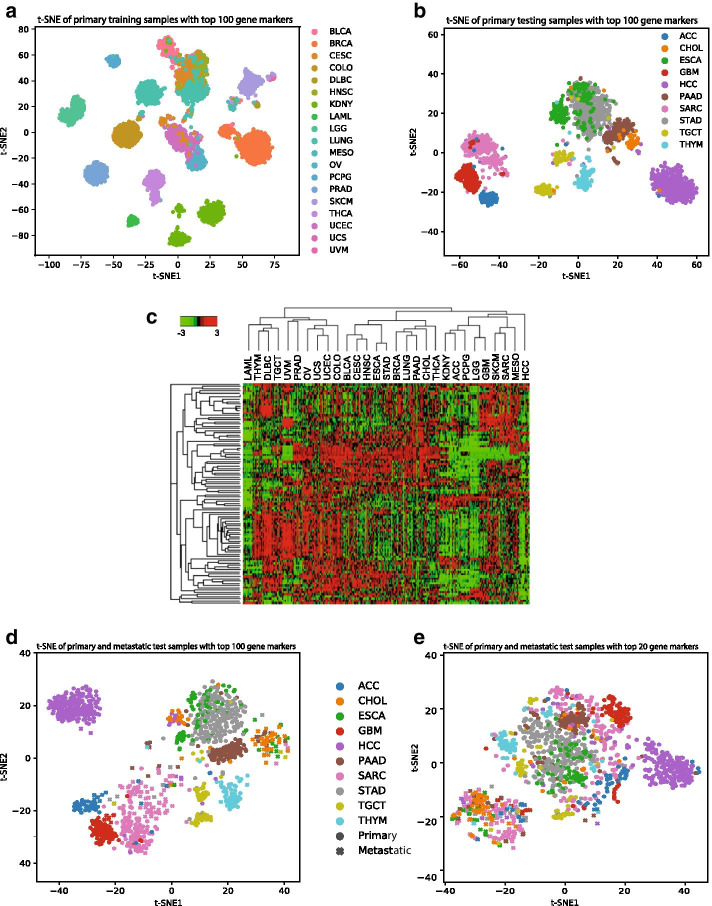
We trained CancerSiamese for cancer type prediction for primary and metastatic tumors using samples from the Cancer Genome Atlas (TCGA) and MET500. Network transfer learning was utilized to facilitate the training of the CancerSiamese models. CancerSiamese was tested for different N-way predictions and yielded an average accuracy improvement of 8% and 4% over the benchmark 1-Nearest Neighbor (1-NN) classifier for primary and metastatic tumors, respectively. Moreover, we applied the guided gradient saliency map and feature selection to CancerSiamese to examine 100 and 200 top marker-gene candidates for the prediction of primary and metastatic cancers, respectively. Functional analysis of these marker genes revealed several cancer related functions between primary and metastatic tumors.

CONCLUSION

This work demonstrated, for the first time, the feasibility of predicting unseen cancer types whose samples are limited. Thus, it could inspire new and ingenious applications of one-shot and few-shot learning solutions for improving cancer diagnosis, prognostic, and our understanding of cancer.

摘要

背景

基于深度学习的最先进癌症类型预测只能预测在训练期间有可用样本的癌症类型,且样本量通常很大。在本文中,我们考虑如何利用现有的训练样本预测训练期间未见过的癌症类型。我们假设存在一组与类型无关的表达表示,这些表示定义了相同/不同类型样本之间的相似性/不相似性,并提出了一种名为CancerSiamese的新型一次性学习模型来学习这种通用表示。CancerSiamese接受一对查询样本和支持样本(基因表达谱),并通过由相似性函数连接的两个并行卷积神经网络学习相似或不相似癌症类型的表示。

结果

我们使用来自癌症基因组图谱(TCGA)和MET500的样本训练CancerSiamese用于原发性和转移性肿瘤的癌症类型预测。利用网络迁移学习来促进CancerSiamese模型的训练。对CancerSiamese进行了不同N路预测的测试,与基准1最近邻(1-NN)分类器相比,原发性和转移性肿瘤的平均准确率分别提高了8%和4%。此外,我们将引导梯度显著性图和特征选择应用于CancerSiamese,分别检查了100个和200个用于预测原发性和转移性癌症的顶级标记基因候选者。对这些标记基因的功能分析揭示了原发性和转移性肿瘤之间的几种癌症相关功能。

结论

这项工作首次证明了预测样本有限的未见过的癌症类型的可行性。因此,它可以激发一次性和少样本学习解决方案在改善癌症诊断、预后以及我们对癌症的理解方面的新颖和巧妙应用。
https://cdn.ncbi.nlm.nih.gov/pmc/blobs/3b6d/8117642/1fafb63c2d72/12859_2021_4157_Fig5_HTML.jpg
https://cdn.ncbi.nlm.nih.gov/pmc/blobs/3b6d/8117642/f32175e7939c/12859_2021_4157_Fig1_HTML.jpg
https://cdn.ncbi.nlm.nih.gov/pmc/blobs/3b6d/8117642/a3e8cc1cb8f4/12859_2021_4157_Fig2_HTML.jpg
https://cdn.ncbi.nlm.nih.gov/pmc/blobs/3b6d/8117642/a15bc90cedb5/12859_2021_4157_Fig3_HTML.jpg
https://cdn.ncbi.nlm.nih.gov/pmc/blobs/3b6d/8117642/28efb9426168/12859_2021_4157_Fig4_HTML.jpg
https://cdn.ncbi.nlm.nih.gov/pmc/blobs/3b6d/8117642/1fafb63c2d72/12859_2021_4157_Fig5_HTML.jpg
https://cdn.ncbi.nlm.nih.gov/pmc/blobs/3b6d/8117642/f32175e7939c/12859_2021_4157_Fig1_HTML.jpg
https://cdn.ncbi.nlm.nih.gov/pmc/blobs/3b6d/8117642/a3e8cc1cb8f4/12859_2021_4157_Fig2_HTML.jpg
https://cdn.ncbi.nlm.nih.gov/pmc/blobs/3b6d/8117642/a15bc90cedb5/12859_2021_4157_Fig3_HTML.jpg
https://cdn.ncbi.nlm.nih.gov/pmc/blobs/3b6d/8117642/28efb9426168/12859_2021_4157_Fig4_HTML.jpg
https://cdn.ncbi.nlm.nih.gov/pmc/blobs/3b6d/8117642/1fafb63c2d72/12859_2021_4157_Fig5_HTML.jpg

相似文献

1
CancerSiamese: one-shot learning for predicting primary and metastatic tumor types unseen during model training.癌症连体网络:用于预测模型训练期间未见过的原发性和转移性肿瘤类型的一次性学习。
BMC Bioinformatics. 2021 May 12;22(1):244. doi: 10.1186/s12859-021-04157-w.
2
Convolutional neural network models for cancer type prediction based on gene expression.基于基因表达的癌症类型预测卷积神经网络模型。
BMC Med Genomics. 2020 Apr 3;13(Suppl 5):44. doi: 10.1186/s12920-020-0677-2.
3
Application of a Neural Network Whole Transcriptome-Based Pan-Cancer Method for Diagnosis of Primary and Metastatic Cancers.基于神经网络全转录组的泛癌方法在原发性和转移性癌症诊断中的应用。
JAMA Netw Open. 2019 Apr 5;2(4):e192597. doi: 10.1001/jamanetworkopen.2019.2597.
4
Multi-label zero-shot learning with graph convolutional networks.基于图卷积网络的多标签零样本学习。
Neural Netw. 2020 Dec;132:333-341. doi: 10.1016/j.neunet.2020.09.010. Epub 2020 Sep 21.
5
Predicting drug response of tumors from integrated genomic profiles by deep neural networks.基于深度神经网络的整合基因组图谱预测肿瘤药物反应
BMC Med Genomics. 2019 Jan 31;12(Suppl 1):18. doi: 10.1186/s12920-018-0460-9.
6
A meta-learning approach to improving radiation response prediction in cancers.一种元学习方法,用于提高癌症的辐射反应预测。
Comput Biol Med. 2022 Nov;150:106163. doi: 10.1016/j.compbiomed.2022.106163. Epub 2022 Oct 5.
7
Deep convolutional neural network and IoT technology for healthcare.用于医疗保健的深度卷积神经网络和物联网技术。
Digit Health. 2024 Jan 17;10:20552076231220123. doi: 10.1177/20552076231220123. eCollection 2024 Jan-Dec.
8
CUP-AI-Dx: A tool for inferring cancer tissue of origin and molecular subtype using RNA gene-expression data and artificial intelligence.CUP-AI-Dx:一种使用 RNA 基因表达数据和人工智能推断癌症组织来源和分子亚型的工具。
EBioMedicine. 2020 Nov;61:103030. doi: 10.1016/j.ebiom.2020.103030. Epub 2020 Oct 9.
9
DEGnext: classification of differentially expressed genes from RNA-seq data using a convolutional neural network with transfer learning.DEGnext:使用具有迁移学习的卷积神经网络对 RNA-seq 数据进行差异表达基因分类。
BMC Bioinformatics. 2022 Jan 6;23(1):17. doi: 10.1186/s12859-021-04527-4.
10
Meta-Transfer Learning Through Hard Tasks.元迁移学习通过硬任务。
IEEE Trans Pattern Anal Mach Intell. 2022 Mar;44(3):1443-1456. doi: 10.1109/TPAMI.2020.3018506. Epub 2022 Feb 3.

引用本文的文献

1
Integrating Omics Data and AI for Cancer Diagnosis and Prognosis.整合组学数据与人工智能用于癌症诊断和预后评估
Cancers (Basel). 2024 Jul 3;16(13):2448. doi: 10.3390/cancers16132448.
2
Machine-learning analysis reveals an important role for negative selection in shaping cancer aneuploidy landscapes.机器学习分析揭示了负选择在塑造癌症非整倍体景观中的重要作用。
Genome Biol. 2024 Apr 15;25(1):95. doi: 10.1186/s13059-024-03225-7.
3
Transfer learning for non-image data in clinical research: A scoping review.临床研究中非图像数据的迁移学习:一项范围综述。

本文引用的文献

1
MapCell: Learning a Comparative Cell Type Distance Metric With Siamese Neural Nets With Applications Toward Cell-Type Identification Across Experimental Datasets.MapCell:使用暹罗神经网络学习比较细胞类型距离度量及其在跨实验数据集进行细胞类型识别中的应用
Front Cell Dev Biol. 2021 Nov 2;9:767897. doi: 10.3389/fcell.2021.767897. eCollection 2021.
2
TripletProt: Deep Representation Learning of Proteins Based On Siamese Networks.TripletProt:基于连体网络的蛋白质深度表征学习
IEEE/ACM Trans Comput Biol Bioinform. 2022 Nov-Dec;19(6):3744-3753. doi: 10.1109/TCBB.2021.3108718. Epub 2022 Dec 8.
3
Classification of Cancer Types Using Graph Convolutional Neural Networks.
PLOS Digit Health. 2022 Feb 17;1(2):e0000014. doi: 10.1371/journal.pdig.0000014. eCollection 2022 Feb.
4
Routine omics collection is a golden opportunity for European human research in space and analog environments.常规组学采集对欧洲在太空及模拟环境中的人体研究而言是一个绝佳机遇。
Patterns (N Y). 2022 Jul 30;3(10):100550. doi: 10.1016/j.patter.2022.100550. eCollection 2022 Oct 14.
5
Artificial intelligence for the early detection of colorectal cancer: A comprehensive review of its advantages and misconceptions.人工智能在结直肠癌早期检测中的应用:优势与误区的综合评述。
World J Gastroenterol. 2021 Oct 14;27(38):6399-6414. doi: 10.3748/wjg.v27.i38.6399.
6
Predicting and characterizing a cancer dependency map of tumors with deep learning.深度学习预测和描绘肿瘤的癌症依赖图谱。
Sci Adv. 2021 Aug 20;7(34). doi: 10.1126/sciadv.abh1275. Print 2021 Aug.
7
Investigation of REFINED CNN ensemble learning for anti-cancer drug sensitivity prediction.基于精细化 CNN 集成学习的抗癌药物敏感性预测研究。
Bioinformatics. 2021 Jul 12;37(Suppl_1):i42-i50. doi: 10.1093/bioinformatics/btab336.
使用图卷积神经网络对癌症类型进行分类
Front Phys. 2020 Jun;8. doi: 10.3389/fphy.2020.00203. Epub 2020 Jun 17.
4
Predicting sites of epitranscriptome modifications using unsupervised representation learning based on generative adversarial networks.基于生成对抗网络的无监督表示学习预测表观转录组修饰位点
Front Phys. 2020 Jun;8. doi: 10.3389/fphy.2020.00196. Epub 2020 Jun 19.
5
Representation of features as images with neighborhood dependencies for compatibility with convolutional neural networks.基于邻域依赖的特征图像表示方法,以与卷积神经网络兼容。
Nat Commun. 2020 Sep 1;11(1):4391. doi: 10.1038/s41467-020-18197-y.
6
iSOM-GSN: an integrative approach for transforming multi-omic data into gene similarity networks via self-organizing maps.iSOM-GSN:一种通过自组织映射将多组学数据转化为基因相似网络的综合方法。
Bioinformatics. 2020 Aug 1;36(15):4248-4254. doi: 10.1093/bioinformatics/btaa500.
7
Convolutional neural network models for cancer type prediction based on gene expression.基于基因表达的癌症类型预测卷积神经网络模型。
BMC Med Genomics. 2020 Apr 3;13(Suppl 5):44. doi: 10.1186/s12920-020-0677-2.
8
Cancer Genome Evolutionary Trajectories in Metastasis.转移中的癌症基因组进化轨迹。
Cancer Cell. 2020 Jan 13;37(1):8-19. doi: 10.1016/j.ccell.2019.12.004.
9
TMSB10 promotes migration and invasion of cancer cells and is a novel prognostic marker for renal cell carcinoma.TMSB10促进癌细胞的迁移和侵袭,是肾细胞癌的一种新型预后标志物。
Int J Clin Exp Pathol. 2019 Jan 1;12(1):305-312. eCollection 2019.
10
Deep learning of pharmacogenomics resources: moving towards precision oncology.基于药理学基因组学资源的深度学习:迈向精准肿瘤学。
Brief Bioinform. 2020 Dec 1;21(6):2066-2083. doi: 10.1093/bib/bbz144.