Laureate Institute for Brain Research, 6655 S Yale Ave, Tulsa, OK, 74136, USA.
Wellcome Centre for Human Neuroimaging, Institute of Neurology, University College London, London, UK.
Sci Rep. 2021 May 12;11(1):10128. doi: 10.1038/s41598-021-89047-0.
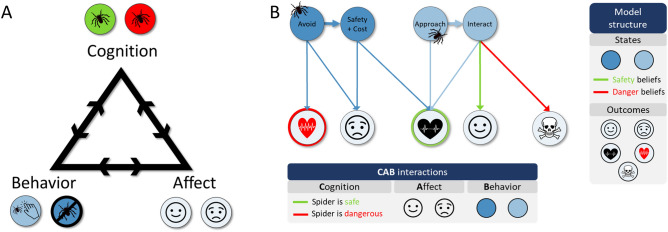
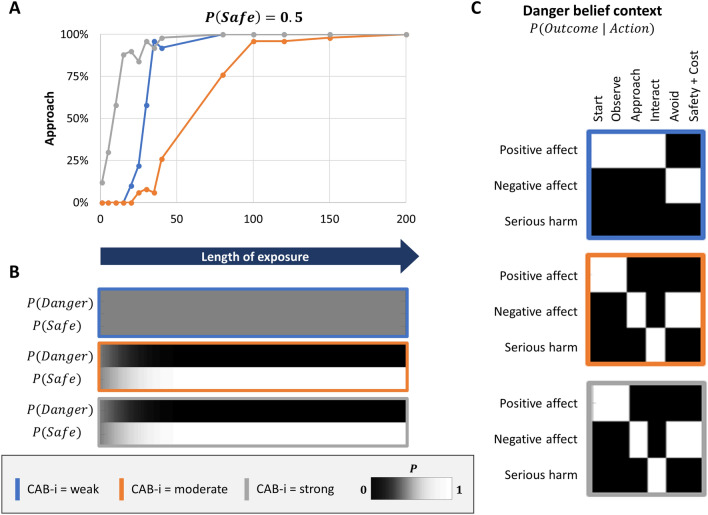
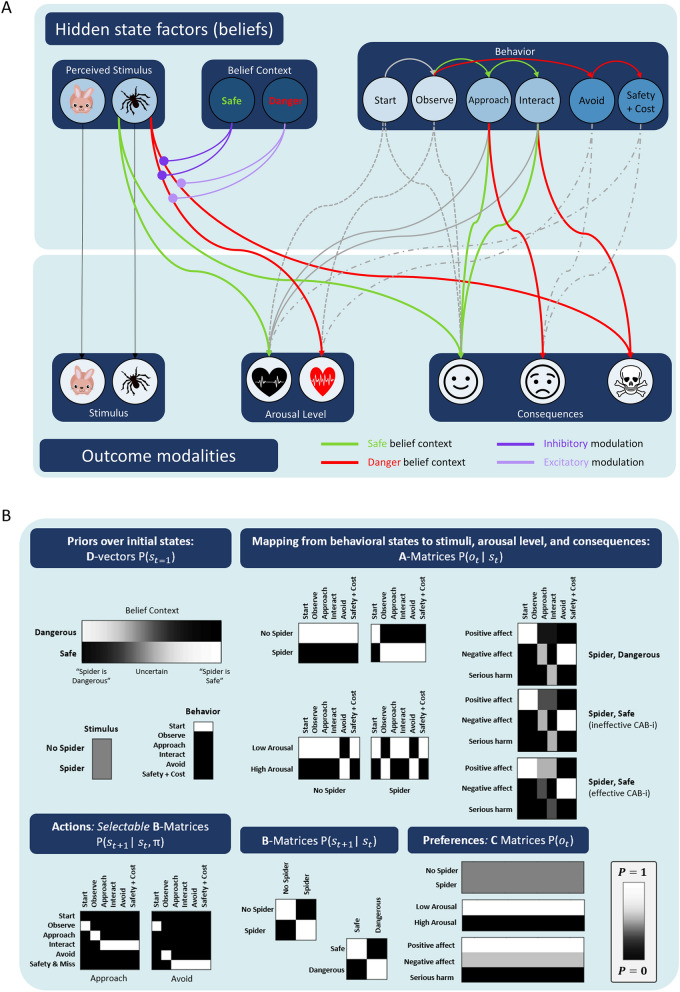
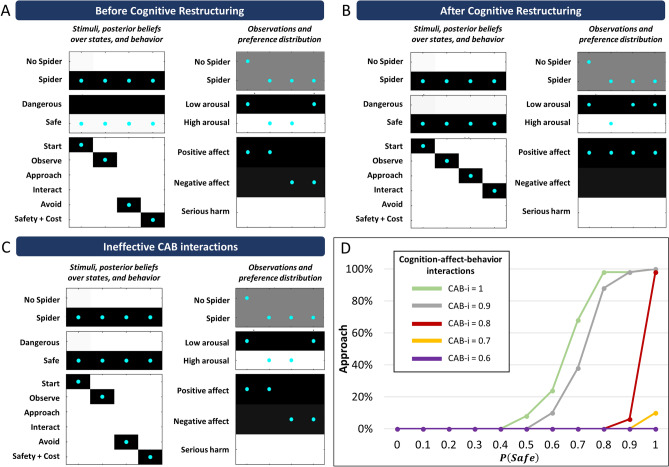
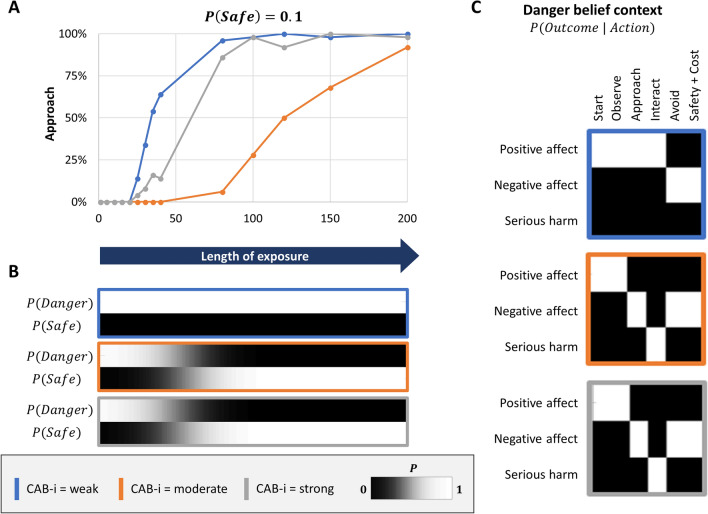
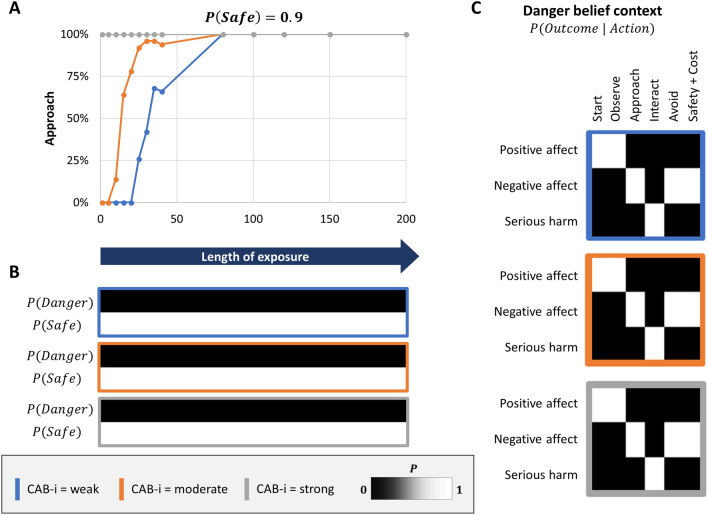
Cognitive-behavioral therapy (CBT) leverages interactions between thoughts, feelings, and behaviors. To deepen understanding of these interactions, we present a computational (active inference) model of CBT that allows formal simulations of interactions between cognitive interventions (i.e., cognitive restructuring) and behavioral interventions (i.e., exposure) in producing adaptive behavior change (i.e., reducing maladaptive avoidance behavior). Using spider phobia as a concrete example of maladaptive avoidance more generally, we show simulations indicating that when conscious beliefs about safety/danger have strong interactions with affective/behavioral outcomes, behavioral change during exposure therapy is mediated by changes in these beliefs, preventing generalization. In contrast, when these interactions are weakened, and cognitive restructuring only induces belief uncertainty (as opposed to strong safety beliefs), behavior change leads to generalized learning (i.e., "over-writing" the implicit beliefs about action-outcome mappings that directly produce avoidance). The individual is therefore equipped to face any new context, safe or dangerous, remaining in a content state without the need for avoidance behavior-increasing resilience from a CBT perspective. These results show how the same changes in behavior during CBT can be due to distinct underlying mechanisms; they predict lower rates of relapse when cognitive interventions focus on inducing uncertainty and on reducing the effects of automatic negative thoughts on behavior.
认知行为疗法(CBT)利用思想、情感和行为之间的相互作用。为了更深入地了解这些相互作用,我们提出了一种认知行为疗法的计算(主动推理)模型,该模型允许对认知干预(即认知重构)和行为干预(即暴露)之间产生适应性行为改变(即减少适应不良的回避行为)进行正式模拟。我们以蜘蛛恐惧症为例,更广泛地说明了适应不良的回避行为,模拟结果表明,当关于安全/危险的有意识信念与情感/行为结果有强烈的相互作用时,暴露疗法期间的行为改变是通过这些信念的改变来介导的,从而防止了泛化。相比之下,当这些相互作用减弱时,认知重构只会引起信念不确定性(而不是强烈的安全信念),行为改变会导致泛化学习(即“覆盖”直接产生回避的关于行动-结果映射的隐含信念)。因此,个体能够面对任何新的情境,无论是安全的还是危险的,保持在一个没有回避行为的内容状态下,从而从 CBT 的角度提高了韧性。这些结果表明,CBT 期间行为的相同变化可能是由于不同的潜在机制所致;当认知干预侧重于诱导不确定性和减少自动消极思维对行为的影响时,它们预测复发率会降低。