Chen Xianhui, Yang Shuai, Li Si, Qu Yun, Wang Hsuan-Yao, Liu Jiangyue, Dunn Zachary S, Cinay Gunce E, MacMullan Melanie A, Hu Fangheng, Zhang Xiaoyang, Wang Pin
Department of Pharmacology and Pharmaceutical Sciences, University of Southern California, Los Angeles, CA, USA.
Department of Biochemistry and Molecular Biology, University of Southern California, Los Angeles, CA, USA.
Mol Ther Oncolytics. 2021 Apr 2;21:144-157. doi: 10.1016/j.omto.2021.03.014. eCollection 2021 Jun 25.
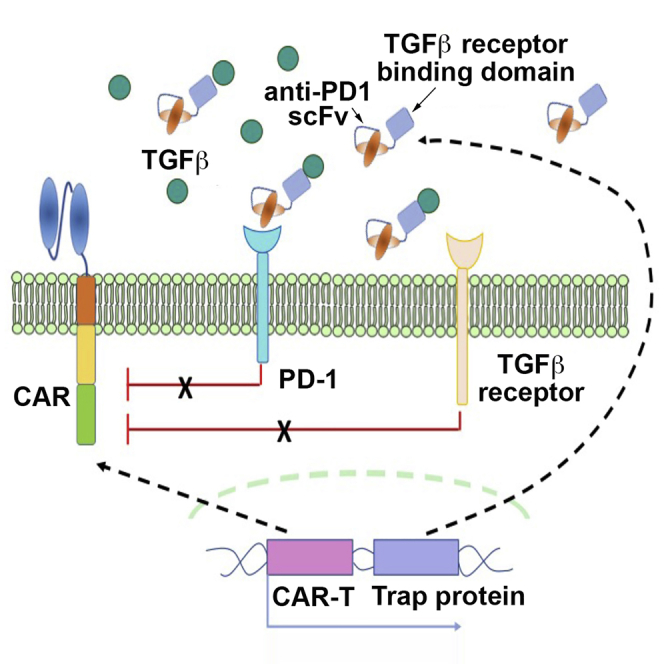
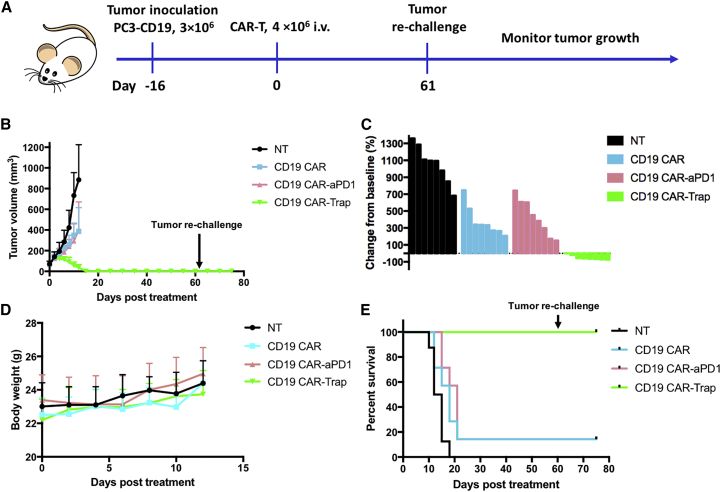
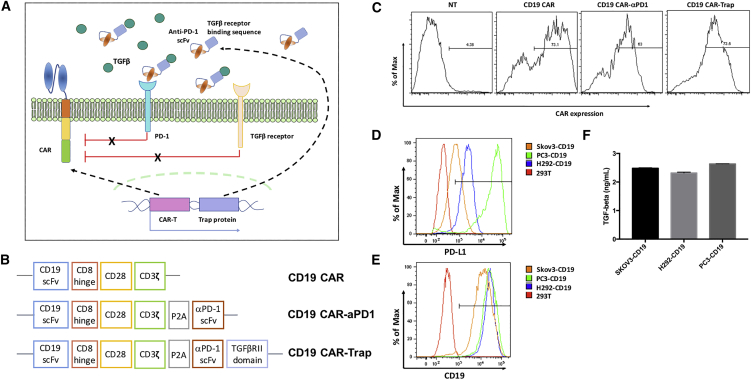
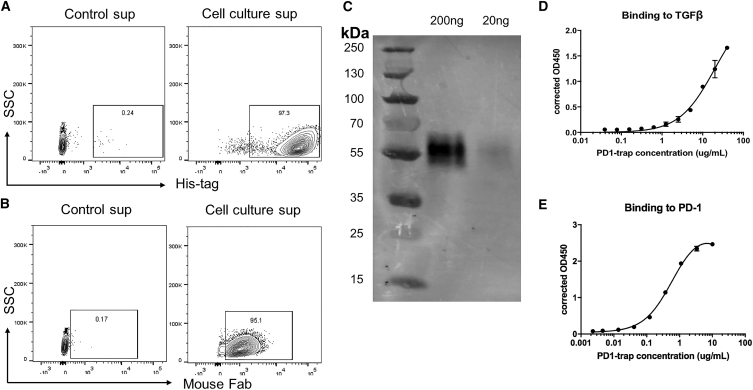
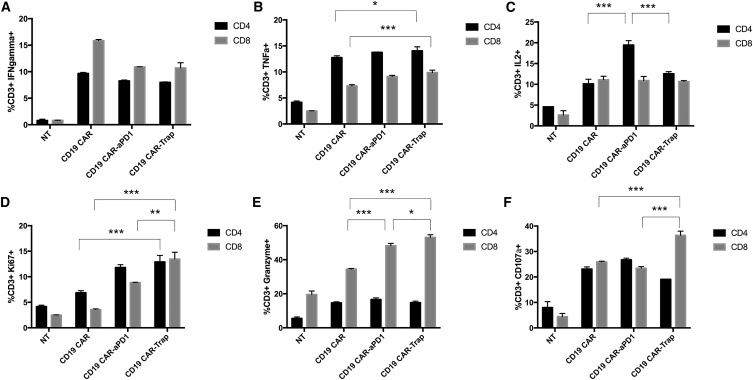
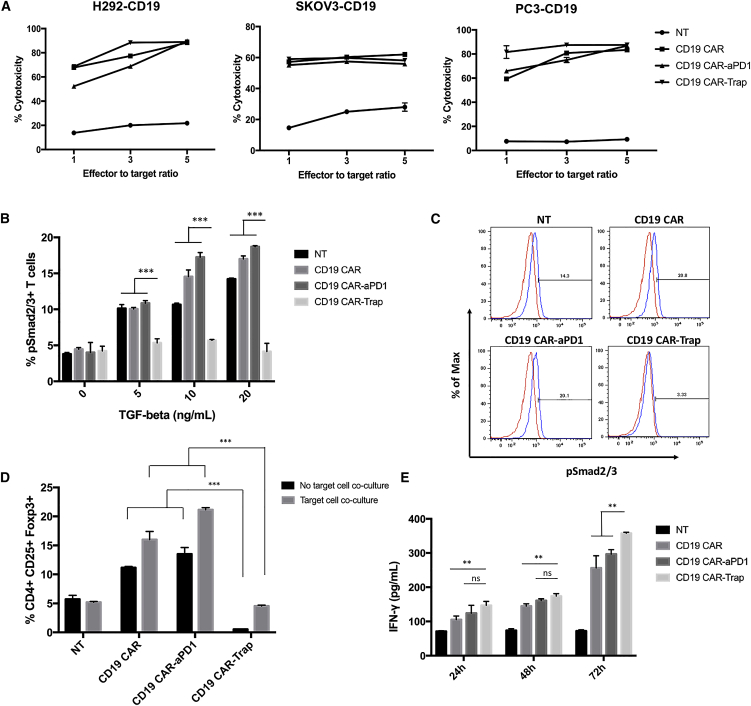
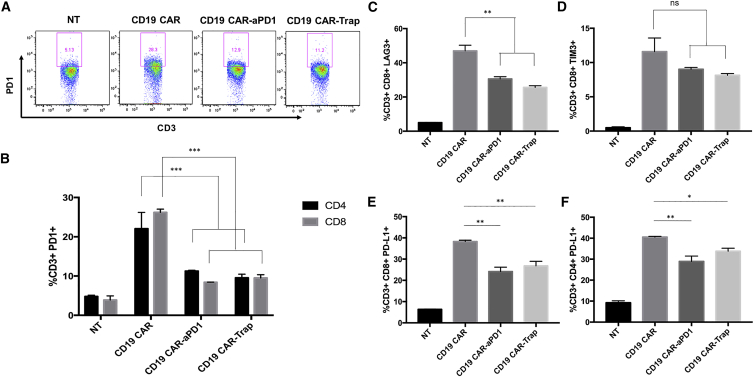
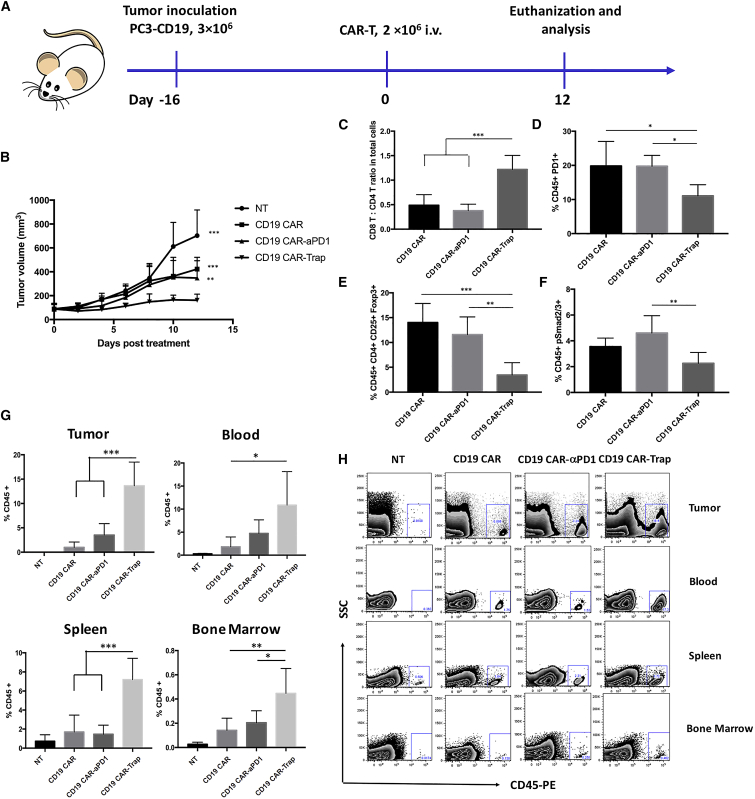
Despite the remarkable success of chimeric antigen receptor-modified T (CAR-T) cell therapy for blood malignancies, the clinical efficacy of this novel therapy in solid tumor treatment is largely limited by the immunosuppressive tumor microenvironment (TME). For instance, immune checkpoints (e.g., programmed cell death protein 1 [PD-1]/programmed death ligand 1 [PD-L1]) in TME play an important role in inhibiting T cell proliferation and functions. Transforming growth factor β (TGF)-β secreted by cancer cells in TME induces regulatory T cells (Tregs) and inhibits cytotoxic T cells. To overcome the inhibitory effect of immune checkpoints, we have previously engineered CAR-T cells to secrete anti-PD-1 to block the PD-1/PD-L1 pathway activity, a step demonstrating superior antitumor efficacy compared with conventional CAR-T cells. In this study, we engineered CAR-T cells that secrete bispecific trap protein co-targeting PD-1 and TGF-β, with the aim of further improving antitumor immunity. Compared with conventional CAR-T cells and anti-PD-1-secreting CAR-T cells, data from and experiments showed that CAR-T cells with trap protein secretion further attenuated inhibitory T cell signaling, enhanced T cell persistence and expansion, and improved effector function and resistance to exhaustion. In the xenograft mouse model, CAR-T cells with trap protein secretion exhibited significantly enhanced antitumor immunity and efficacy. With these observations, we demonstrate the potential of trap protein self-secreting CAR-T cells as a potent therapy for solid tumors.
尽管嵌合抗原受体修饰的T(CAR-T)细胞疗法在血液恶性肿瘤治疗中取得了显著成功,但这种新型疗法在实体瘤治疗中的临床疗效在很大程度上受到免疫抑制性肿瘤微环境(TME)的限制。例如,TME中的免疫检查点(如程序性细胞死亡蛋白1 [PD-1]/程序性死亡配体1 [PD-L1])在抑制T细胞增殖和功能方面发挥着重要作用。TME中癌细胞分泌的转化生长因子β(TGF)-β可诱导调节性T细胞(Tregs)并抑制细胞毒性T细胞。为了克服免疫检查点的抑制作用,我们之前对CAR-T细胞进行了改造,使其分泌抗PD-1以阻断PD-1/PD-L1信号通路的活性,这一步骤显示出比传统CAR-T细胞更优越的抗肿瘤疗效。在本研究中,我们构建了分泌双特异性捕获蛋白同时靶向PD-1和TGF-β的CAR-T细胞,旨在进一步提高抗肿瘤免疫力。与传统CAR-T细胞和分泌抗PD-1的CAR-T细胞相比,[具体实验1]和[具体实验2]的实验数据表明,分泌捕获蛋白的CAR-T细胞进一步减弱了抑制性T细胞信号传导,增强了T细胞的持久性和扩增能力,并改善了效应器功能和抗耗竭能力。在异种移植小鼠模型中,分泌捕获蛋白的CAR-T细胞表现出显著增强的抗肿瘤免疫力和疗效。基于这些观察结果,我们证明了捕获蛋白自分泌CAR-T细胞作为实体瘤有效治疗方法的潜力。