Noorul Islam Centre for Higher Education, Kumrancoil, Tamil Nadu, India.
, Malappuram, India.
BMC Med Imaging. 2021 May 13;21(1):82. doi: 10.1186/s12880-021-00614-3.
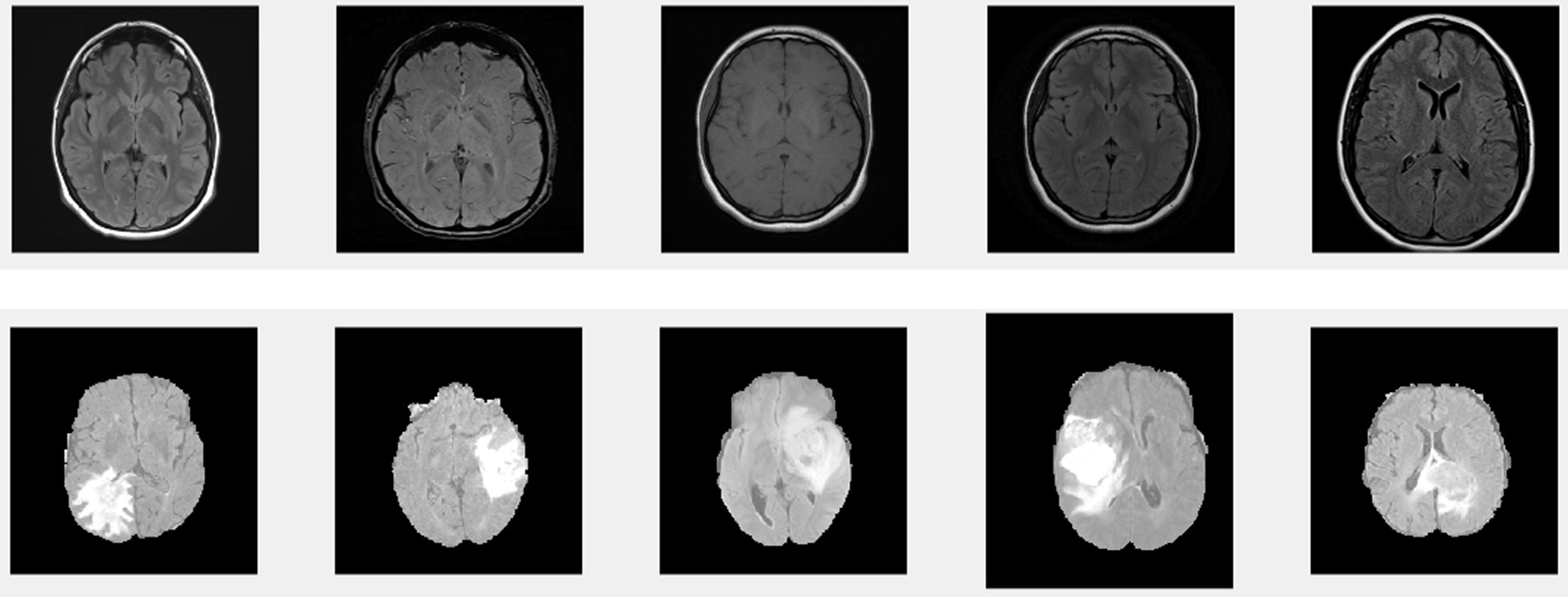
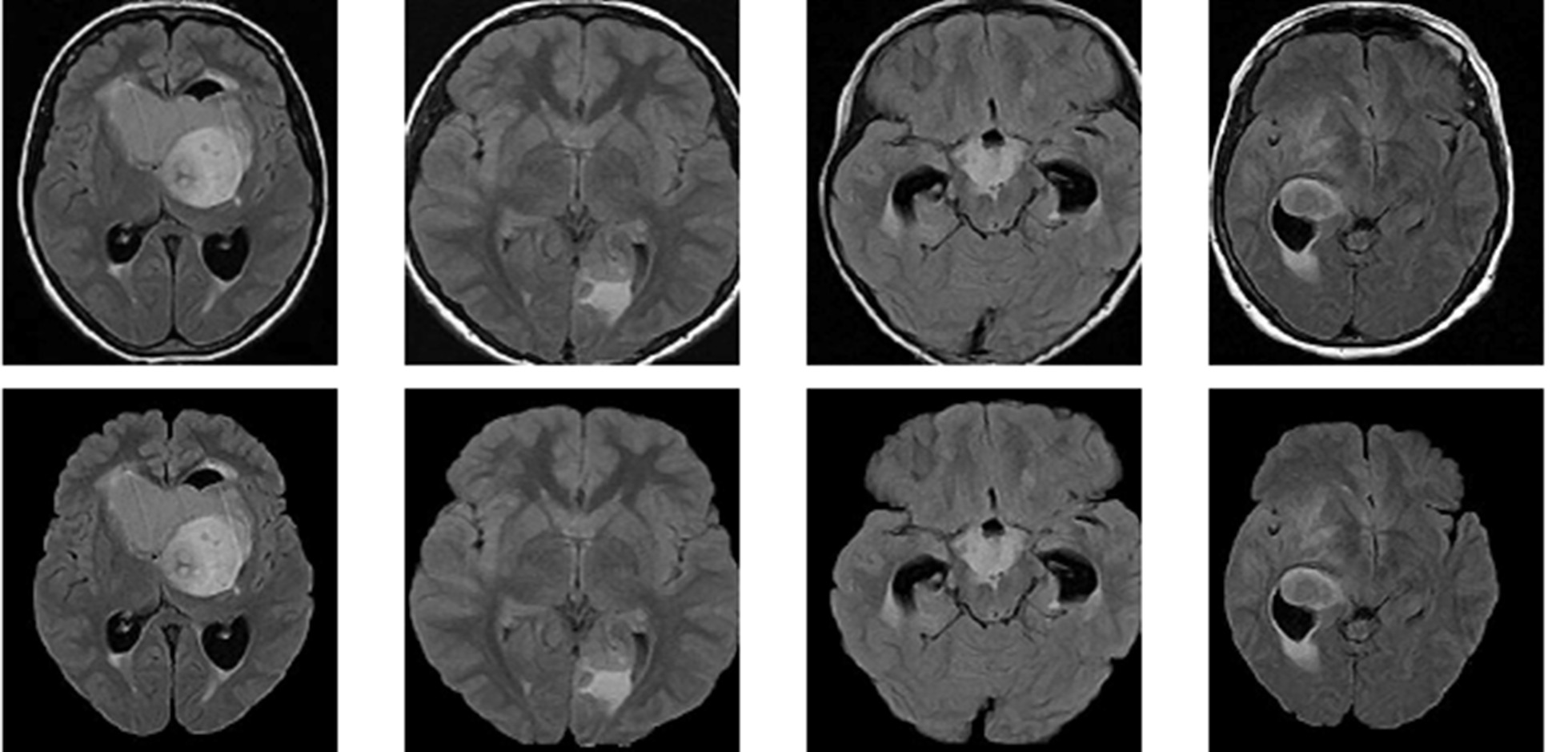
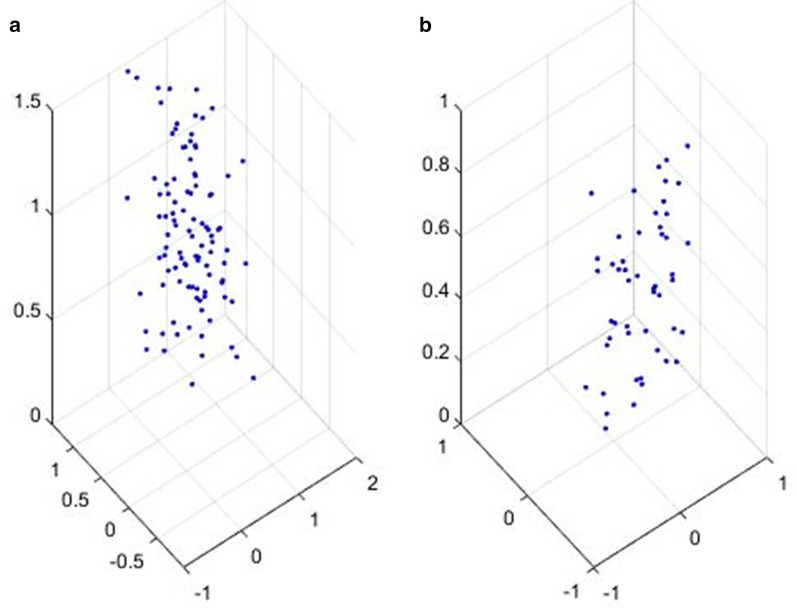
The brain tumor is the growth of abnormal cells inside the brain. These cells can be grown into malignant or benign tumors. Segmentation of tumor from MRI images using image processing techniques started decades back. Image processing based brain tumor segmentation can be divided in to three categories conventional image processing methods, Machine Learning methods and Deep Learning methods. Conventional methods lacks the accuracy in segmentation due to complex spatial variation of tumor. Machine Learning methods stand as a good alternative to conventional methods. Methods like SVM, KNN, Fuzzy and a combination of either of these provide good accuracy with reasonable processing speed. The difficulty in processing the various feature extraction methods and maintain accuracy as per the medical standards still exist as a limitation for machine learning methods. In Deep Learning features are extracted automatically in various stages of the network and maintain accuracy as per the medical standards. Huge database requirement and high computational time is still poses a problem for deep learning. To overcome the limitations specified above we propose an unsupervised dual autoencoder with latent space optimization here. The model require only normal MRI images for its training thus reducing the huge tumor database requirement. With a set of normal class data, an autoencoder can reproduce the feature vector into an output layer. This trained autoencoder works well with normal data while it fails to reproduce an anomaly to the output layer. But a classical autoencoder suffer due to poor latent space optimization. The Latent space loss of classical autoencoder is reduced using an auxiliary encoder along with the feature optimization based on singular value decomposition (SVD). The patches used for training are not traditional square patches but we took both horizontal and vertical patches to keep both local and global appearance features on the training set. An Autoencoder is applied separately for learning both horizontal and vertical patches. While training a logistic sigmoid transfer function is used for both encoder and decoder parts. SGD optimizer is used for optimization with an initial learning rate of .001 and the maximum epochs used are 4000. The network is trained in MATLAB 2018a with a processor capacity of 3.7 GHz with NVIDIA GPU and 16 GB of RAM.
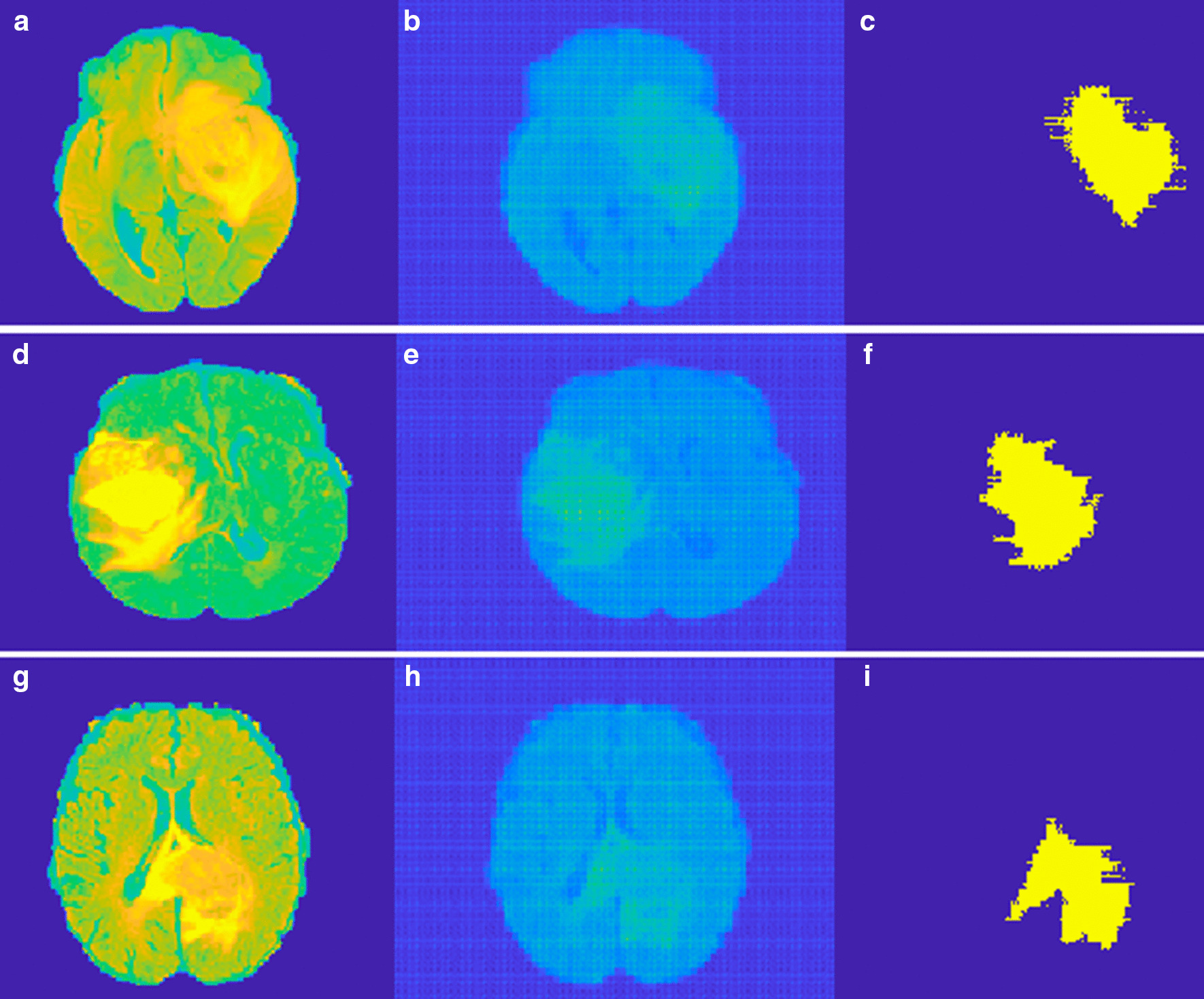
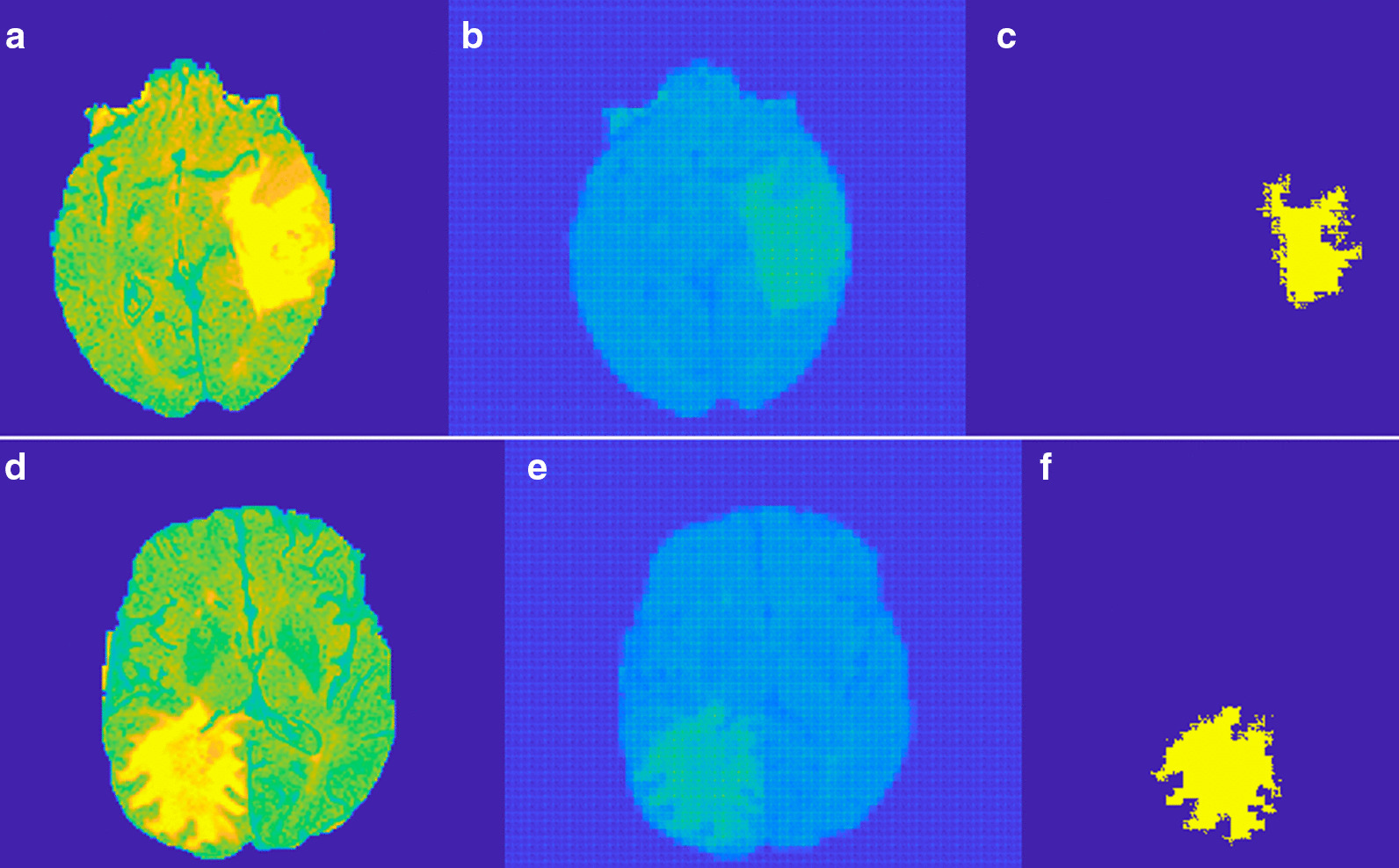
The results are obtained using a patch size of 16 × 64, 64 × 16 for horizontal and vertical patches respectively. In Glioma images tumor is not grown from a point rather it spreads randomly. Region filling and connectivity operations are performed to get the final tumor segmentation. Overall the method segments Meningioma better than Gliomas. Three evaluation metrics are considered to measure the performance of the proposed system such as Dice Similarity Coefficient, Positive Predictive Value, and Sensitivity.
An unsupervised method for the segmentation of brain tumor from MRI images is proposed here. The proposed dual autoencoder with SVD based feature optimization reduce the latent space loss in the classical autoencoder. The proposed method have advantages in computational efficiency, no need of huge database requirement and better accuracy than machine learning methods. The method is compared Machine Learning methods Like SVM, KNN and supervised deep learning methods like CNN and commentable results are obtained.
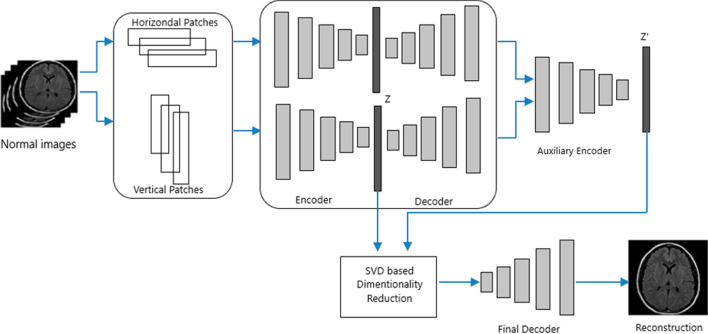
脑瘤是大脑内部异常细胞的生长。这些细胞可以长成恶性或良性肿瘤。使用图像处理技术从 MRI 图像中分割肿瘤始于几十年前。基于图像处理的脑肿瘤分割可分为三类:传统图像处理方法、机器学习方法和深度学习方法。由于肿瘤的空间变化复杂,传统方法在分割方面缺乏准确性。机器学习方法是传统方法的良好替代品。支持向量机 (SVM)、KNN、模糊等方法以及这些方法的任意组合都能以合理的处理速度提供良好的准确性。在处理各种特征提取方法和保持符合医疗标准的准确性方面仍然存在困难,这仍然是机器学习方法的一个限制。在深度学习中,特征在网络的各个阶段自动提取,并根据医疗标准保持准确性。庞大的数据库需求和高计算时间仍然是深度学习的一个问题。为了克服上述限制,我们在这里提出了一种带有潜在空间优化的无监督双自动编码器。该模型仅需要正常的 MRI 图像进行训练,从而减少了对大型肿瘤数据库的需求。使用一组正常类数据,自动编码器可以将特征向量重新生成到输出层。经过训练的自动编码器在处理正常数据时效果很好,但无法将异常情况重新生成到输出层。但是,经典自动编码器由于潜在空间优化不佳而受到影响。通过沿特征优化基于奇异值分解 (SVD) 使用辅助编码器,降低了经典自动编码器的潜在空间损失。用于训练的补丁不是传统的正方形补丁,而是我们同时使用水平和垂直补丁来保留训练集中的局部和全局外观特征。自动编码器分别用于学习水平和垂直补丁。在训练过程中,逻辑斯谛 sigmoid 传递函数用于编码器和解码器部分。使用 SGD 优化器进行优化,初始学习率为.001,最大 epoch 数为 4000。网络在具有 NVIDIA GPU 和 16GB RAM 的 3.7GHz 处理器容量的 MATLAB 2018a 中进行训练。
使用 16×64 和 64×16 的补丁大小分别获得水平和垂直补丁的结果。在神经胶质瘤图像中,肿瘤不是从一个点生长的,而是随机扩散的。进行区域填充和连接操作以获得最终的肿瘤分割。总体而言,该方法对脑膜瘤的分割优于神经胶质瘤。考虑了三个评估指标来衡量所提出系统的性能,例如骰子相似系数、阳性预测值和灵敏度。
本文提出了一种从 MRI 图像中分割脑肿瘤的无监督方法。所提出的基于 SVD 的特征优化双自动编码器减少了经典自动编码器中的潜在空间损失。与机器学习方法相比,所提出的方法具有计算效率高、不需要庞大的数据库需求和更高的准确性的优点。该方法与 SVM、KNN 等机器学习方法以及 CNN 等监督深度学习方法进行了比较,并获得了可评论的结果。