Department of Connectomics, Max Planck Institute for Brain Research, Frankfurt, Germany.
Helmholtz Zentrum München, German Research Center for Environmental Health, Institute of Computational Biology, Neuherberg, Germany.
Nat Commun. 2021 May 13;12(1):2785. doi: 10.1038/s41467-021-22856-z.
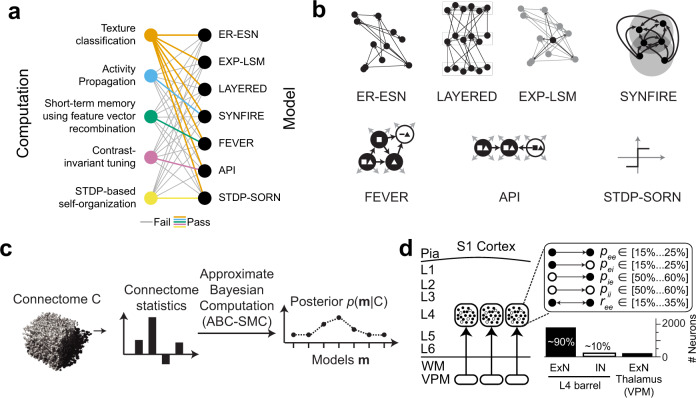
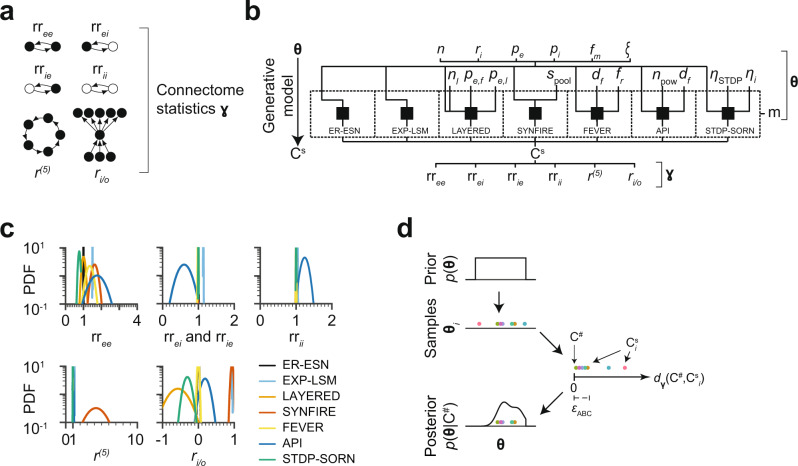
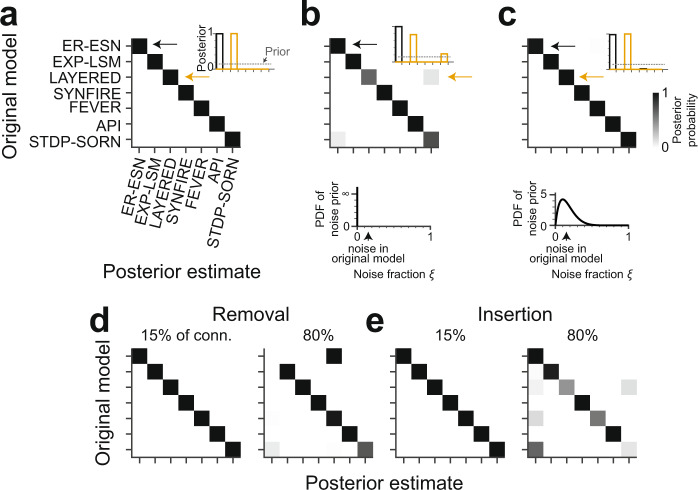
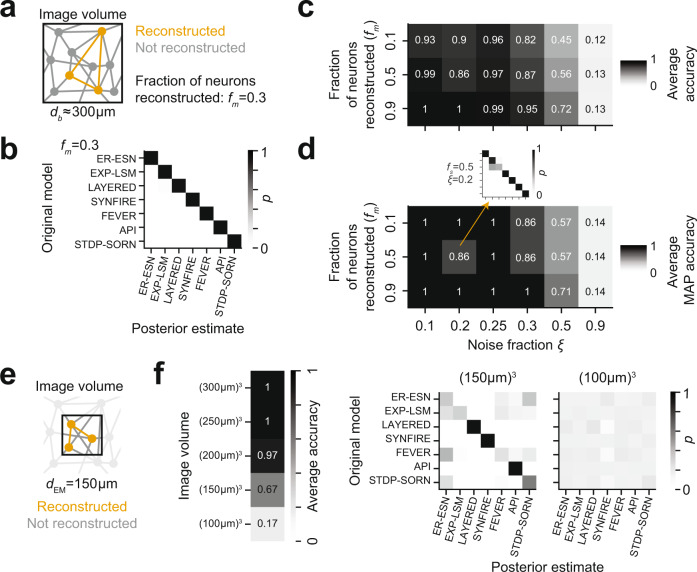
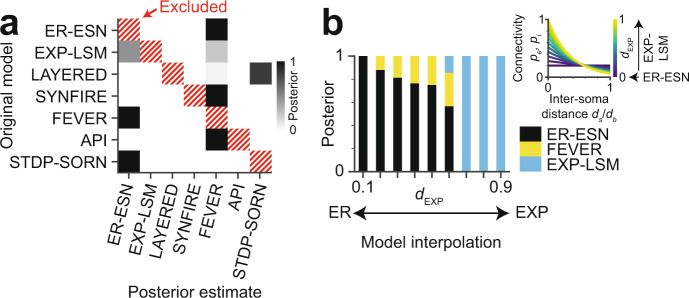
With the availability of cellular-resolution connectivity maps, connectomes, from the mammalian nervous system, it is in question how informative such massive connectomic data can be for the distinction of local circuit models in the mammalian cerebral cortex. Here, we investigated whether cellular-resolution connectomic data can in principle allow model discrimination for local circuit modules in layer 4 of mouse primary somatosensory cortex. We used approximate Bayesian model selection based on a set of simple connectome statistics to compute the posterior probability over proposed models given a to-be-measured connectome. We find that the distinction of the investigated local cortical models is faithfully possible based on purely structural connectomic data with an accuracy of more than 90%, and that such distinction is stable against substantial errors in the connectome measurement. Furthermore, mapping a fraction of only 10% of the local connectome is sufficient for connectome-based model distinction under realistic experimental constraints. Together, these results show for a concrete local circuit example that connectomic data allows model selection in the cerebral cortex and define the experimental strategy for obtaining such connectomic data.
随着哺乳动物神经系统的细胞分辨率连接组图(connectomes)的出现,人们开始质疑如此大规模的连接组数据对于区分哺乳动物大脑皮层中的局部回路模型有多大的信息量。在这里,我们研究了细胞分辨率连接组数据是否原则上可以用于区分小鼠初级体感皮层 4 层中的局部回路模块。我们使用基于一组简单连接组统计量的近似贝叶斯模型选择,根据要测量的连接组来计算给定模型的后验概率。我们发现,根据纯粹的结构连接组数据,基于特定的连接组数据,对所研究的局部皮质模型的区分是忠实可行的,并且这种区分在连接组测量存在实质性误差的情况下是稳定的。此外,在现实的实验限制下,只映射局部连接组的 10% 就足以进行基于连接组的模型区分。总之,这些结果表明,对于一个具体的局部回路示例,连接组数据允许在大脑皮层中进行模型选择,并定义了获得这种连接组数据的实验策略。