Zhu Ying, Guo Yu-Biao, Xu Di, Zhang Jing, Liu Zhen-Guo, Wu Xi, Yang Xiao-Yu, Chang Dan-Dan, Xu Min, Yan Jing, Ke Zun-Fu, Feng Shi-Ting, Liu Yang-Li
Department of Radiology, The First Affiliated Hospital of Sun Yat-sen University, Guangzhou, China.
Division of Pulmonary and Critical Care Medicine, The First Affiliated Hospital of Sun Yat-sen University, Guangzhou, China.
Ann Transl Med. 2021 Apr;9(7):545. doi: 10.21037/atm-20-6473.
Epidermal growth factor receptor () co-mutated with could reduce responsiveness to tyrosine kinase inhibitors (TKIs) and worsen patients' prognosis compared to wild type patients in.
mutated lung adenocarcinomas (LUAD). To identify this genetically unique subset prior to treatment through computed tomography (CT) images had not been reported yet.
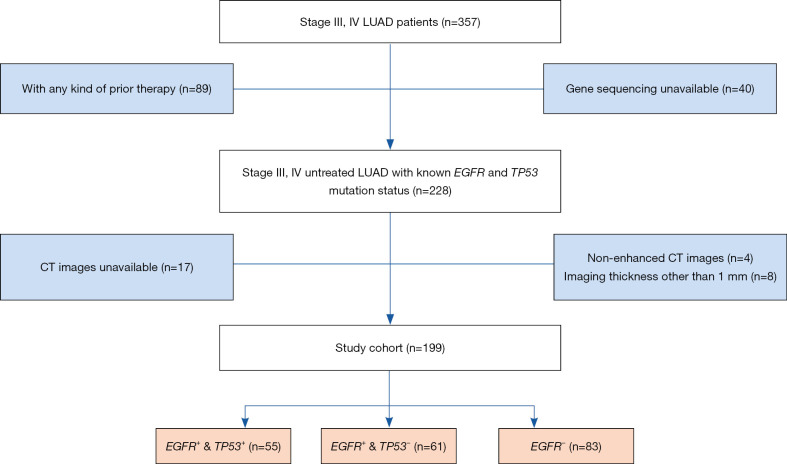
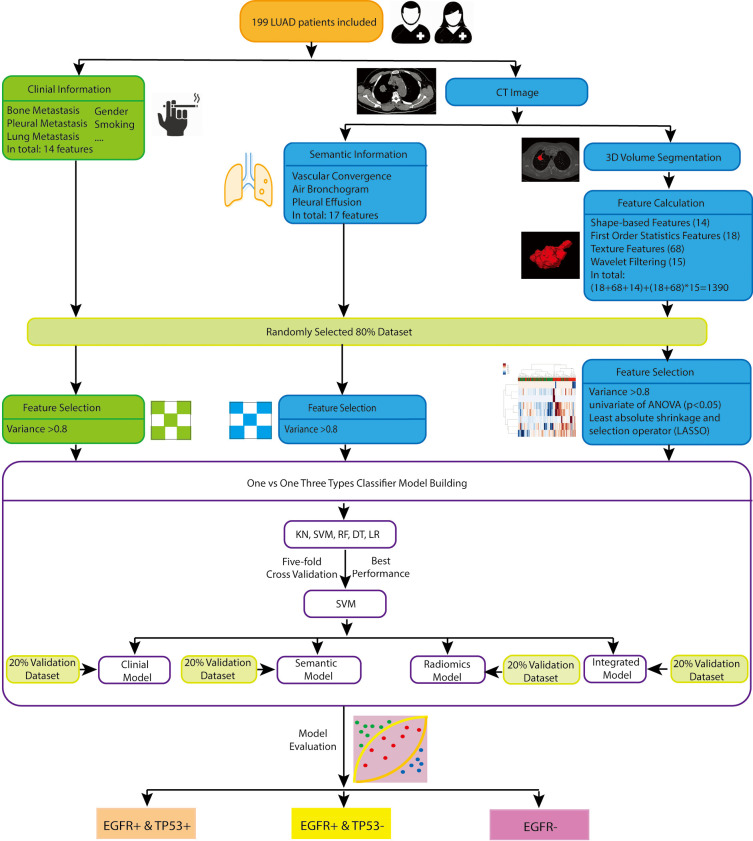
Stage III and IV LUAD with known mutation status of and from The First Affiliated Hospital of Sun Yat-sen University (May 1, 2017 to June 1, 2020) were collected. Characteristics of pretreatment enhanced-CT images were analyzed. One-versus-one was used as the multiclass classification strategy to distinguish the three subtypes of co-mutations: & , & , . The clinical model, semantic model, radiomics model and integrated model were built. Area under the receiver-operating characteristic curves (AUCs) were used to evaluate the prediction efficacy.
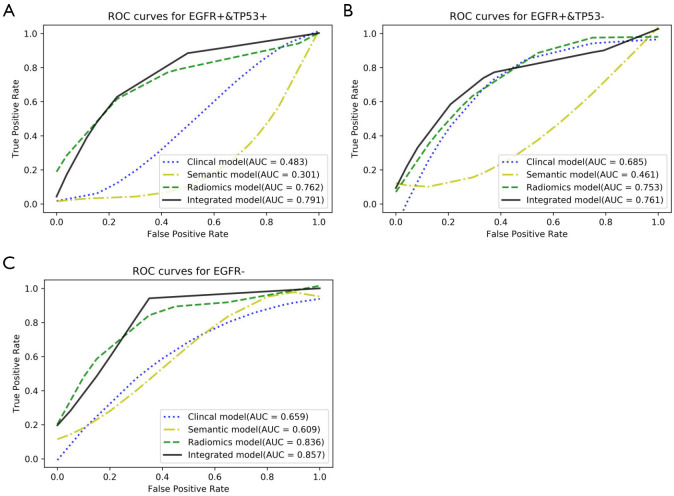
A total of 199 patients were enrolled, including 83 (42%) cases of , 55 (28%) cases of & , 61 (31%) cases of & . Among the four different models, the integrated model displayed the best performance for all the three subtypes of co-mutations: (AUC, 0.857; accuracy, 0.817; sensitivity, 0.998; specificity, 0.663), & (AUC, 0.791; accuracy, 0.758; sensitivity, 0.762; specificity, 0.783), & (AUC, 0.761; accuracy, 0.813; sensitivity, 0.594; specificity, 0.977). The radiomics model was slightly inferior to the integrated model. The results for the clinical and the semantic models were dissatisfactory, with AUCs less than 0.700 for all the three subtypes.
CT imaging based artificial intelligence (AI) is expected to distinguish co-mutation status involving and . The proposed integrated model may serve as an important alternative marker for preselecting patients who will be adaptable to and sensitive to TKIs.
与 共同突变的表皮生长因子受体()可降低对酪氨酸激酶抑制剂(TKIs)的反应性,与 野生型患者相比,会使患者预后更差。
表皮生长因子受体(EGFR):突变的肺腺癌(LUAD)。此前尚未有通过计算机断层扫描(CT)图像在治疗前识别这一基因独特亚组的报道。
收集中山大学附属第一医院(2017年5月1日至2020年6月1日)已知 和 突变状态的Ⅲ期和Ⅳ期LUAD患者。分析治疗前增强CT图像的特征。采用一对一作为多类分类策略来区分三种共同突变亚型: 和 、 和 、 。构建临床模型、语义模型、影像组学模型和综合模型。采用受试者操作特征曲线下面积(AUC)评估预测效能。
共纳入199例患者,其中 83例(42%), 和 55例(28%), 和 61例(31%)。在四种不同模型中,综合模型对所有三种共同突变亚型均表现出最佳性能: (AUC,0.857;准确率,0.817;敏感性,0.998;特异性,0.663), 和 (AUC,0.791;准确率,0.758;敏感性,0.762;特异性,0.783), 和 (AUC,0.761;准确率,0.813;敏感性,0.594;特异性,0.977)。影像组学模型略逊于综合模型。临床模型和语义模型的结果不尽人意,所有三种亚型的AUC均小于0.700。
基于CT成像的人工智能(AI)有望区分涉及 和 的共同突变状态。所提出的综合模型可作为预选择适合TKIs并对其敏感的患者的重要替代标志物。