Department of Biostatistics, School of Public Health, Nanjing Medical University, Nanjing, China.
Department of GCP Research Center, Affiliated Hospital of Nanjing University of Chinese Medicine, Jiangsu Province Hospital of TCM, Nanjing, China.
Thorac Cancer. 2019 Oct;10(10):1904-1912. doi: 10.1111/1759-7714.13163. Epub 2019 Aug 14.
Tumor mutation burden (TMB) is an important determinant and biomarker for response of targeted therapy and prognosis in patients with lung cancer. The present study aimed to determine whether radiomics signature could non-invasively predict the TMB status and driver mutations in patients with resectable early stage lung adenocarcinoma (LUAD).
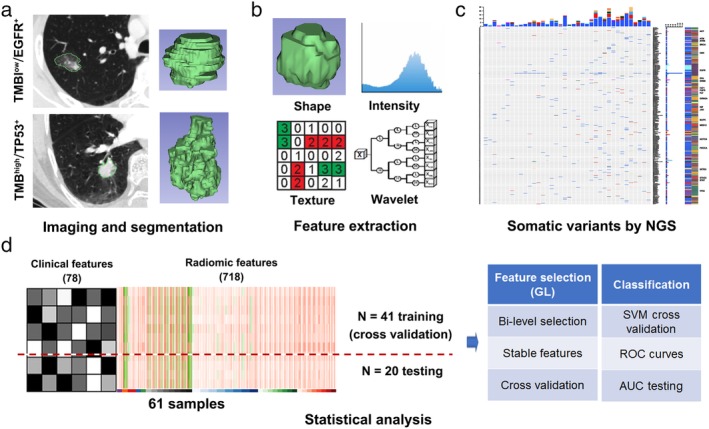
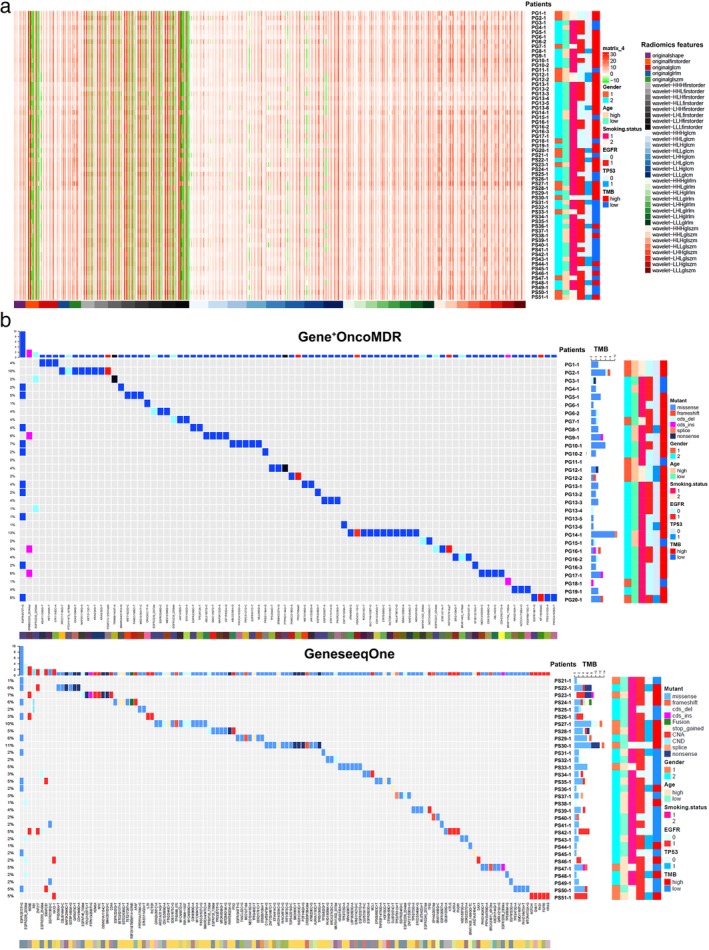
A total of 61pulmonary nodules (PNs) from 51 patients post-operatively diagnosed LUAD were enrolled for analysis. Two datasets were divided according to two-thirds of patients from different commercial Comprehensive Genomic Profiling (CGP) panels: a training cohort including 41 PNs and a testing cohort including rest 20PNs. We sequenced all tumor specimens and paired blood cells using next generation sequencing (NGS), so as to detect TMB status and somatic mutations. We collected 718 quantitative 3D radiomics features extracted from segmented volumes of each PNs and 78 clinical and pathological features retrieved from medical records as well. Support vector machine methods were performed to establish the predictive model.
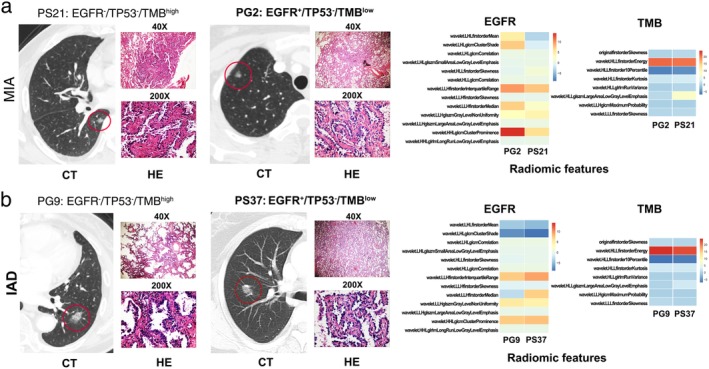
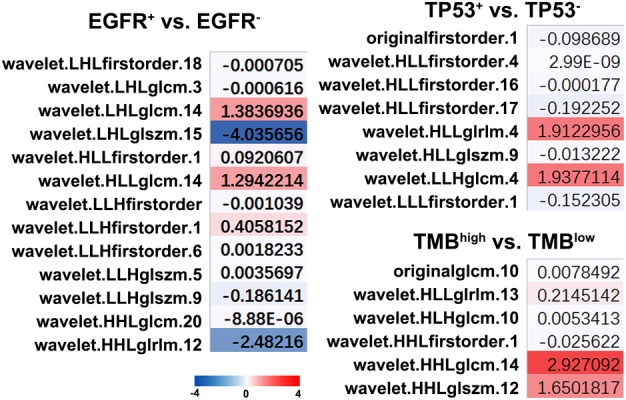
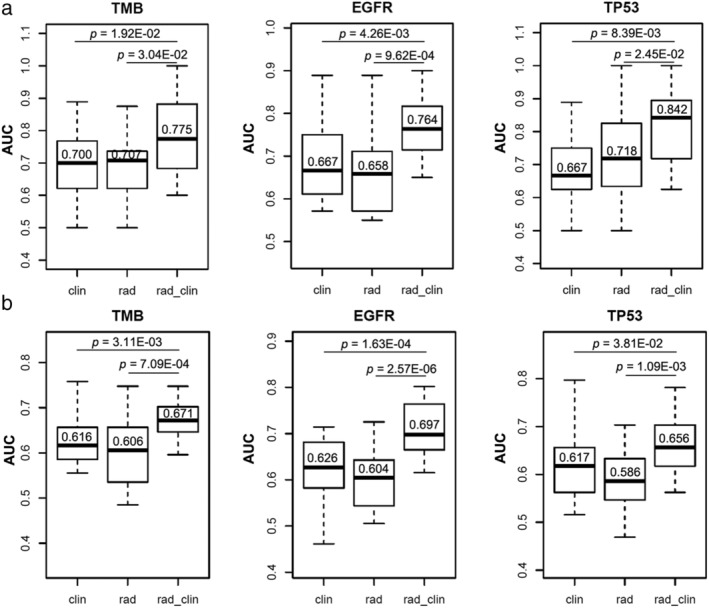
We established an efficient fusion-positive tumor prediction model that predicts TMB status and EGFR/TP53 mutations of early stage LUAD. The radiomics signature yielded a median AUC value of 0.606, 0.604, and 0.586 respectively. Combining radiomics with the clinical information can further improve the prediction performance, which the median AUC values are 0.671 for TMB, 0.697 and 0.656 for EGFR/TP53 respectively.
It is feasible and effective to facilitate TMB and somatic driver mutations prediction by using the radiomics signature and NGS data in early stage LUAD.
肿瘤突变负荷(TMB)是预测肺癌患者靶向治疗反应和预后的重要决定因素和生物标志物。本研究旨在确定放射组学特征是否可以无创地预测可切除早期肺腺癌(LUAD)患者的 TMB 状态和驱动突变。
共纳入 51 例术后诊断为 LUAD 的患者 61 个肺结节(PNs)进行分析。根据来自不同商业综合基因组分析(CGP)面板的三分之二患者将数据集分为两组:训练队列包括 41 个 PNs,测试队列包括其余 20 个 PNs。我们使用下一代测序(NGS)对所有肿瘤标本和配对的血细胞进行测序,以检测 TMB 状态和体细胞突变。我们从每个 PNs 的分割体积中收集了 718 个定量 3D 放射组学特征,并从病历中收集了 78 个临床和病理特征。采用支持向量机方法建立预测模型。
我们建立了一种有效的融合阳性肿瘤预测模型,可预测早期 LUAD 的 TMB 状态和 EGFR/TP53 突变。放射组学特征的 AUC 值中位数分别为 0.606、0.604 和 0.586。放射组学特征与临床信息相结合可以进一步提高预测性能,TMB 的 AUC 值中位数为 0.671,EGFR/TP53 的 AUC 值中位数分别为 0.697 和 0.656。
在早期 LUAD 中,使用放射组学特征和 NGS 数据有助于预测 TMB 和体细胞驱动突变是可行且有效的。