Ding Jingyi, Wang Ju, Chen Jiajia
State Key Laboratory for Diagnosis and Treatment of Infectious Diseases, National Clinical Research Center for Infectious Diseases, Collaborative Innovation Center for Diagnosis and Treatment of Infectious Diseases, The First Affiliated Hospital, Zhejiang University School of Medicine, Hangzhou, China.
Ann Transl Med. 2021 Apr;9(8):735. doi: 10.21037/atm-20-5422.
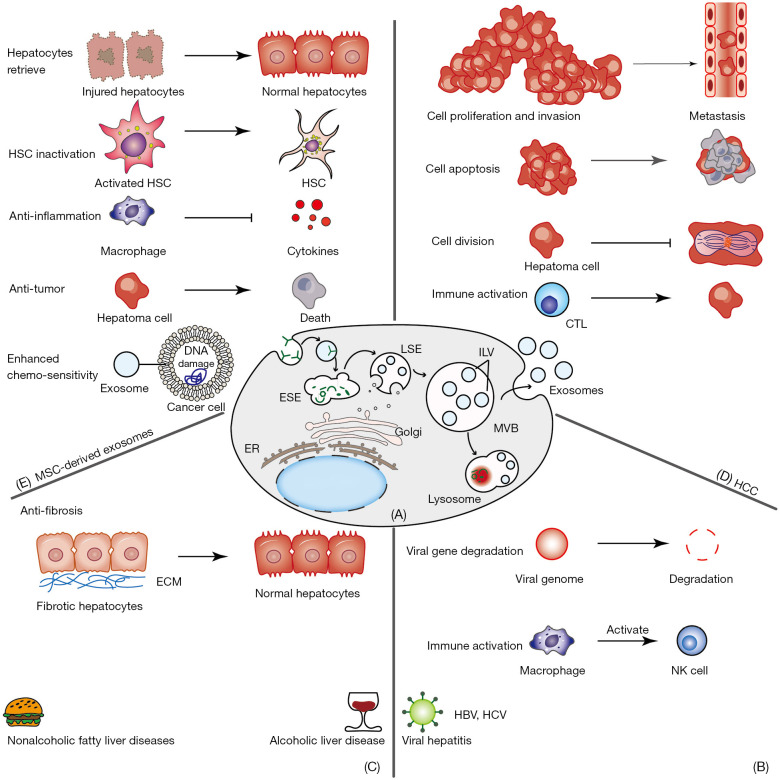
The diagnosis and treatment of various liver diseases have progressed greatly over the years, but clinical outcomes are still not satisfying. New research on the mechanisms and application thereof may effectuate positive changes. Exosomes are membrane-derived nanovesicles ranging in size from 40 to 160 nm and are released by a diversity of cells. They contain a variety of cargo, including lipids, proteins, coding RNAs, and noncoding RNAs. Recent studies have recognized exosomes as intercellular communication agents, which play important roles in physiological or biological processes in acute or chronic liver disorders by horizontal transferring of genetic bioinformation from donor cells to neighboring or distal target cells. In the hope that exosomes can potentially be used as vehicles for clinical intervention, this review aims to focus on the roles of exosomes and their cargo in the field of various liver disorders, including virus-related liver diseases, alcoholic liver diseases (ALD), nonalcoholic fatty liver diseases (NAFLD), and liver cancer. In addition, many studies have indicated that mesenchymal stem cell (MSC)-derived exosomes or engineered MSC-derived exosomes can also exert hepatoprotection, antioxidation, or enhance drug sensitivity on corresponding liver diseases with the advantage of low immunogenicity and high biocompatibility. Overall, exosomes are expected to serve as an important therapeutic tool for various liver diseases. However, there are still many problems that need to be resolved by further research and a greater body of evidence before exosomes are ready for clinical application.
多年来,各种肝脏疾病的诊断和治疗取得了很大进展,但临床结果仍不尽人意。对其机制及其应用的新研究可能会带来积极变化。外泌体是大小在40到160纳米之间的膜衍生纳米囊泡,由多种细胞释放。它们包含多种物质,包括脂质、蛋白质、编码RNA和非编码RNA。最近的研究已将外泌体视为细胞间通讯介质,其通过将遗传生物信息从供体细胞水平转移到邻近或远处的靶细胞,在急性或慢性肝脏疾病的生理或生物学过程中发挥重要作用。鉴于外泌体有可能用作临床干预的载体,本综述旨在聚焦外泌体及其所含物质在各种肝脏疾病领域中的作用,包括病毒相关性肝病、酒精性肝病(ALD)、非酒精性脂肪性肝病(NAFLD)和肝癌。此外,许多研究表明,间充质干细胞(MSC)衍生的外泌体或工程化MSC衍生的外泌体也可对相应的肝脏疾病发挥肝保护、抗氧化作用或增强药物敏感性,具有低免疫原性和高生物相容性的优势。总体而言,外泌体有望成为治疗各种肝脏疾病的重要工具。然而,在外泌体准备好用于临床应用之前,仍有许多问题需要通过进一步研究和更多证据来解决。